
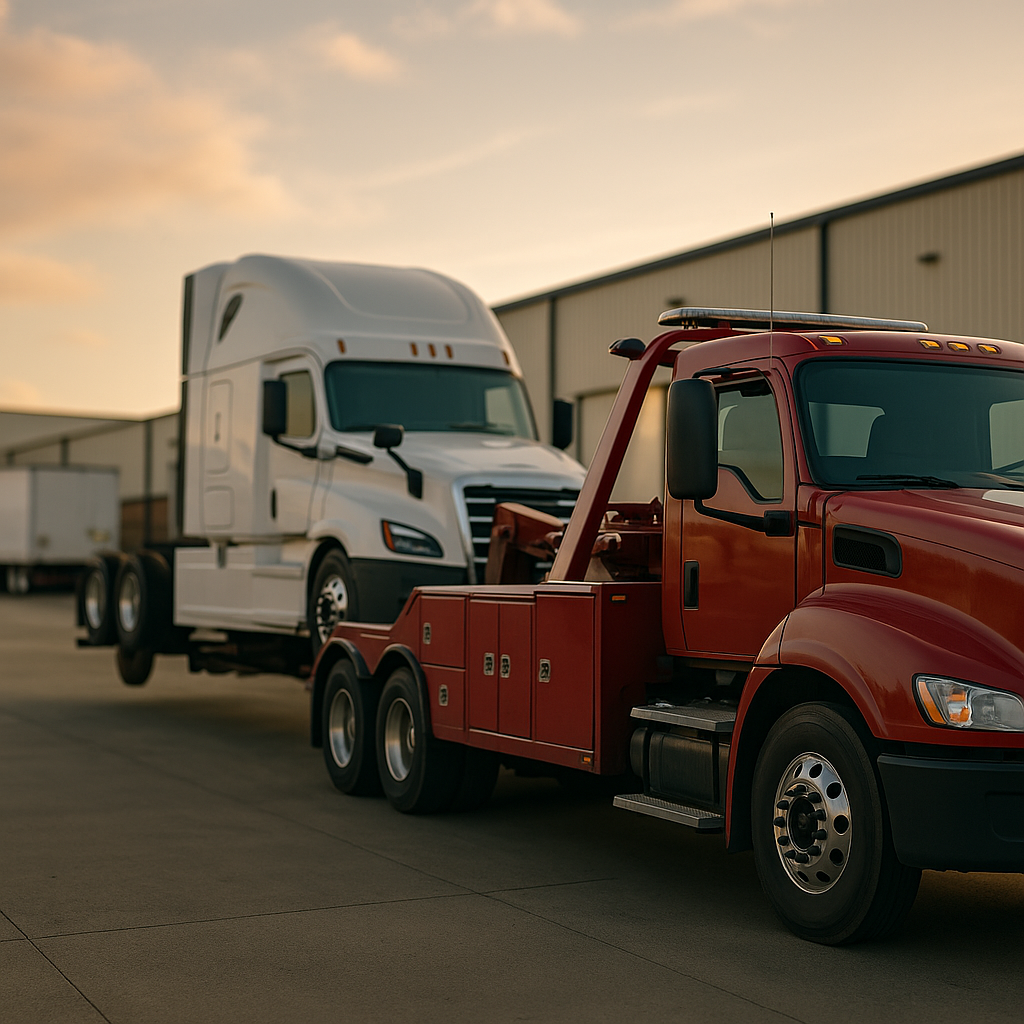

Commercial vehicle tow rules for 2026: equipment basics, fee breakdowns, nonconsensual tow rights, and recovery steps—plus insurance tips. Get prepared today.
A commercial vehicle tow can cost anywhere from a few hundred dollars for a basic hookup to five figures once recovery labor, after-hours rates, and storage stack up—so the “rules” that matter most are authorization, documentation, and invoice control. Commercial tows also carry higher damage risk because air brakes, driveline setups, lift axles, and load conditions change what “safe towing” looks like.
If you want fewer surprises, start by tightening up your commercial truck insurance basics and writing down who can authorize a tow, where the unit can be taken, and what photos must be captured before it leaves the scene.
Table of Contents
Reading time: 8 minutes
- What Counts as a Commercial Vehicle Tow? (And Why It’s Different)
- Commercial Vehicle Tow Costs in 2026: Typical Fees + State Rate Examples
- Nonconsensual Commercial Vehicle Tow: Who Can Authorize It (and How to Respond)
- How to Recover a Towed Commercial Vehicle (Step-by-Step) + Liability & Insurance Basics
- Frequently Asked Questions
- Conclusion: Control Tow Costs, Reduce Downtime, and Protect Your Insurance Position

What Counts as a Commercial Vehicle Tow? (And Why It’s Different)
A commercial vehicle tow is any tow or recovery involving a business-use vehicle—often a CMV regulated under 49 CFR §390.5—and it typically requires heavy-duty equipment and documented authorization because the financial and safety stakes are higher than passenger-vehicle towing.
Image placeholder: safe roadside commercial tow setup
What it is (plain English)
A “commercial tow” isn’t one thing—it’s a few common scenarios that look similar on the phone call but price out very differently on the invoice:
- Consensual tows: You called for help after a breakdown.
- Recovery tows: Winching, uprighting, ditch pulls, accident cleanup, or pulling a unit off a barrier.
- Nonconsensual/impound tows: The vehicle was removed from private property or ordered by an authority without you requesting it.
Why it’s essential to treat it differently
Commercial units bring higher damage exposure because tow method changes with air brake systems, driveline configuration, lift axles, and load condition. A wrong hookup can turn into driveshaft, suspension, fairing, or brake damage that’s hard to prove later if you don’t document condition early.
If the tow is connected to an accident, inspection, cargo issue, or reportable incident, align your process with a compliance mindset like a DOT compliance checklist for owner-operators so your records are defensible.
Pro tip (simple policy that prevents expensive arguments)
Put this in writing and train it: no one authorizes a tow without (1) exact location, (2) unit/trailer number, (3) reason, (4) photos/video, and (5) destination yard name and address.
Commercial Vehicle Tow Costs in 2026: Typical Fees + State Rate Examples
Commercial towing invoices are usually priced as an itemized stack of charges—hook/base fee + mileage + recovery labor + after-hours + storage—and storage is often the line item that grows fastest if release paperwork isn’t ready.
Image placeholder: commercial tow fee breakdown table
Common 2026 invoice line items (what they mean + what to ask)
| Invoice Line Item (2026) | What It Usually Means | Question to Ask Before Hookup |
|---|---|---|
| Base / hook-up fee | Standard dispatch and initial hookup charge | “What’s included in the base?” |
| Mileage | Scene-to-yard and sometimes yard-to-scene (varies) | “Is mileage one-way or portal-to-portal?” |
| Recovery labor | Winching, uprighting, traffic control, cleanup time | “What’s the hourly rate and minimum?” |
| After-hours surcharge | Nights/weekends/holidays pricing window | “When does after-hours start and end?” |
| Storage (daily) | Daily yard fee; cutoffs can trigger an extra day | “What’s the daily rate and cutoff time?” |
| Admin / processing | Paperwork, gate fees, misc. line items | “Is the invoice itemized?” |
State examples (verify applicability before relying on them)
Some states publish guidance or maximum allowable charges for certain nonconsensual tows by vehicle class, and those documents can be useful for disputes when they apply to your scenario and effective date.
- Connecticut: CT DMV publishes a nonconsensual towing charges PDF (verify which tow types and vehicle classes it covers): https://portal.ct.gov/dmv/-/media/dmv/20/29/nonconsensual-towing.pdf
- Colorado: Colorado PUC provides commercial towing information and retrieval/complaint pathways (state-specific): https://puc.colorado.gov/puc-home/transportation/towing/commercial-towing-information
Budgeting and premiums: why towing shows up in your overall risk
Tow and storage exposure is one reason your total risk cost isn’t only about crashes; downtime, frequency of roadside events, and vendor control can feed into your operating profile and claim patterns over time. To understand the broader pricing picture, see truck insurance cost factors and treat towing vendors like a managed program, not a random number at 2 a.m.
Nonconsensual Commercial Vehicle Tow: Who Can Authorize It (and How to Respond)
A nonconsensual commercial vehicle tow is a removal performed without the owner/operator requesting it, and the authorization, notice, and fee rules are governed by state and local law rather than one nationwide standard.
Who can authorize a nonconsensual tow (general categories)
Depending on jurisdiction and circumstance, authorization may come from:
- Property owner or authorized agent: Private property/trespass tows (often signage and notice rules apply).
- Law enforcement or highway authority: Roadway incident, crash scene, or hazard removal.
- Rotation or contracted provider: Local/agency towing rotation programs.
- Posted towing operator: Where local rules allow a designated operator under posted terms.
How to respond fast (the “don’t get trapped in storage fees” play)
Nonconsensual tows become expensive when the unit sits while people argue about who can pick it up, what forms are required, and who has release authority. Build a standard dispatch checklist and keep state contacts handy using a reference like state trucking requirements by state so your team isn’t guessing under time pressure.
Pro tip (fleet policy that saves real money)
Set two internal controls: (1) only dispatch/on-call management can approve a tow above a fixed dollar threshold, and (2) drivers must ask, “Where is it going, what’s the release process, and what are storage rates?” before the unit leaves.
How to Recover a Towed Commercial Vehicle (Step-by-Step) + Liability & Insurance Basics
A recover-and-release process is a written sequence that reduces downtime and disputes by requiring proof of authority, an itemized invoice, and documented vehicle condition before exit.
Image placeholder: recovery checklist visual
Step-by-step recovery checklist
- Locate the unit fast. Call the property manager/authority first (if applicable), then the tow yard; confirm address, hours, and accepted payment methods.
- Verify the authorization trail. Ask who ordered it, the time/date, exact pickup location, and reason; request an itemized invoice.
- Bring the right paperwork. Government ID, registration/lease, company authorization letter (if picking up for a business), and any incident report/case number.
- Inspect before you roll. Photograph all sides and common contact points (bumper corners, frame area, axles, driveshaft zone, air lines, fairings, wheels/tires), and note any damage in writing before leaving.
- Escalate quickly if something’s wrong. Start with yard management, then the state/local complaint channel if applicable, and then your insurer/claims team when damage or cargo exposure is credible.
Use a disciplined documentation workflow like what to do after a truck accident (documentation checklist), because the same basics apply: timestamps, clear photos, and a clean narrative beat “he said/she said.”
Where trucking insurance fits (without the hype)
Tow-related disputes typically fall into (1) pre-existing damage from the incident, (2) damage during tow/recovery/storage, or (3) cargo loss/delay caused by downtime. Coverage depends on policy wording, deductibles, and facts, so it helps to understand physical damage structure and exclusions up front.
If you do end up filing or disputing, follow an organized workflow like the commercial claims process so evidence and timelines don’t get lost.
Cost-control reality check: “Affordable” coverage is only affordable if it still protects your balance sheet when storage fees stack for days while release paperwork is sorted out.
Regulatory reference: FMCSA’s CMV definition appears in 49 CFR §390.5, and CDL standards are addressed in 49 CFR Part 383 (towing and operator requirements can vary by state and configuration).
Frequently Asked Questions
Sometimes, but many commercial vehicles should be towed by a commercial/heavy-duty operator because weight, air brakes, and driveline setup can require specific methods and equipment. If the tow provider uses the wrong method, damage can occur at common failure points like the driveshaft area, suspension components, fairings, and air lines. Before hookup, ask where the unit is going, whether the tow is lift-only vs. full recovery, and whether the invoice will be itemized (hook/base fee, mileage, recovery labor, after-hours, and storage). For disputes later, photos and timestamps from the scene are your leverage.
A commercial motor vehicle (CMV) under FMCSA rules generally includes vehicles used in interstate commerce with a GVWR/GCWR of 10,001 lbs or more, vehicles designed to transport 16+ passengers (including the driver), or vehicles transporting placarded hazardous materials, as defined in 49 CFR §390.5. States can also define “commercial vehicle” differently for towing rates, registration, and impound procedures, so a truck can be “commercial” for tow purposes even when a driver is focused on a different compliance definition. When in doubt, confirm how your state and locality classify the unit for towing and storage rules.
Yes, commercial towing often costs more because it may require heavier equipment, more labor hours, and longer scene time for recovery and traffic control. Most commercial towing invoices combine base/hook fee, mileage, recovery labor, after-hours surcharges, and daily storage, and storage can climb quickly if release paperwork isn’t ready. Some states publish maximum charges or guidance for certain nonconsensual tows (for example, Connecticut provides a public reference document: CT DMV PDF), but applicability depends on tow type, vehicle class, and effective dates. Always ask for itemization before the unit leaves.
If your truck was damaged during towing or storage, the outcome usually depends on documented proof of condition, the tow ticket/invoice terms, and the timing of when damage was discovered and reported. Start with facts: take photos/video at release, keep the itemized invoice, and note damage in writing before you leave the yard. Escalate in order—tow company management, the state/local complaint process (if applicable), and your insurer/claims team when damage is material or the unit is unsafe to operate. A clear timeline with timestamps is what separates a solvable claim from an open-ended dispute.
Conclusion: Control Tow Costs, Reduce Downtime, and Protect Your Insurance Position
A commercial vehicle tow is a cost-and-liability event, and in 2026 the biggest “cost traps” are still the same: unclear authorization, non-itemized invoices, and storage fees that run while paperwork drags. If you lock down who can approve a tow, require itemized pricing, and document condition before leaving the yard, you’ll prevent a lot of expensive surprises.
Key Takeaways:
- Control authorization: limit who can approve tows and require destination + release details before hookup.
- Demand itemization: base fee, mileage, recovery labor, after-hours, and storage should be separated.
- Document condition: photos, timestamps, and written notes at release protect you in damage disputes.
For deeper coverage context, review physical damage coverage for semi trucks and reduce avoidable tows with roadside assistance coverage for trucks.





