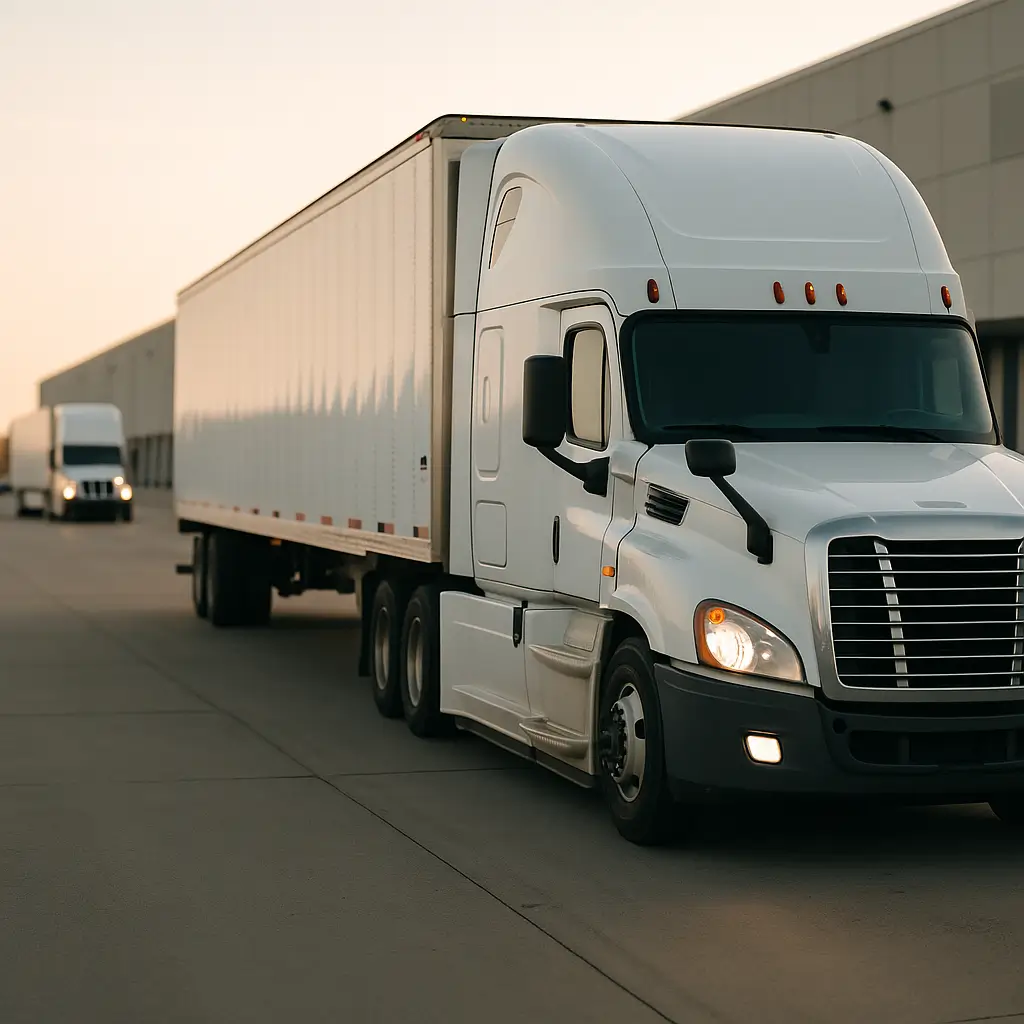

See 2026 New Jersey truck insurance costs, minimum liability limits, required filings, NJCAIP options, and practical ways to lower premiums.
New Jersey truck insurance rules can require higher limits than what many carriers expect, and a single missed filing or renewal lapse can sideline your authority fast. In practice, many intrastate summaries cite $1.5M liability for 26,001+ lbs GVWR, while brokers commonly demand $1M+ even when the law doesn’t.
This guide breaks down limits, coverage, filings, NJCAIP assigned risk, and real-world pricing. If you want the quick foundation first, start with this trucking insurance overview.
Watch the quick New Jersey cost breakdown before diving into the details:
Table of Contents
Reading time: 7 minutes
- NJ Truck Insurance Requirements in 2026 (Minimum Liability Limits)
- What Does New Jersey Truck Insurance Typically Include? (Required vs Optional)
- How Much Does Commercial Truck Insurance Cost in New Jersey?
- NJ Truck Insurance Filings, NJCAIP (Assigned Risk) & How to Pay Less
- Frequently Asked Questions
- Conclusion: Get Compliant in NJ and Control Your Premium

NJ Truck Insurance Requirements in 2026 (Minimum Liability Limits)
Published summaries of New Jersey intrastate rules commonly report $1,500,000 minimum liability for trucks 26,001+ lbs GVWR and $300,000 for 10,001–26,000 lbs GVWR, but your exact requirement depends on intrastate vs interstate operations and your registration/use.
Before you price out commercial truck insurance, confirm which rulebook applies:
- Intrastate (NJ-only): pickup and delivery both inside New Jersey.
- Interstate: crossing state lines or hauling freight treated as “interstate commerce.”
Minimum liability limits by truck weight class (NJ intrastate)
| Vehicle/Weight Class (Intrastate NJ) | Commonly Reported Minimum Liability |
|---|---|
| 10,001–26,000 lbs GVWR | $300,000 |
| 26,001+ lbs GVWR | $1,500,000 |
Snippet-ready summary: For heavy trucks in New Jersey (26,001+ lbs GVWR), published summaries of NJ intrastate rules commonly report a $1.5M minimum liability requirement, with $300K often cited for 10,001–26,000 lbs. Your real requirement depends on intrastate vs interstate operations—and many brokers still require $1M+ regardless.
Do NJ requirements exceed federal levels?
FMCSA sets baseline insurance and filing requirements for for-hire interstate carriers (often $750,000 liability minimum for non-hazmat general freight), while New Jersey intrastate rules can be stricter for certain vehicle classes and operations.
For the federal filing overview, see FMCSA’s insurance filing requirements: https://www.fmcsa.dot.gov/registration/insurance-filing-requirements.
If you want to line up authority, compliance, and insurance as one workflow, keep this page handy: DOT compliance requirements tied to insurance and authority.
Who should double-check NJ-specific minimums?
NJ minimums matter most when your day-to-day operation is actually “NJ intrastate,” not just passing through on I‑95.
- Intrastate-only operators: local delivery, construction, or some port-to-warehouse moves.
- Small fleets adding units: adding a truck can trigger updates to certificates, filings, and contracts.
- Out-of-state carriers doing NJ intrastate work: intrastate loads aren’t covered by “we’re interstate” assumptions.
What Does New Jersey Truck Insurance Typically Include? (Required vs Optional)
Most New Jersey truck insurance programs stack auto liability (legal requirement) with physical damage and cargo (common lender/broker requirements), plus optional coverages that close gaps like dock liability or non-owned trailers.
Think of the “legal minimum” as the bottom block; your contracts and real-world risk are everything above it. For a deeper checklist built for independents, use this: owner-operator insurance coverage guide.
Core coverages most NJ truckers carry
- Auto Liability (required): pays for injury/property damage to others when you’re at fault, and it’s the main limit NJ and/or FMCSA cares about for legality.
- Physical Damage (often required by lenders): comprehensive + collision for your tractor (and sometimes scheduled trailers).
- Motor Truck Cargo (often required by contract): not always a legal requirement, but many brokers/shipper setups won’t tender freight without it.
Common add-ons that prevent expensive gaps
- General Liability: covers non-auto claims like property damage at a dock or slip-and-fall exposures.
- Trailer Interchange: helps when you pull a non-owned trailer under an interchange agreement.
- Uninsured/Underinsured Motorist: can matter more in metro-heavy lanes where severe crashes and low-limit drivers are common.
- Downtime/rental options: availability varies, but it’s worth asking about if a single missed week breaks your cash flow.
Who needs what? (Quick practical guide)
| Coverage | Usually Needed When |
|---|---|
| Liability | Always (required) |
| Physical Damage | Financed truck, newer unit, or you can’t self-insure repairs |
| Cargo | Broker/shipper requires it, or your freight value is meaningful |
| Trailer Interchange | You hook to trailers you don’t own under agreement |
| General Liability | You want protection beyond auto-related incidents |
Not sure what auto liability actually covers in a real claim? Here’s a plain-language breakdown:
How Much Does Commercial Truck Insurance Cost in New Jersey?
Many New Jersey operators see commercial truck insurance premium ranges around $16,000–$26,000 per year, but new ventures, metro exposure, cargo class, and loss history can push pricing significantly higher.
If you want deeper NJ-specific tables and scenarios, see: commercial truck insurance cost in New Jersey.
Cost examples by operation type (quick scenarios)
These are common underwriting patterns (not guaranteed pricing), but they match what we see when quotes are structured correctly.
- Local intrastate (tight radius): can price better if your lanes and driver history are clean.
- Port/metro exposure (Newark/Elizabeth/NYC-adjacent): often higher due to congestion, theft risk, and claim frequency.
- Long-haul interstate: more miles can mean more exposure; lanes and safety record do most of the work.
- Higher-value freight / reefer: may require higher cargo limits and tighter exclusions review.
What drives NJ truck insurance rates (and what you control)
ATRI’s operational cost research consistently shows insurance is one of trucking’s largest expenses, and rate swings follow claims trends and market cycles.
Reference: ATRI’s annual Operational Costs of Trucking research.
- New venture/new authority: underwriters price uncertainty until you build a track record.
- Lapses in coverage: one lapse can shrink your market and spike your premium.
- Radius + lanes: dense metro lanes typically price higher.
- Cargo class: theft targets and regulated freight can change your quote fast.
- MVR/CSA signals: violations and preventables tend to follow you into renewal pricing.
- Truck value + deductibles: higher value and lower deductibles usually cost more.
NJ Truck Insurance Filings, NJCAIP (Assigned Risk) & How to Pay Less
FMCSA requires interstate for-hire carriers to keep continuous liability coverage and have insurers file proof electronically (commonly via BMC-91/BMC-91X filings with an MCS-90 endorsement), while New Jersey intrastate compliance depends on your vehicle class and state documentation rules.
If you want a tactical playbook focused on price without creating coverage gaps, use: how to save on truck insurance without creating coverage gaps.
FMCSA notes that insurance proof forms such as BMC-91/91X and BMC-34 are submitted electronically by registered electronic filers: FMCSA registration forms.
Step-by-step: interstate (FMCSA authority path)
If you operate interstate under your own authority, the workflow usually looks like this:
- Quote correctly: real radius, real cargo, real garaging ZIP, real driver history.
- Bind coverage: pay the down payment and confirm effective dates.
- Carrier files proof with FMCSA: electronic filing plus required endorsements.
- Authority activates: once filings are accepted and your other items are satisfied.
- Maintain continuous coverage: cancellations/lapses can trigger authority suspension.
Before you decide on your limit, watch this first:
FMCSA reference: https://www.fmcsa.dot.gov/registration/insurance-filing-requirements
Step-by-step: intrastate NJ (state compliance path)
Intrastate can be simpler, but only if you confirm the rules for your exact class and use.
- Confirm your GVWR/weight class.
- Confirm the required liability limit for your operation.
- Ask your agent what state proof/filings are required for your registration (don’t guess).
- Keep current ID cards + certificates ready for brokers, shippers, and roadside checks.
- Avoid last-minute renewals; paperwork delays cost real money.
What is NJCAIP (Assigned Risk) and when is it needed?
NJCAIP (New Jersey Commercial Automobile Insurance Plan) is New Jersey’s assigned risk mechanism that places eligible higher-risk commercial auto accounts when the voluntary market declines them.
Official site: https://www.njcaip.org/
- What to expect: fewer carrier options, typically higher premiums, and more rigid terms.
- How to apply: work with an NJCAIP-certified producer and bring complete documentation (drivers, vehicles, prior coverage, loss history).
How to compare “best” truck insurance companies in New Jersey (without guessing)
There isn’t one “best” carrier for everyone; the best option is the one with real appetite for your operation and clean service on filings and certificates.
For a breakdown of carriers with appetite in New Jersey, see New Jersey commercial auto insurance companies.
- Filings: do they handle FMCSA/state filings quickly and correctly?
- Cargo fit: do they write your commodity without exclusions that break broker contracts?
- Payments: do they offer workable payment plans for cash flow?
- Claims: ask about process, timelines, and claim handling.
- Tech credits: are discounts available for dashcams/telematics?
- Renewal behavior: do they re-underwrite fairly after a clean year?
Fast savings checklist (no gimmicks)
- Keep continuous coverage: avoid lapses at all costs.
- Tighten your radius: if your lanes changed, don’t overstate mileage and territory.
- Choose deductibles honestly: only raise deductibles if you can cash-flow a claim.
- Clean up driver files: hiring discipline and MVR monitoring matter.
- Re-shop early: start 30–45 days before renewal and compare multiple markets.
Frequently Asked Questions
These New Jersey truck insurance FAQs cover 2026 minimum limits (commonly up to $1.5M intrastate), typical NJ premium ranges ($16k–$26k/year), FMCSA/state filings, and when cargo coverage is required by contract.
The minimum liability for heavy trucks in New Jersey is commonly summarized as $1,500,000 for 26,001+ lbs GVWR for intrastate operations, but your exact requirement depends on whether you’re operating intrastate or under FMCSA interstate rules. Many summaries also cite $300,000 for 10,001–26,000 lbs GVWR. Separately, broker and shipper contracts often require $1,000,000 liability even when a lower state minimum applies. The safest move is to confirm your GVWR class, confirm intrastate vs interstate status, and have your agent document the required limit in writing.
Commercial truck insurance cost in New Jersey is often quoted in the $16,000–$26,000 per year range for many owner-operators, but the spread can be much wider for new ventures and high-exposure lanes. Underwriters price based on authority age, garaging ZIP, radius, cargo type, vehicle value, driver MVRs, and prior losses, and higher limits (like $1M+) can change the premium quickly. For NJ-specific scenarios and benchmarks, review commercial truck insurance cost in New Jersey and quote with accurate details so you don’t get hit with a surprise re-rate.
For interstate authority, FMCSA requires your insurer to file proof of liability coverage electronically (commonly through BMC-91/BMC-91X filings, with an MCS-90 endorsement) before your operating authority can remain active. For intrastate New Jersey operations, required proof/filings depend on your vehicle class, use, and state documentation rules tied to registration and compliance. The practical rule is: treat filings as part of your compliance checklist, not an afterthought, and confirm the exact filing/proof requirement with your agent so your truck doesn’t get parked for paperwork.
Yes—cargo insurance is often required in New Jersey because most brokers and shippers won’t tender loads without it, even when cargo coverage isn’t mandated by state law for your operation. What matters is the limit and the exclusions: theft sublimits, unattended vehicle exclusions, commodity restrictions, and temperature-control requirements can all make a “cheap” policy useless on a real claim. Before you sign a rate confirmation, match your cargo policy to your commodity and contract language, and review this breakdown of cargo insurance so you know what’s covered (and what isn’t).
NJCAIP (New Jersey Commercial Automobile Insurance Plan) is the state’s assigned risk pool for commercial auto accounts that the voluntary market has declined — often because of loss history, new authority, higher-risk cargo, or violations. Once you’re in assigned risk, expect higher premiums and fewer options. The path out is building a cleaner risk profile: a year or more without losses, better MVRs, continuous coverage, and demonstrable operational stability. When it is time to re-shop, work with a broker who can access multiple voluntary markets and submit a complete, accurate account.
Yes — a coverage lapse is one of the biggest premium triggers in trucking insurance, and it affects both NJ intrastate and interstate operators. Even a short lapse can push you into a harder market, shrink your carrier options, and eliminate prior-insurance credits. For interstate authority, a lapse can also trigger FMCSA authority suspension. Set up autopay or a renewal reminder at least 45 days before expiration, and avoid canceling coverage in the hope of rebinding cheaper later.
Yes, but being licensed as an interstate carrier does not automatically mean every intrastate New Jersey load is covered for compliance purposes. If you pick up and deliver inside New Jersey — rather than just passing through — you may be subject to NJ intrastate rules, including liability minimums for your GVWR class. Confirm with your agent before accepting intrastate loads in a new state, and document the required limit in writing.
They serve different functions. The BMC-91 or BMC-91X is the electronic filing your insurer submits to FMCSA to prove you have the required liability coverage; it helps activate and maintain your operating authority. The MCS-90 is an endorsement attached to the policy that acts as a federal backstop for certain public liability claims. In practice, interstate for-hire carriers commonly need the filing to satisfy FMCSA and the endorsement attached to the policy itself.
Conclusion: Get Compliant in NJ and Control Your Premium
If you’re operating in New Jersey and want to confirm your limits, clean up your filings, or compare markets before your next renewal, LogRock can help. Talk to our team to review your operation, identify any coverage gaps, and get a quote built around your actual lanes and cargo.
Speak with LogRock and Request a Quote
If you’re operating in New Jersey and want to confirm your limits, clean up your filings, or compare markets before your next renewal, LogRock can help. Talk to our team to review your operation, identify any coverage gaps, and get a quote built around your actual lanes and cargo.
Speak with LogRock and Request a QuoteKeeping New Jersey truck insurance compliant in 2026 usually means confirming your GVWR class, verifying whether you’re intrastate or interstate, and carrying continuous coverage with zero lapses.
New Jersey isn’t the place to “hope” your limits are right—match legal requirements, match broker requirements, and keep your certificates and filings clean.
Key Takeaways:
- Minimums can be higher in NJ intrastate: summaries commonly cite $1.5M for 26,001+ lbs GVWR.
- Pricing has a real band: many operators land around $16k–$26k/year, but metro lanes and new authority can push higher.
- Filings and renewals are part of operations: keep them on a calendar and never allow a lapse.
Related Reading (Tri-State Benchmarks):
If you want better pricing, start early, quote accurately, and compare multiple markets before renewal.