
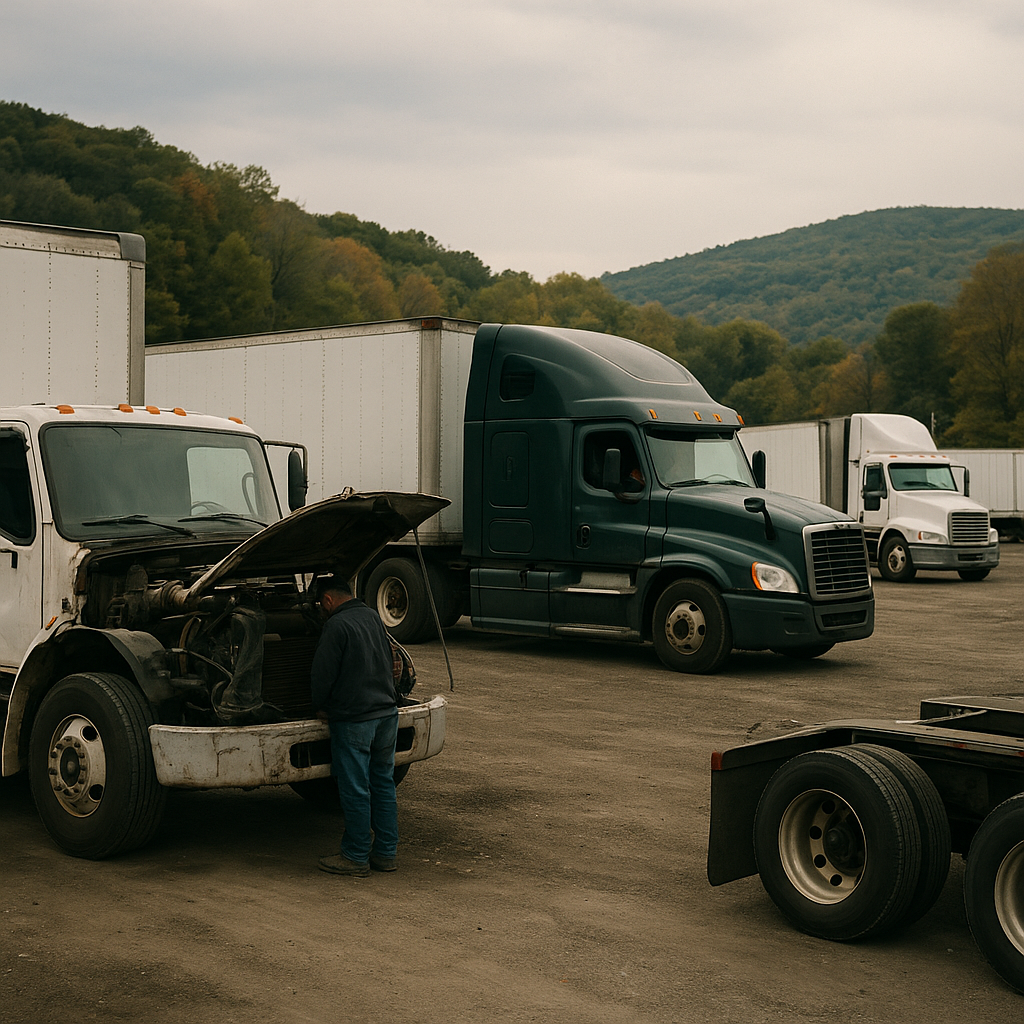

If you use a box truck for work in Pennsylvania, you usually need commercial coverage, not a personal auto policy. What you need depends on how you run the truck, what you haul, how far you go, and whether you stay in Pennsylvania or cross state lines.
A lot of operators get tripped up here. They hear a state minimum, hear somebody mention FMCSA rules, and assume it all means the same thing. It doesn’t, and that confusion is how people end up with the wrong policy, the wrong limits, or missing filings when they need them most.
What Pennsylvania Box Truck Insurance Covers#
Box truck insurance in Pennsylvania usually means a commercial policy built for business use, with coverage shaped by your hauling setup, cargo, driving radius, and whether you operate intrastate or interstate. For most owner-operators and small fleets, the main pieces to compare are auto liability, physical damage, cargo, and a few operation-specific add-ons.
A box truck used for business generally needs commercial coverage because the risk is different from personal driving. A personal auto policy is written for private use like commuting, errands, and family driving. Once the truck is making deliveries, hauling freight, moving goods for pay, or supporting a business, personal coverage often stops fitting the exposure.
The exact policy changes with the operation. A local bakery making deliveries around one city has a different insurance profile than a for-hire carrier taking regional loads across state lines. Cargo type, vehicle size, operating radius, where the truck is garaged, and whether you hire drivers all push the policy in different directions.
The Pennsylvania Department of Insurance oversees insurance sold in the state, but the policy itself still has to match the way the truck is actually used. That’s the part many operators miss when they shop by price alone.
Box truck insurance vs. personal auto#
Commercial auto liability pays for bodily injury and property damage you cause to others while operating the insured truck in covered business use. That is the foundation of most box truck policies.
Personal auto insurance usually isn’t built for a box truck doing paid work. If a claim happens during business use, the carrier may question coverage, limit coverage, or deny it based on exclusions and misclassification.
Who typically needs a commercial policy#
Most Pennsylvania box truck operators using the vehicle for business need a commercial policy. That includes owner-operators, delivery businesses, contractors using a box truck to move tools or materials, and small fleets with two to five trucks.
For example, a single-truck operator hauling local retail freight around Harrisburg may need basic commercial auto, physical damage, and cargo if the shipper requires it. A three-truck fleet running loads into Ohio and New Jersey may need higher liability attention, driver scheduling controls, cargo protection, and federal filing support tied to interstate operations.
Coverage lines that matter most#
Physical damage covers damage to your truck itself from collision and non-collision losses like theft, fire, or weather, depending on the coverages selected. Cargo covers the goods you’re hauling when that exposure applies. General liability can matter for some for-hire business exposures away from the truck, and non-trucking liability may matter only in narrow leased-on situations, not for regular paid hauling.
One of the biggest mistakes is assuming auto liability also covers the freight in the box. It doesn’t. Another is assuming a personal policy somehow stretches to business use because the truck isn’t a tractor. It usually doesn’t.
Pennsylvania Requirements for Box Trucks#
Pennsylvania box truck insurance requirements depend on whether you’re operating only within the state or crossing state lines, and whether federal motor carrier rules apply to your setup. The required liability level is not based on “box truck” alone. It changes based on carrier type, weight, cargo, and operating authority status.
State rules and federal rules are related, but they are not the same thing. Pennsylvania can have its own registration and insurance expectations for vehicles operating in the state. Federal rules come into play when the operation meets interstate motor carrier thresholds or requires federal authority.
State rules vs. federal rules#
Intrastate means you operate only within one state. Interstate means you cross state lines or haul freight that is part of interstate commerce.
If you’re a Pennsylvania business using a box truck only inside Pennsylvania, your insurance setup may be driven mainly by state requirements, contract requirements, and the practical risks of your work. If that same truck starts hauling freight into Maryland, New Jersey, or Ohio, federal registration, insurance standards, and filing requirements may come into the picture.
This is where operators get confused by generic advice online. Your state minimum is not automatically your federal minimum. And federal liability minimums are not one-size-fits-all.
Under 49 CFR Part 387, for-hire interstate carriers hauling general freight in vehicles over 10,001 pounds must carry at least $750,000 in public liability. Other operations can require different minimums, including $300,000 for certain for-hire interstate operations under 10,000 pounds, $1,000,000 for certain auto haulers, and $5,000,000 for certain hazardous materials operations. The right number depends on the operation, not just the truck body style.
When FMCSA rules apply#
FMCSA is the Federal Motor Carrier Safety Administration, the federal agency that regulates many interstate motor carriers and commercial vehicle operations. USDOT registration and, in some cases, an MC number can become relevant when your box truck operation crosses into federally regulated territory.
An MC number is operating authority that allows certain for-hire carriers to haul regulated interstate freight for compensation. Not every box truck needs one, but many interstate for-hire setups need to at least ask the question before they buy coverage.
A local-only moving or delivery business staying inside Pennsylvania may have a very different compliance path than a for-hire box truck carrier crossing state lines weekly. The truck can look the same from the outside, while the insurance and compliance needs are completely different.
Why filings and authority matter#
An MCS-90 is a federal endorsement attached to a liability policy to satisfy certain financial responsibility rules for motor carriers under federal law. If you need federal authority, the insurer may also need to support the required filing structure behind that authority.
You can verify carrier status and operating details through FMCSA and check public carrier registration information on SAFER. That matters because a mismatch between your authority, operating scope, and insurance can slow down activation, create contract issues, or leave you out of compliance.
A practical example: a local Pennsylvania box truck doing appliance delivery for one store may mainly need state-compliant business coverage. A box truck hauling for-hire general freight from Pittsburgh into West Virginia may trigger federal liability standards and filing needs. A hauler moving specialized or higher-risk cargo may need more than the baseline minimum and more than one proof document depending on the shipper and carrier setup.
If you’re staring at quotes and still aren’t sure which rules actually apply,
How Much Box Truck Insurance Costs in Pennsylvania#
Box truck insurance in Pennsylvania can vary widely because underwriters price the operation, not just the truck. Your premium depends on factors like driving history, vehicle value, cargo, radius, mileage, claims record, garaging location, and whether the truck runs local, regional, or interstate work.
That means two operators with similar trucks can get very different quotes. One may look straightforward on paper, while the other shows loss activity, tougher cargo, a wider operating radius, or a denser metro garaging address.
Cost factors that move a quote#
Driving record is usually one of the first things that moves the quote. A clean record with stable experience usually prices better than recent violations, preventable accidents, or gaps in commercial driving history.
Vehicle value also matters, especially when you add physical damage. A newer financed box truck with higher replacement cost usually carries a different premium structure than an older paid-off truck where the owner is only insuring liability or using a higher deductible.
Cargo changes the picture too. Hauling boxed retail goods is different from hauling higher-theft items, temperature-sensitive products, or freight with stricter shipper requirements. Annual mileage, overnight parking, and the neighborhood where the truck is garaged also affect the risk.
Why two similar trucks can price differently#
A one-truck owner-operator may price differently from a three-truck fleet even if the trucks are similar. That’s because underwriting looks at the whole operation: who drives, how often the trucks run, how the business is managed, and whether there are prior claims or turnover issues.
A small fleet with hired drivers may present more scheduling and supervision risk than an owner-operator who drives the same route every day. On the other hand, a more established fleet with strong hiring controls and cleaner loss history can sometimes look more stable than a brand-new one-truck startup.
Examples of common price drivers#
Take two Pennsylvania operators with the same-size box truck. The first has a newer truck, a clean commercial record, local daytime deliveries, and no prior losses. The second has an older truck, a prior collision claim, occasional overnight parking away from the listed garaging address, and regional runs into multiple states. Those are not the same insurance risk, even if the vehicle class matches.
Another example: a local furniture delivery truck that stays within one county may rate differently from a box truck running scheduled retail loads from Pennsylvania into New York every week. The second operation usually adds more road time, more exposure, and often more compliance complexity.
Trying to lower the premium by stripping out cargo or physical damage can backfire fast. If the truck is financed, leased, or central to your income, cutting the wrong coverage may save premium on paper but leave you exposed where the loss actually happens.

Coverage Options to Compare Before You Buy#
The best box truck policy is usually the one that matches how the truck actually works, not the one with the longest list of add-ons. For most Pennsylvania operators, the first coverages to compare are liability, physical damage, cargo, and any business-use protections tied to leased-on work, for-hire exposure, or fleet operations.
Some coverages are core for many box truck businesses. Others matter only for certain setups. The goal is fit, not buying every box on the quote screen.
Required and commonly requested coverages#
Auto liability is the core coverage most operators start with because it handles damage or injury you cause to others. If you are in a federally regulated for-hire interstate setup, the liability minimum may be tied to 49 CFR Part 387, not just a state-level assumption.
Motor truck cargo covers the freight you are hauling when that exposure is part of the operation. This matters for many for-hire box truck operators because brokers and shippers often care about cargo protection as much as auto liability. General liability can also matter for some for-hire businesses when a contract asks for protection beyond the truck itself.
Protection for the truck itself#
Physical damage usually includes collision and comprehensive-style protection for the truck itself. Collision covers damage from impact or upset. Comprehensive handles many non-collision losses such as theft, vandalism, and certain weather events. Some forms may separate fire and theft with combined additional coverage options depending on the market.
This is where a lot of price shoppers make a bad trade. They figure the truck is older, so they remove physical damage without thinking through what happens after a total loss, theft, or major body repair. If that truck is how the business earns money, losing it can be worse than the claim itself.
Protection for cargo and business operations#
Cargo doesn’t come with liability by default. That’s a separate line, and it needs to fit what you’re hauling. If you’re delivering goods locally under your own business name, cargo may still be critical if customers expect you to make them whole after a loss.
Non-trucking liability covers non-business use only for certain leased-on owner-operators and never covers paid hauling. For many box truck businesses operating under their own authority or using the truck directly for work, it may not be relevant at all. A lease-on operator should be especially careful here because it’s easy to buy a policy that sounds right but doesn’t cover the trip you’re actually making.
A local delivery truck may need straightforward liability plus physical damage. A leased-on operator may need to confirm when the motor carrier’s coverage applies and when it doesn’t. A small fleet with hired drivers may need tighter review of driver eligibility, cargo terms, and deductibles across all units.
How to Pay Less Without Buying the Wrong Policy#
You can usually lower box truck insurance costs by improving the risk you present and by matching coverage closely to the operation. The safest way to shop is to compare quotes on the same terms, not to chase the lowest number while changing limits, deductibles, or coverages so much that the policy no longer fits the job.
Price matters, especially for a one-truck business. But a cheap quote that excludes the real exposure isn’t a bargain.
Risk factors you can control#
Cleaner drivers usually help more than almost anything else. That means careful hiring, regular MVR review, and not putting the wrong driver in the truck just because a route needs to move.
Accurate garaging also matters. If the truck sleeps in Philadelphia but the policy says it stays in a quieter area outside the city, that mismatch can create both pricing and claim problems. A clean loss history, realistic mileage, and honest cargo descriptions all help build a quote that holds up.
Policy choices that affect price#
Deductible is one lever, but it should be used carefully. Raising the physical damage deductible can lower premium, but only if the business can actually absorb that out-of-pocket cost after a loss.
Cargo scope affects structure too. If the operation changed from hauling mixed merchandise to a narrower, lower-risk cargo profile, the quote may change. But narrowing the cargo description just to lower premium is risky if the truck later hauls something outside the stated class.
Ways small fleets reduce waste#
Small fleets often reduce waste by standardizing drivers, routes, and equipment instead of insuring every truck as if it does completely different work. Consistent operations are easier to underwrite than a fleet that says yes to every load with no clear pattern.
The best way to compare is simple: same truck facts, same driver list, same radius, same cargo, same limits, same deductibles. If you’re not sure whether your current setup is missing something or carrying the wrong thing,
How to Get a Pennsylvania Box Truck Quote the Fast Way#
The fastest way to get a useful box truck quote is to have the truck, driver, cargo, and operating details ready before you start. For Pennsylvania owner-operators and small fleets, the process usually moves quickly when the information is complete and the policy is being built around the real operation instead of guesses.
Start with the basics. Have the VIN, year, make, model, and stated value ready for each truck. You should also have the garaging address, business name, driver license details, recent driving history, operating radius, annual mileage estimate, and a plain-language description of what the truck hauls.
If your operation crosses state lines or runs for-hire freight, have your USDOT details, any MC number information, and filing needs ready too. That helps avoid the back-and-forth that slows quotes down.
The quote path is usually straightforward: share the operation details, review the coverage structure, compare deductible and limit options, confirm any filing needs, and then bind once the policy matches the business use. For someone working from the cab, speed usually comes down to accuracy more than anything else.
Before binding, check the parts that matter most: liability limits, physical damage deductible, cargo terms, driver schedule, excluded uses, and whether filings or authority support are actually included where needed.
FAQ#
Do I need commercial insurance for a box truck in Pennsylvania?
Yes, if the box truck is used for business, you usually need commercial insurance rather than a personal auto policy. That includes paid delivery, hauling goods, contractor use, moving business property, or operating for-hire. The exact policy depends on how the truck is used, what it carries, where it operates, and whether it stays intrastate or crosses state lines.
A truck used only for personal reasons is a different case, but most working box trucks do not fit that profile. If the vehicle supports income, assume the policy needs to be built for commercial use and then confirm the exact structure based on the operation.
What insurance does a box truck need to meet Pennsylvania and FMCSA rules?
That depends on whether the operation is intrastate only or subject to federal interstate rules. Pennsylvania may have its own insurance expectations for a commercial vehicle, while FMCSA-related standards can apply when the operation is for-hire, interstate, and within the federal scope.
For example, under 49 CFR Part 387, for-hire interstate carriers hauling general freight in vehicles over 10,001 pounds must carry at least $750,000 in public liability. But that is not a universal rule for every box truck. The right requirement depends on carrier type, vehicle weight, cargo, and operating scope. Some operators also need filings tied to authority.
Is personal auto insurance enough for a box truck used for work?
Usually no. Personal auto insurance is generally meant for private use, not business hauling, delivery work, or commercial operations. A box truck used for work creates a different risk profile, and personal policies often contain exclusions or limitations that can cause major problems when a claim happens during business use.
That matters even for small operations. A one-truck local delivery business may still need a commercial policy because the truck is part of revenue-producing work. If a loss happens and the insurer decides the truck was being used outside the policy’s intended purpose, the cheapest policy you found can become the most expensive mistake.
What affects the cost of box truck insurance in Pennsylvania?
The biggest cost drivers are usually driving record, truck value, cargo type, operating radius, annual mileage, claims history, garaging location, and whether the truck runs local, regional, or interstate routes. Insurers also look at business stability, driver experience, and whether the operation uses hired drivers.
That’s why similar trucks can price very differently. A newer truck with a clean record doing local daytime deliveries may look much different to an underwriter than an older truck with prior losses running multistate routes. The premium follows the risk profile of the operation, not just the body style of the vehicle.
Which coverages should a small box truck business compare first?
Start with liability, physical damage, and cargo if you haul goods for others or need cargo protection under contracts. Those are usually the first coverages that matter most to a Pennsylvania box truck operator. Some operations should also review general liability or leased-on protections, but those depend on how the business is set up.
The key is not to assume one line covers another. Auto liability does not cover cargo. Physical damage covers the truck, not the freight. Personal auto usually does not solve business use. Comparing the core coverages first helps you avoid both overbuying and dangerous gaps.
How can I lower my box truck insurance cost without cutting needed protection?
Focus on the parts you can control: safer drivers, accurate operating details, realistic garaging, clean loss history, and coverage that fits the actual operation. When you compare quotes, make sure the limits, deductibles, cargo terms, and driver assumptions are the same. Otherwise, the lower quote may only be lower because it covers less.
Higher deductibles can help in some cases if the business can comfortably handle the out-of-pocket cost. Narrowing cargo to match what you truly haul can also help. But stripping away essential physical damage, cargo, or required liability just to reduce premium usually creates more risk than savings.
What information do I need to get a quote quickly?
Have the VIN, year, make, model, truck value, garaging address, business name, driver license information, recent driving history, operating radius, annual mileage, and cargo description ready. If the truck runs interstate or for-hire, also have USDOT information, any MC number details, and any filing needs available.
That preparation cuts down on the usual delays. Instead of spending days answering follow-up questions from the road, you can move straight into comparing limits, deductibles, and policy structure. For a small operator running the business from the cab, complete information is usually the fastest route to a usable quote.





