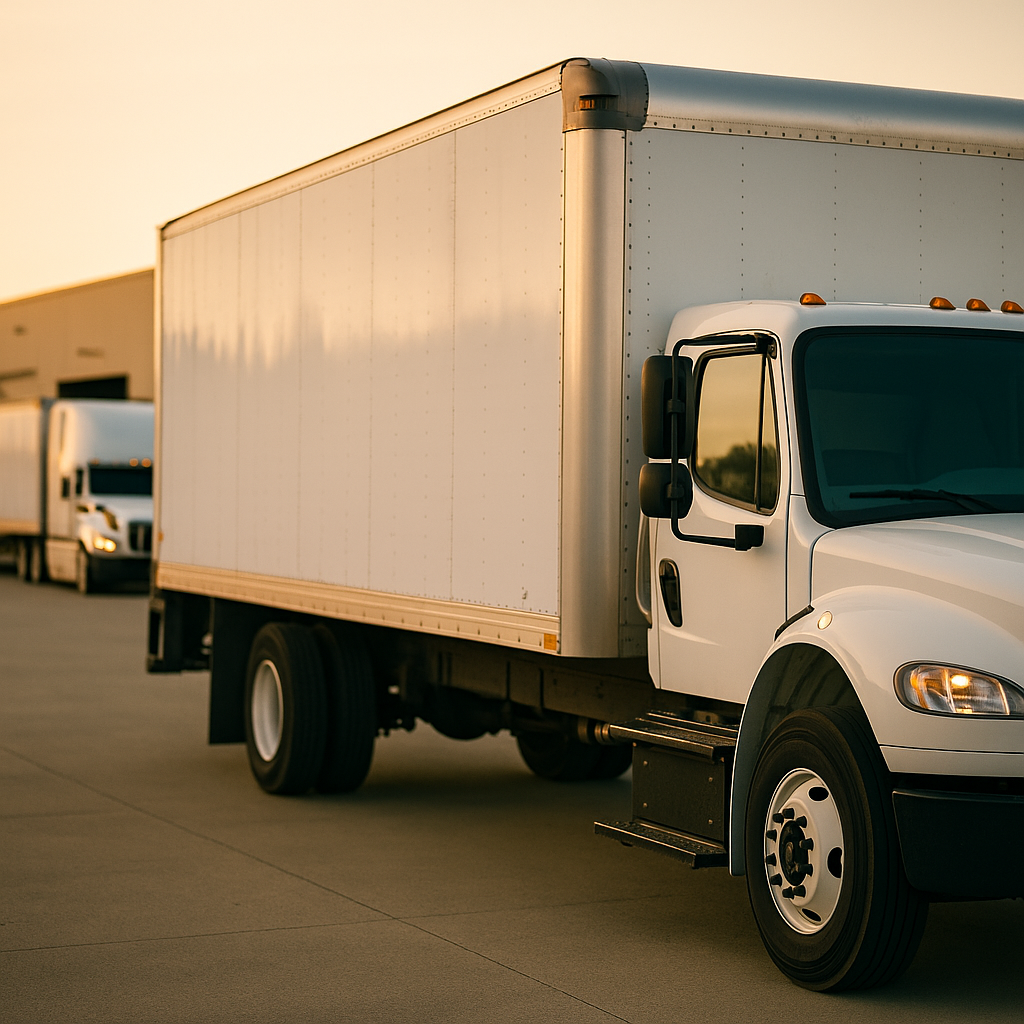

2026 rates: 26‑ft box truck insurance runs $250–$2,600+/mo. Compare full package vs liability-only, ZIP & operation factors, and cut costs—get a quote today.
26 ft box truck insurance cost in 2026 typically falls between $250–$2,600+ per month for for-hire operators, depending on whether you buy liability-only or a full package (liability + physical damage + cargo), plus your garaging ZIP, operation type, and insurance history.
If you’re budgeting for a 26-foot box, pressure-test your numbers against broader market context using these commercial box truck insurance cost benchmarks so you’re not guessing off one quote.
Key takeaways:
- Plan on $250–$2,600+/month for 26‑ft box truck commercial truck insurance in 2026; ops type + ZIP code decide where you land.
- Liability-only is cheaper but doesn’t protect your truck; financed/leased units usually need physical damage.
- New venture pricing is real; the first 6–12 months are usually the most expensive if you don’t have continuous coverage history.
- Fastest path to savings: apples-to-apples quotes, realistic radius, smart deductibles, and better garaging/security.
👉 Ready to save on your box truck insurance?
Watch the video below for a quick overview of box truck insurance rules, how much it costs, and practical ways to save. Or give us a call: (704) 290-3630
Table of Contents
Reading time: 8 minutes
Typical 26‑ft Box Truck Insurance Cost (Monthly + Annual)
In 2026, a for-hire 26‑foot box truck commonly budgets between $250–$900/month for liability-only and $650–$2,600+/month for a full package, with the final price driven by MVR, garaging ZIP, cargo, radius, and insurance history.
Insurance is one of the biggest “fixed” costs you pay whether freight is good or bad, and industry cost studies regularly rank insurance among major operating cost categories (ATRI research library: https://truckingresearch.org/).
2026 cost ranges by policy type (planning numbers)
These are budgeting ranges—not a promise. Your inputs can move the price significantly.
| Policy Type | What It Usually Includes | Typical Monthly Range | Typical Annual Range |
|---|---|---|---|
| Liability-only | Primary auto liability (no comp/collision) | $250–$900/mo | $3,000–$10,800/yr |
| Full package | Liability + physical damage + cargo (often with required add-ons) | $650–$2,600+/mo | $7,800–$31,200+/yr |
If you want a deeper pricing walkthrough (and how specific coverages change the payment), use: deeper box truck insurance price breakdown.
Down payment & cash-flow planning (what catches new owners)
Many owner-operators get blindsided by startup cash (down payment + fees + first installment), not just the monthly bill.
- New venture status: limited commercial insurance history often reduces carrier options.
- Lapses in coverage: even short lapses can trigger higher pricing or fewer programs.
- MVR items: speeding, at-fault accidents, suspensions, and DUIs can sharply raise premium.
- Payment plan: monthly financing typically costs more than pay-in-full.
Practical rule: if you’re starting authority or switching into for-hire, keep a cash buffer so insurance doesn’t force you into bad freight just to make the payment.

Cost by Operation Type (26‑ft Box Truck Rate Matrix)
Underwriters rate 26‑ft box truck risk primarily by operation type—including stop frequency, radius, commodity, and garaging—not by truck length alone.
That’s why two identical 26-foot boxes can price wildly different if one runs dense multi-stop routes and the other runs predictable regional lanes.
Common 26‑ft operations and what they typically pay
| Operation Type | Typical Monthly Range | Why It Prices This Way | Must-Have Coverages (Typical) |
|---|---|---|---|
| For-hire general freight (regional) | $550–$1,100 | Fewer stops than local; moderate mileage/radius | Liability + cargo + physical damage (if financed) |
| Local last-mile / multi-stop delivery | $700–$1,600 | High stop frequency increases loss frequency | Liability + cargo; contract-driven options may apply |
| Moving / household goods | $900–$2,200+ | Higher claim severity (handling, damage disputes) | Liability + cargo; higher cargo limits may be required |
| Contracted routes (parcel/retail) | $650–$1,400 | Predictable lanes, but steady exposure | Liability + cargo; endorsements per contract |
| High-theft metro runs / overnight street parking | $1,200–$2,600+ | Theft + vandalism + dense traffic claims | Liability + physical damage with tighter underwriting controls |
Three “quote-style” scenarios (realistic examples)
- Example A — Lower-end profile: clean MVR, documented experience in similar equipment, secured rural/suburban garaging, continuous prior insurance.
- Example B — Middle profile: mixed metro/suburban routes, financed truck, moderate cargo limit, minor MVR items, higher delivery density.
- Example C — High-end profile: new venture + metro ZIP + higher-theft storage, higher cargo limits, night delivery, any recent at-fault or lapse.
If you want to understand what underwriters are reacting to (and avoid “non-comparable” quotes), review: what affects truck insurance rates.
What a “Full Package” Policy Usually Includes (and What It Doesn’t)
A “full package” for a 26‑ft box truck usually means commercial auto liability + physical damage + motor truck cargo, but the exact terms, exclusions, and required add-ons depend on your contracts and carrier underwriting.
Most owner-operators end up here because brokers, shippers, and lenders often require more than bare minimum liability.
Core coverages (the stack that drives the price)
Primary Auto Liability (Commercial Auto)
This pays for injuries and property damage you cause in an at-fault crash. Many brokers and shippers commonly require $1,000,000 liability even when legal minimums vary by operation and cargo. Federal insurance filing rules and forms live here; see FMCSA’s insurance filing overview: https://www.fmcsa.dot.gov/registration/insurance-filing-requirements.
Physical Damage (Comprehensive + Collision)
This protects your truck (not the other party’s). If your 26‑ft box truck is financed or leased, the lienholder typically requires comp and collision with specific deductibles. For a clear breakdown of deductibles and lender requirements, read: physical damage coverage explained.
Motor Truck Cargo
This covers the customer’s freight you’re hauling up to the policy limit, subject to exclusions and conditions. Common surprises include exclusions tied to unattended theft, certain commodities, improper securement, or contract language that requires higher limits than you purchased. For a deeper guide, see: cargo insurance for box trucks.
Add-ons that can move your premium (and your compliance)
Depending on your contracts, you may also need:
- General Liability (GL): slip-and-fall and premises-type claims (not tied to auto use).
- Hired & Non-Owned Auto: exposure from rented/borrowed vehicles or employees using personal cars for business tasks.
- Non-Trucking Liability (NTL): typically for leased-on drivers in specific non-business use scenarios (not the same as for-hire liability).
This is where “cheap” insurance becomes expensive—because a claim exposes a missing coverage your contract assumed you had.
Why Your Rate Is High (Location + Driver + New Venture) and How to Lower It
The most common drivers of high 26 ft box truck insurance cost are garaging ZIP/theft exposure, driver and loss history, and new venture status, and each one has practical steps that can reduce premium without breaking contracts.
Location: metro ZIP vs rural ZIP (the underwriting logic)
Carriers price based on expected loss frequency (how often claims happen) and loss severity (how expensive they are).
- Traffic density: more vehicles + more intersections = more crash exposure.
- Theft/vandalism: overnight parking and key control matter.
- Garaging address: street parking typically prices worse than a fenced, secured lot.
- Repair costs: labor rates and parts availability vary by region.
New venture timeline: what usually improves in 12–24 months
Many carriers treat the first year as the “prove it” period because you don’t have established commercial loss history, stable operations data, or long-term continuous coverage.
- 0–3 months: often the tightest window for pricing and carrier options.
- 6–12 months: re-shop if you kept continuous coverage and clean operations.
- 12–24 months: more programs may open up if your record supports it.
Action plan: 10 moves that tend to lower premium (without breaking contracts)
Insurance savings usually come from tightening controllable underwriting inputs, not from stripping coverage below what your contracts require.
- Quote apples-to-apples: same limits, deductibles, radius, drivers, and cargo.
- Tighten radius: don’t say “nationwide” if you operate local/regional.
- Improve garaging: secured lot beats street parking—especially in high-theft ZIPs.
- Add theft controls: immobilizer, GPS tracking, cameras, and documented key control.
- Install a dash cam: some carriers credit it; all carriers like the claims defense.
- Be strict on driver selection: one bad MVR can move the account more than you expect.
- Raise deductibles strategically: only if you can absorb the out-of-pocket risk.
- Avoid high-loss ops when possible: night delivery, high-claim areas, risky shippers.
- Document safety basics: pre-trip inspections, maintenance logs, driver coaching.
- Re-shop on schedule: especially after 6–12 months of clean history.
For a deeper checklist and practical examples, use: how to save on truck insurance.
Mini decision tool (quick triage)
- If you’re expensive because you’re new: prioritize continuous coverage, clean inspections, and re-shop at 6–12 months.
- If you’re expensive because of ZIP/theft: change garaging first (secured lot), then add tracking/immobilizers.
- If you’re expensive because of physical damage: reassess truck value, deductible, and whether the lienholder forces comp/collision.
How to get an accurate quote (what to bring your agent)
Better inputs reduce re-quotes and tighten pricing accuracy.
- Driver info: experience, MVR details, prior commercial history.
- Truck info: VIN, year, stated value, lienholder (if any).
- Ops info: garaging address, radius, commodities, annual miles, typical lanes.
- Insurance history: prior policy, lapse details, loss runs (if available).
Frequently Asked Questions
In 2026, most for-hire operators should budget $250–$2,600+ per month for 26‑ft box truck insurance depending on whether it’s liability-only ($250–$900/mo) or a full package ($650–$2,600+/mo). The biggest pricing swings usually come from garaging ZIP (metro vs rural), theft exposure, operation type (multi-stop vs predictable routes), and whether you’re a new venture. If you want to sanity-check your quote against broader market context, compare it to these commercial box truck insurance cost benchmarks.
The biggest drivers of box truck insurance rates are driver MVR and experience, claims and loss history, new venture status, garaging location, radius and delivery density, and cargo type/limits. For example, a multi-stop last-mile operation in a dense metro ZIP with overnight street parking usually prices higher than a regional route with secured garaging. If you want a carrier-style explanation of how those inputs change premium (and how to keep quotes comparable), review what affects truck insurance rates.
Usually no, because financed or leased 26‑ft box trucks typically require physical damage coverage (comprehensive and collision) to protect the lender’s collateral. Liability-only pays for damage you cause to others, but it won’t repair or replace your truck after a theft, vandalism, fire, or at-fault accident—so you could lose the truck and still owe the note. Deductibles and stated value can meaningfully change the premium, but they also change your out-of-pocket risk. For a practical breakdown, see physical damage coverage explained.
Most brokers and shippers verify coverage with a Certificate of Insurance (COI) showing limits, effective dates, and the insured’s name exactly as contracted. Many contracts also require an Additional Insured (AI) endorsement and a Waiver of Subrogation (WOS), and loads can be rejected if wording or limits don’t match the agreement. If you’re under your own authority, filings and compliance requirements may also apply depending on your operation (FMCSA insurance filing overview: https://www.fmcsa.dot.gov/registration/insurance-filing-requirements). For a document-by-document breakdown, use proof of insurance and filings (COI, AI, WOS).
Conclusion: Budget the Right Range—Then Lower It
For most for-hire operators, the real-world 26 ft box truck insurance cost in 2026 usually lands between $250 and $2,600+ per month, with operation type, garaging ZIP, and new venture status doing most of the heavy lifting.
If you want to pay less, don’t chase the cheapest coverage on paper—build a package that clears contracts, then tighten the controllables (radius, garaging, deductibles, and documentation).
Key Takeaways:
- Know your policy type: liability-only vs full package is the biggest pricing split.
- Fix the “ZIP + parking” issue first: secured garaging and theft controls often move the needle.
- Re-shop on a schedule: new ventures should review options after 6–12 months of clean history.
When you’re ready to stop guessing, get apples-to-apples quotes and make sure your limits and endorsements match what your contracts require.