
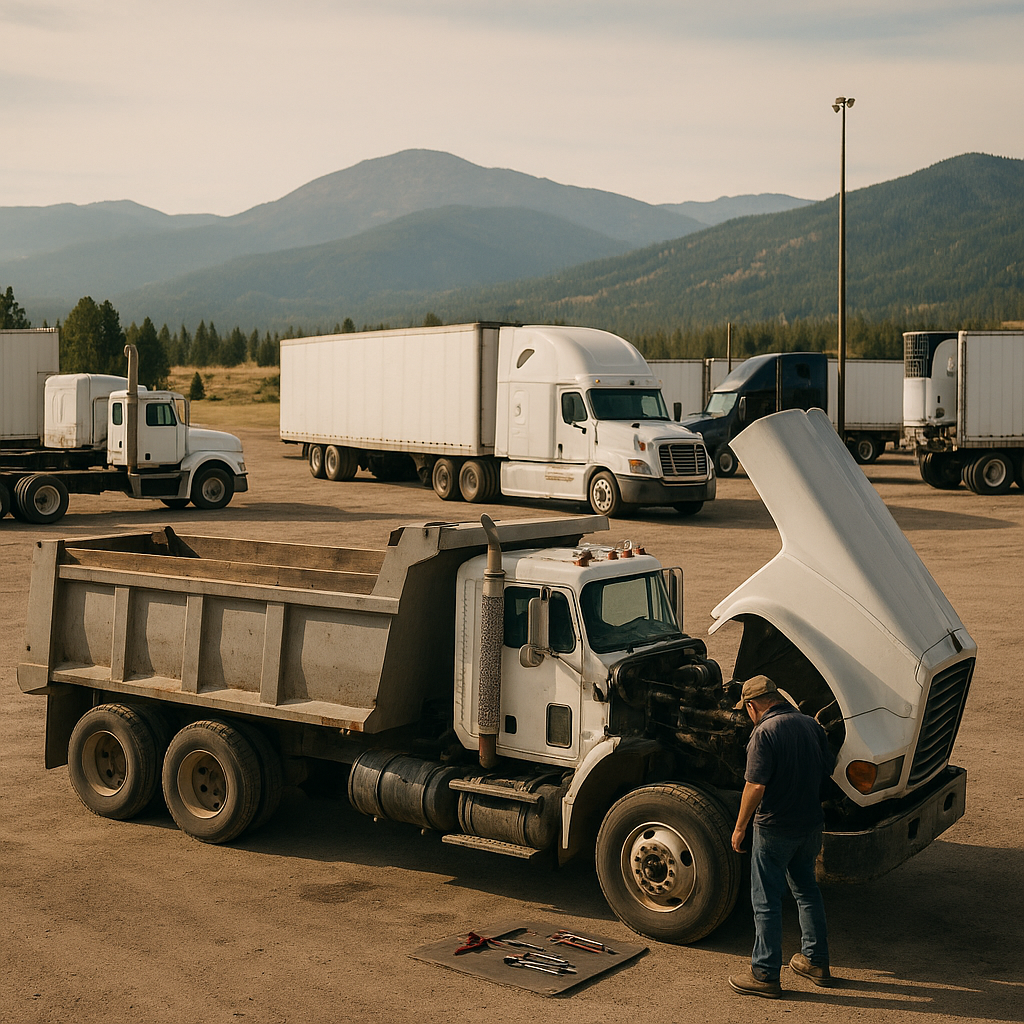

Montana dump truck insurance is commercial coverage built for a truck used to haul, dump, and work on jobsites. If you run a dump truck in Montana, the right setup depends on your operation, cargo, truck weight, radius, and whether you stay in-state or cross state lines.
Montana dump truck insurance basics#
Montana dump truck insurance is a commercial policy setup for trucks doing hauling, dumping, and jobsite work. Most operators need more than a basic auto policy because dump trucks create highway risk, jobsite risk, and material-handling risk that personal insurance usually doesn’t contemplate.
What makes dump truck coverage different#
Dump truck insurance means commercial coverage for a truck used in business to transport and unload materials like dirt, gravel, asphalt, or debris. That matters because a dump truck doesn’t just drive from point A to point B. It backs into tight spaces, works on uneven ground, tips loads, and deals with rocks, dust, debris, and site traffic.
Those exposures can create claims that look different from standard freight hauling. A cracked windshield from flying aggregate, a rollover during a dump, or damage during loading isn’t the same risk profile as a pickup used for errands.
Commercial auto vs. personal auto#
Commercial auto insurance is vehicle coverage written for business use. Personal auto insurance is written for private, non-business driving, and it usually won’t fit a dump truck being used for paid work.
That’s one of the biggest mistakes new operators make. If the truck hauls for money, works under a business name, or operates as part of a trucking business, you usually need a commercial policy built around that operation.
Who this guide is for#
This guide is for Montana owner-operators and small fleets trying to sort out what coverage actually fits a dump truck operation. It focuses on three things: compliance clarity, coverage fit, and why quotes vary so much from one operation to another.
What Montana dump truck operators usually need#
Most Montana dump truck operators start with auto liability, then build the policy around truck value, hauling work, and contract requirements. The usual decision points are liability for damage you cause, physical damage for the truck itself, and added protection for cargo, jobsite exposures, or off-duty use where it fits.
Auto liability and required filings#
Auto liability covers bodily injury and property damage you cause with the truck. For a dump truck, this is the foundation of the policy because it’s the piece most directly tied to legal operation and, in some cases, federal or state filing requirements.
If you’re strictly intrastate, Montana rules may control more of the picture. If you’re a for-hire interstate carrier, federal financial responsibility rules can come into play depending on the operation, vehicle weight, and commodity.
An MCS-90 is an endorsement tied to federal financial responsibility for certain motor carriers. It isn’t the same thing as saying a policy is “full coverage,” and it doesn’t replace understanding what the policy actually covers.
Physical damage for the truck itself#
Physical damage covers the truck for direct loss, usually through collision and comprehensive causes. Collision pays for impact damage; comprehensive covers non-collision losses like theft, vandalism, weather, or fire, depending on the policy structure.
Dump trucks often carry a lot of value in the chassis, body, hydraulics, and attached equipment. That makes physical damage a serious part of the decision, especially if the truck is financed or leased.
Cargo and jobsite-related exposures#
Motor truck cargo covers damage to property you’re hauling when that exposure fits the operation. General liability covers certain non-auto business liability exposures, which can matter around jobsites or contract work.
Not every dump truck operation needs every coverage line. But cargo, loading, unloading, debris handling, and dumping activity can create losses that a basic auto policy doesn’t address well.
If you’ve ever looked at a quote and still couldn’t tell whether it actually fits the work,
Optional coverages that may matter#
Non-trucking liability, sometimes called bobtail in conversation, is coverage for non-business use of a truck. It does not cover paid hauling.
Coverage needs also change when the truck is financed, leased onto another carrier, or run under your own authority. A lender may require physical damage. A lease agreement may impose specific limits. An authority-based operation may need filings that a local, intrastate-only truck doesn’t.
Montana rules, federal rules, and when each one applies#
Montana rules and federal trucking rules are not the same thing, and dump truck operators get burned when they treat them like they are. Purely intrastate work may be governed mainly by state rules, while interstate for-hire trucking can trigger FMCSA requirements, filings, and minimums that go beyond state minimum insurance language.
Montana-only operations#
If your dump truck stays within Montana and your work is truly intrastate, state-level rules may be the main starting point. The Montana Department of Insurance is the right state source for insurance regulation and consumer guidance.
That said, “intrastate” isn’t just what you prefer to call your operation. It depends on how the freight moves, who you’re hauling for, and whether the work is part of interstate commerce.
Interstate trucking and FMCSA requirements#
The FMCSA is the Federal Motor Carrier Safety Administration, the agency that regulates interstate commercial motor carriers. If your dump truck operation crosses state lines or falls into interstate commerce, federal rules may apply differently than they do for a Montana-only operator.
Under 49 CFR Part 387, for-hire interstate carriers hauling general freight in vehicles over 10,001 lbs must carry at least $750,000 in public liability. That figure is not universal for every trucker. Requirements vary by carrier type, vehicle weight, cargo, and whether you operate interstate or intrastate.
A USDOT number identifies a commercial motor carrier for safety oversight. An MC number is operating authority for certain for-hire interstate carriers.
State minimums vs. federal filings#
State minimum insurance and federal financial responsibility are separate concepts. A truck can meet a state minimum and still not satisfy the federal requirement that applies to its operation.
You can check carrier status and some authority details on SAFER. That’s useful when you’re trying to confirm whether federal filings may matter for your setup.
Why authority status changes the policy#
Authority status changes the policy because the insurer has to write for the operation you actually run. A dump truck working local construction jobs under someone else’s authority can be a different insurance problem than a dump truck running for-hire interstate loads under its own authority.
That difference affects filings, documentation, underwriting, and sometimes which carriers will even consider the risk.
How much Montana dump truck insurance costs#
Montana dump truck insurance doesn’t have a one-price answer because insurers rate the exposure, not just the truck. Your premium depends on what the truck does, where it runs, who drives it, what it’s worth, how it’s garaged, what materials it hauls, and whether the operation is intrastate or interstate.
Main cost drivers#
The biggest pricing factors are usually the driver’s record, prior claims, truck value, garaging address, operating radius, hauling type, and where the truck actually works day to day. A truck hauling aggregate around active jobsites presents a different exposure than one doing lighter, more predictable work.
Insurers also look hard at business setup and experience. A new venture with a heavy truck, limited history, and rough jobsite exposure usually gets viewed differently than an established operator with clean loss history and stable accounts.
Why dump trucks often cost more than expected#
Dump truck insurance often feels expensive because the claim pattern is rougher than many operators expect. These trucks see backing losses, debris claims, tire and body damage, loading-zone incidents, hydraulic and dump-related accidents, and physical damage from uneven terrain.
That’s why broad searches like “cheapest dump truck insurance Montana” usually lead people the wrong way. The real question is whether the quote matches the work without leaving a hole that shows up during a claim.
The NAIC, or National Association of Insurance Commissioners, provides plain-language consumer insurance education, including basic state insurance concepts at naic.org. That matters here because even terms like liability, deductibles, and no-fault get mixed up when people compare personal auto talk to commercial trucking policies.
What changes quotes the most#
Small details can move a quote more than people think. Changing from dirt to demolition debris, changing the garaging location, adding a second driver, changing the radius, or shifting from intrastate to interstate work can all change eligibility or price.
Truck condition matters too. So does maintenance history, vehicle age, and whether the truck has safety controls or a pattern of downtime and repairs.
How to get a meaningful quote#
A meaningful quote starts with accurate information. Have the VIN, unit details, driver information, loss history, business entity, garaging address, operating radius, and hauling description ready.
Don’t compare quotes by premium alone. Compare the deductible, exclusions, endorsements, liability setup, physical damage terms, and whether the policy contemplates the actual dump work being done.
Why dump truck insurance is often expensive#
Dump truck insurance is often expensive because the work creates frequent opportunities for both small and severe losses. Insurers price for the chance of claims from jobsites, loading areas, tipping operations, debris, and truck damage, not just for highway miles.
Jobsite and debris risk#
A lot of dump truck claims happen off the highway. Tight access roads, soft shoulders, mud, sharp rock, backing congestion, and flying debris all increase claim frequency.
Even a “minor” incident can get expensive fast when it involves body damage, glass, tires, hydraulics, or another contractor’s property.

Loading, unloading, and tipping hazards#
Loading and dumping are where many operators take on risk that a generic vehicle discussion misses. Uneven ground, shifting loads, overhead clearance problems, and tip-overs can turn a routine unload into a major loss.
That is also why coverage wording matters. Some losses tied to loading, unloading, or jobsite operations may not land where the owner assumed they would.
Physical damage frequency#
Dump trucks take abuse. They’re exposed to rough terrain, jobsite congestion, heavy material, and repetitive wear that raises both the chance and severity of physical damage claims.
Insurers know that, so they don’t price these units like a simpler commercial vehicle class.
How safer operations can help#
Better insurability usually starts with boring habits done consistently: cleaner MVRs, documented maintenance, stable routes, trained drivers, and clearer jobsite procedures. Those things don’t create a magic rate drop, but they do help support a better underwriting story over time.
Common coverage gaps dump truck owners should watch#
The most common dump truck coverage gaps come from assuming one policy covers every business exposure. Personal auto usually doesn’t fit commercial dump work, basic auto liability doesn’t automatically solve cargo or jobsite issues, and lease or finance terms can require coverage the owner didn’t plan for.
Personal auto confusion#
This is still the biggest one. A personal auto policy usually is not built for a dump truck being used in business.
If the truck is titled in a business, used for paid hauling, or regularly operates as part of commercial work, the coverage needs to be scoped as commercial trucking insurance.
Cargo and dumping exclusions#
Operators often assume that if material is on the truck, any loss involving that material is covered. That’s not always true.
Cargo damage, debris-related issues, and losses tied to loading or unloading can fall outside a basic auto setup if the policy wasn’t built with those exposures in mind. The same goes for damage that happens during dumping operations rather than during ordinary road travel.
General liability blind spots#
General liability is a business liability policy for certain non-auto claims. Some dump truck owners assume their truck policy covers every accident connected to the business, but that’s not always the case.
If you work around contractors, jobsites, or site-access agreements, there may be contractual expectations or liability exposures outside straightforward road use.
Leased or financed truck issues#
A financed truck often needs physical damage because the lender has a financial interest in the unit. A leased setup can come with its own insurance language, proof requirements, or limit requirements.
Always line up the policy with the truck’s ownership structure and any contract terms before binding coverage.
How to compare insurance companies for dump trucks#
The right dump truck insurer is the one that understands your operation, not the one with the loudest marketing. For Montana operators, that means comparing whether a carrier can handle your hauling type, your filing needs, your operating territory, and the specific exposures that come with dump work.
What to ask before buying#
Ask plain questions. Does this policy fit aggregate, dirt, demolition debris, or mixed hauling? Does it contemplate jobsite exposure? Are there exclusions tied to loading, unloading, or dumping activity?
Also ask what documentation is included. If filings matter for your operation, that shouldn’t be a surprise after binding.
Why carrier fit matters#
Some insurers fit smaller intrastate operators better. Others are built for authority-based interstate risks or fleets with more moving parts.
Dump truck underwriting can be picky, so appetite matters. A carrier that understands local hauling patterns and work-class details is usually a better fit than one treating the truck like generic commercial auto.
Comparing coverage, not just price#
A cheaper quote with the wrong exclusions can be the expensive one later. Compare terms, deductibles, endorsements, claims handling, and service responsiveness along with premium.
When to get a quote#
Get quotes when the truck changes, the work changes, the radius expands, or authority status changes. If you’re sorting that out now,
How to save money without weakening coverage#
The best way to lower insurance pressure is to improve fit and reduce avoidable risk, not blindly strip coverage. Cleaner driver records, solid maintenance, accurate radius and mileage, and a policy matched to the actual operation all help keep the quote grounded in reality.
Risk controls that can help#
Document maintenance. Tighten hiring standards. Keep loss runs clean where possible. Use routes and jobsites that reduce unnecessary backing, congestion, and rough-surface exposure.
Policy design choices#
Choose the coverages the operation actually needs. That’s different from buying everything and different from cutting everything to chase price.
Aligned limits, sensible deductibles, and correct classifications usually age better than a bare-bones policy that misses the real exposure.
Driver and vehicle practices#
Safer vehicles and safer habits matter. So do inspections, tire condition, glass protection, and making sure the truck’s use hasn’t drifted beyond what the policy was written for.
When to review the policy#
Review the policy when the truck changes use, ownership, financing, territory, or hauling type. Small operational changes can have big insurance consequences.
Get a Montana dump truck insurance quote the right way#
A good Montana dump truck insurance quote should help you decide whether the policy fits, not just show a premium. Before you ask for quotes, gather the VIN, driver records, garaging address, hauling type, operating radius, and any USDOT, MC number, or authority details that apply.
Information to have ready#
Bring clean, specific information. Vague descriptions like “construction hauling” are often too broad.
Say what the truck actually does: gravel, dirt, asphalt, demolition debris, mixed aggregate, or something else. Be clear about where it runs and whether it ever crosses state lines.
What a good quote should answer#
The quote should show what is covered, what is excluded, the deductible structure, and whether filings or proof requirements are included where needed. It should also reflect the ownership setup, including any lease or finance interest.
Next steps after the quote#
Compare fit first, then price. If two quotes look similar, the better one is usually the one that more clearly matches the real operation and leaves fewer surprises at claim time.
FAQ#
How much does it cost to get insurance on a dump truck?
Dump truck insurance cost depends on exposure, not a flat statewide number. Insurers usually look at the truck’s value, driver history, prior claims, hauling type, operating radius, garaging location, and whether the operation is intrastate or interstate. They also consider how much jobsite work the truck does and whether the business is new or established.
That means two Montana dump trucks can price very differently even if they look similar on paper. The best way to get a useful answer is to compare quotes built on the same details, limits, deductibles, and work description.
What insurance companies insure dump trucks?
Insurance companies that write dump trucks vary by state, hauling class, authority status, and risk profile. Some carriers are more comfortable with small intrastate operators, while others have appetite for interstate or more specialized trucking risks. The real issue isn’t just which company writes dump trucks in general, but which company fits your specific truck, work, and filings.
A good broker helps match the operation to carriers that understand dump exposure. That matters more than chasing a brand name, because eligibility often turns on details like materials hauled, jobsite exposure, claims history, and driver quality.
Why is dump truck insurance so high?
Dump truck insurance is often high because dump operations produce more frequent and sometimes more severe claims than simpler commercial vehicle use. Backing, tipping, uneven terrain, debris, loading-zone congestion, and physical damage from rough jobsites all raise the likelihood of loss. Even low-speed incidents can lead to expensive repairs.
Insurers price that reality into the premium. They aren’t just charging for road miles. They’re charging for the full operating environment, including body damage, glass claims, jobsite hazards, and the chance of losses tied to loading, unloading, and dumping activity.
Is Montana a no-fault state?
No. Montana is not a no-fault auto insurance state. In plain terms, that means fault matters when auto injury claims are handled, unlike in no-fault systems where each driver’s own coverage may pay certain losses regardless of fault. The NAIC provides general consumer explanations of no-fault terminology.
For dump truck operators, that doesn’t replace commercial trucking analysis. Your policy still needs to match whether the truck is used commercially, what it hauls, whether it operates intrastate or interstate, and whether state or federal trucking rules apply to the operation.
Do Montana dump truck operators need federal filings?
Some do, and some don’t. It depends on whether the operation is for-hire or private, whether it operates interstate, the truck’s weight, and what commodity is hauled. Under 49 CFR Part 387, certain for-hire interstate motor carriers must meet federal financial responsibility requirements that go beyond state minimum language.
If your dump truck operation stays purely intrastate in Montana, the federal filing picture may be different. If you cross state lines or participate in interstate commerce, check your status through SAFER and make sure the policy reflects the authority and filing requirements that actually apply.





