
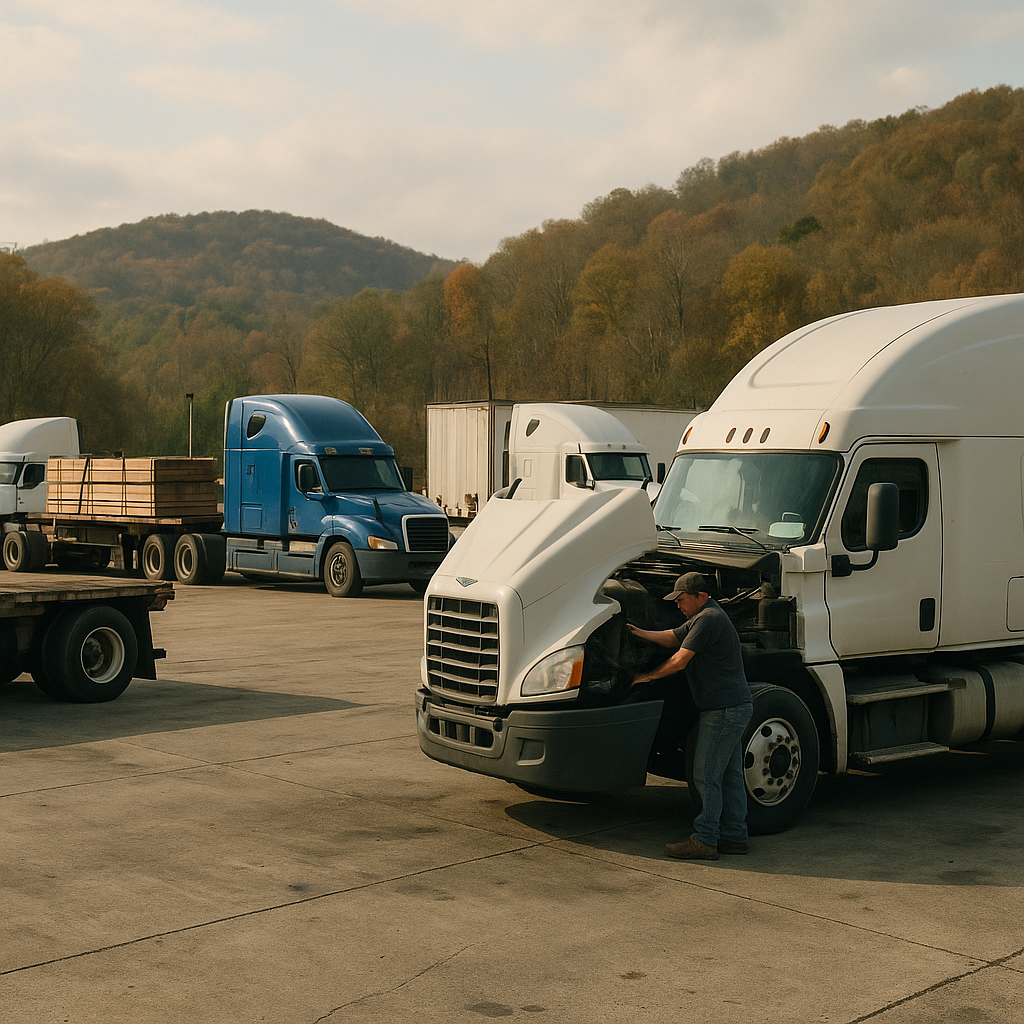

Flatbed trucking insurance in Tennessee usually means a commercial trucking policy built for hauling freight, not a personal auto policy with a business-sounding label. If you run a flatbed as an owner-operator or small fleet, the real job is matching coverage to your cargo, truck, operating radius, and whether Tennessee rules, FMCSA rules, or both apply.
What Flatbed Trucking Insurance Covers#
Flatbed trucking insurance in Tennessee is a group of commercial coverages that protect your truck, your legal liability, and in some cases the freight you haul. For most flatbed owner-operators, the core policies are auto liability, motor truck cargo, physical damage, and sometimes general liability, depending on how the operation is set up.
Flatbed trucking insurance means commercial insurance written for a truck used to haul freight on an open-deck trailer. That open-deck setup changes the risk compared with a dry van because the load is more exposed to weather, theft, shifting, and securement problems.
Core policies for flatbed operations#
Auto liability pays for injuries or property damage you cause to others in a covered accident. This is the coverage tied most directly to FMCSA and state financial responsibility rules.
Motor truck cargo covers the freight you’re hauling, subject to the policy terms, exclusions, and limit. If the question is "does this protect the load," cargo is the coverage you’re looking at.
Physical damage covers damage to your truck from collision and non-collision causes like fire, theft, or some weather events, depending on the policy form. For a financed truck, this is often required by the lender.
General liability covers some non-driving business exposures, such as certain bodily injury or property damage claims that don’t come from operating the truck on the road. It isn’t a substitute for auto liability.
What makes flatbed risk different#
Flatbed freight sits out in the open, so underwriters look closely at what you haul and how it’s secured. Steel, lumber, machinery, and building materials can bring a different claim profile than palletized dry freight.
A tarp failure, securement issue, or theft at a stop can turn into a claim fast. That’s why flatbed operators need to compare not just the premium, but the actual policy scope for cargo, deductibles, exclusions, and how the operation is classified.

Do You Need Commercial Insurance for a Flatbed Truck?#
If you use a flatbed truck to haul freight for business, you generally need commercial trucking insurance, not personal auto coverage. Personal auto policies usually exclude business hauling, and they aren’t designed around trucking risks like freight liability, operating authority, or commercial vehicle use.
A flatbed hauling loads for hire is commercial use. That sounds obvious, but plenty of owner-operators still get tripped up because a truck might be registered personally, driven home, or used only part-time.
Personal auto vs. commercial use#
A personal auto policy is insurance written for private, non-business driving. In most cases, once you’re hauling freight, pulling a trailer for business, or operating under trucking authority, you’re outside what a personal auto policy was meant to cover.
That matters most at claim time. A policy that looked cheaper upfront can become useless if the insurer says the truck was being used for commercial hauling and the loss falls outside the policy.
If you’re unsure whether your setup is correctly classified,
Who needs a policy built for trucking#
Owner-operators under their own authority, leased operators with specific insurance obligations, and small fleets running flatbeds all need coverage scoped to the real operation. That means the insurer needs the right carrier type, the right vehicle weight, the right cargo class, and the right interstate or intrastate footprint.
A local Tennessee operation may have a different insurance setup than an interstate flatbed carrier crossing multiple states. The mistake is assuming one generic "commercial auto" policy covers every trucking use case. It doesn’t.
Tennessee Requirements vs. FMCSA Requirements#
Tennessee rules and FMCSA rules are not the same thing, and mixing them up causes a lot of bad insurance decisions. Tennessee may have its own registration, licensing, and proof-of-insurance expectations, while interstate for-hire carriers must also meet federal financial responsibility rules based on operation type, vehicle weight, and cargo.
The clean way to think about it is simple: state rules govern state-level operation issues, and federal rules kick in when your operation falls under FMCSA authority. Your state minimum is not automatically your federal minimum.
State rules for operating in Tennessee#
Tennessee operators should check the Tennessee Department of Commerce and Insurance and the State of Tennessee for current state-level insurance, registration, and licensing expectations. Depending on how you operate, you may need to satisfy state proof-of-insurance or vehicle filing requirements in addition to any federal obligations.
If you only look at Tennessee registration paperwork, you can miss a federal requirement. The reverse is also true: having federal filings handled doesn’t mean every state-level step is covered automatically.
Federal requirements for interstate carriers#
The FMCSA is the Federal Motor Carrier Safety Administration, the agency that regulates interstate commercial motor carriers. Under FMCSA rules and 49 CFR Part 387, for-hire interstate carriers hauling general freight in vehicles over 10,001 lbs must carry at least $750,000 in public liability.
That number is not universal for all truckers. Under 49 CFR Part 387, minimum financial responsibility depends on carrier type, weight, and commodity. For example, carriers under 10,000 lbs can fall under a different threshold, auto haulers generally need more, and certain hazmat operations require much higher limits.
BIPD means bodily injury and property damage liability, the core public liability exposure federal rules address. MCS-90 is the endorsement used to show proof of financial responsibility for certain federally regulated motor carriers.
If you’re applying for or running interstate authority, the U.S. DOT and FMCSA materials are the right source, not a forum post or a driver’s shorthand. That’s also where you’ll see related authority terms like USDOT number, which identifies a commercial carrier, and MC number, which is tied to certain operating authority.
Key Coverages Flatbed Owners Should Compare#
Flatbed owners should compare auto liability, motor truck cargo, physical damage, and general liability based on what each one actually protects. Cargo covers the freight, physical damage covers the truck, auto liability covers damage you cause to others, and general liability can cover some business exposures away from the driving risk.
The easiest way to avoid buying the wrong policy is to ask one question for each coverage: what problem does this fix if something goes wrong?
Auto liability#
Auto liability protects you when your truck causes bodily injury or property damage to someone else in a covered accident. For many operators, this is the policy that satisfies the core legal requirement to be on the road.
For a Tennessee flatbed carrier running interstate, the required minimum depends on the operation under 49 CFR Part 387. Many owner-operators still choose higher limits when shippers, brokers, or contracts require them.
Motor truck cargo#
Motor truck cargo protects the freight you’re hauling, subject to the policy limit and exclusions. If a load of steel, lumber, or machinery is damaged, stolen, or affected by a covered event, this is the policy that may respond.
Flatbed cargo deserves extra scrutiny because open-deck loads face weather, theft, and securement-related exposure. Not every cargo policy treats every commodity the same, so the exact freight class matters.
Physical damage#
Physical damage protects your insured truck from collision and other covered losses. In trucking, that usually means collision plus comprehensive or fire and theft with combined additional coverage, depending on the policy design.
This is separate from cargo. If the truck is wrecked but the freight is fine, you’re looking at physical damage, not cargo.
General liability#
General liability covers some non-auto business exposures, such as certain premises or operations claims that don’t arise from driving the truck. For-hire trucking operations sometimes need it because a shipper, terminal, or contract asks for it.
It doesn’t replace auto liability, and it doesn’t cover the load itself. It matters most when your operation touches customers, yards, or business activities beyond simply driving from pickup to delivery.
How Flatbed Insurance Cost Is Usually Determined#
Flatbed trucking insurance in Tennessee doesn’t have one standard price because underwriters rate the operation, not just the truck. Your actual premium depends on your cargo, driving history, truck specs, routes, authority status, limits, deductibles, and how the insurer views that risk class.
That’s why two flatbed owner-operators with similar tractors can get very different quotes. The load profile and operating details often matter as much as the equipment.
Cargo and freight type#
Commodity drives a big part of flatbed risk. A carrier hauling machinery or steel may look different to an insurer than one hauling lighter building materials or mixed freight.
Some freight classes bring higher theft exposure, higher damage severity, or more securement concerns. If the quoted cargo class doesn’t match what you really haul, the quote may be misleading from day one.
Driving record and operating history#
Loss history, CDL experience, authority age, and prior violations all affect pricing. A new venture flatbed operator often faces a different market than a seasoned owner-operator with clean history and stable lanes.
Insurer appetite matters too. One carrier may be comfortable with a certain flatbed profile while another may price it aggressively or decline it outright.
Truck specs and radius of operation#
The year, value, and type of truck influence physical damage and overall risk. So does your operating radius, where you park, and whether you stay mostly intrastate or run interstate lanes.
Longer radius usually means more exposure hours, more road conditions, and more claim opportunities. A quote built on local hauling assumptions can fall apart if you actually run regional or multi-state freight.
Deductibles and limits#
Higher limits can increase premium, and higher deductibles can shift more of the loss back onto you before insurance pays. The right setup depends on your contracts, truck value, cash flow, and tolerance for out-of-pocket loss.
The important thing is not chasing a thin quote that only looks good because the scope is smaller. If you’re sorting through flatbed quote options and not sure what’s actually comparable,
How to Think About Cargo Coverage for a Flatbed#
Cargo coverage for a flatbed is meant to protect the freight you haul, but the right limit depends on the value of the loads you actually carry and what your contracts require. A $100,000 cargo limit can be appropriate for some flatbed operations, but it is not automatically the right answer for every Tennessee carrier.
The better question is not "how much does $100,000 cargo cost" by itself. It’s "does that limit match my freight exposure?"
What cargo coverage is for#
Cargo insurance responds to covered loss or damage involving the load, subject to the policy wording. That can matter if freight is stolen, damaged in transit, or affected by a covered incident.
For flatbeds, the nature of the freight matters a lot. Open-deck hauling creates more exposure to rain, wind, debris, theft, and load movement than enclosed freight operations.
How to size a cargo limit#
Start with the maximum value of a typical load, not the average cheap load you hauled last month. Then check broker and shipper contracts to see whether they require a certain cargo limit.
If you regularly haul freight that can spike above your stated limit, the lower-cost option may not be a real fit. The cheapest-looking cargo line on a quote can become a contract problem or a claim problem fast.
Common flatbed cargo pitfalls#
Flatbed claims often turn on what was hauled, how it was secured, and what the policy excludes. Weather exposure, theft at a stop, tarp failures, and securement-related losses can all become coverage disputes if the policy and the operation don’t line up.
That doesn’t mean cargo is optional. It means the commodity description, limit, and policy terms need to be checked carefully before you bind.
How to Compare Flatbed Quotes Without Buying the Wrong Policy#
The best way to compare flatbed trucking insurance in Tennessee is to compare policy scope first and premium second. A quote is only useful if the authority type, cargo class, operating radius, truck value, and required certificates all match your real operation.
A lot of bad trucking policies aren’t "bad" on paper. They’re just built on the wrong assumptions.
Questions to ask before quoting#
Before you shop, gather the basics:
- Whether you’re for-hire or private
- Whether you operate interstate or intrastate
- Your USDOT and MC status, if applicable
- Truck year, value, and VIN
- Trailer type
- Main commodities hauled
- Typical radius and states run
- Desired cargo limit
- Loss runs and driver history
You can also verify carrier status and authority information through FMCSA SAFER. SAFER is FMCSA’s public system for checking carrier registration and operating status.
Common coverage gaps to watch for#
Watch for quotes built on the wrong cargo class, the wrong radius, or the wrong authority type. Those mistakes can affect premium, filings, eligibility, and claim handling.
Also check whether physical damage is included if you need it, whether cargo limits match contract requirements, and whether certificates can be issued the way your brokers or shippers expect. An incomplete quote can look competitive right up until dispatch asks for something the policy doesn’t support.
When a cheaper quote is actually incomplete#
If one quote is much lower, find out what’s missing before you celebrate. It may have a lower cargo limit, a narrower commodity class, no physical damage, a higher deductible, or assumptions that don’t match how the truck really runs.
The right comparison is apples to apples: same operation, same limits, same deductibles, same endorsements, same filings. If you’re not sure what coverage fits your operation, LogRock can help you scope it.
FAQ: Flatbed Trucking Insurance in Tennessee#
How much is flatbed insurance?#
Flatbed insurance pricing varies based on the operation, not just the truck. Insurers usually look at the cargo you haul, the truck and trailer setup, your driving history, how long you’ve held authority, your operating radius, and the limits and deductibles you choose. A Tennessee flatbed owner-operator hauling steel interstate can price very differently from a local intrastate operator hauling lighter building materials. The useful way to compare cost is to quote the exact operation profile, then compare scope and exclusions instead of chasing one blanket number.
Do you need commercial insurance for a flatbed truck?#
If the flatbed is used to haul freight for business, you generally need commercial trucking insurance. Personal auto usually isn’t built to cover commercial hauling, business use, or trucking-specific exposures like cargo, filings, or authority-based liability requirements. That applies whether you’re running under your own authority or operating in another business arrangement with commercial obligations. For Tennessee operators, the policy should match how the truck is really used, including cargo type, vehicle weight, and whether the operation is interstate or intrastate.
How much does $100,000 cargo insurance cost?#
The cost of a $100,000 motor truck cargo limit depends on what you haul, how often you haul it, your claims history, your operating territory, and the insurer’s appetite for that freight class. Flatbed cargo can price differently than enclosed freight because the load is more exposed to weather, theft, and securement-related damage. The smarter move is to choose a cargo limit based on the value of your typical and maximum loads, plus any broker or shipper requirements, then compare quotes built on the same commodities and policy terms.
What are the requirements for commercial insurance in Tennessee?#
Tennessee requirements depend on the operation, and they don’t automatically replace FMCSA requirements. A Tennessee carrier may need to satisfy state registration, licensing, or proof-of-insurance expectations through the appropriate state agencies, while an interstate for-hire carrier must also meet federal financial responsibility rules under FMCSA. For example, under 49 CFR Part 387, for-hire interstate general freight carriers over 10,001 lbs must meet at least the applicable federal public liability minimum. The right answer depends on whether you’re for-hire or private, interstate or intrastate, and what cargo you haul.





