
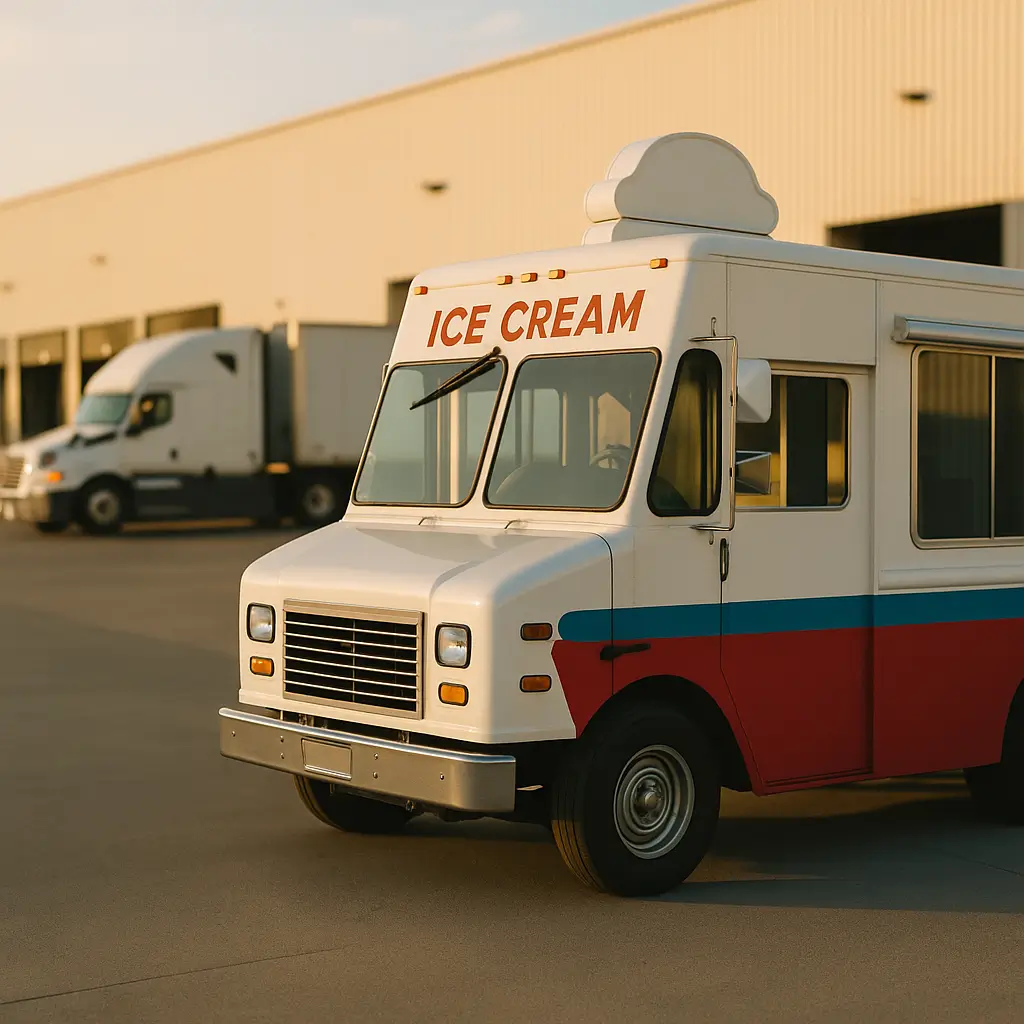
Learn 7 essential ice cream truck insurance coverages, 2026 costs from $150–$400 per month, permit and COI needs, useful add-ons, and ways to save.

Ice cream truck insurance usually means a bundle of commercial auto plus general liability (often including product liability), with common add-ons like equipment breakdown/spoilage and property coverage for mobile gear. Most operators planning for 2026 land around $150–$400 per month, depending on drivers, territory, truck value, and limits.
If your freezer quits on a 95° day, you don’t just lose product—you lose the whole day’s sales. If a kid darts into your blind spot during a curbside stop, you’re facing an auto claim that can get expensive fast. Start with the foundation—commercial auto, not personal auto—and build from there. For the baseline, see how commercial auto insurance is structured for business vehicles.
Table of Contents
Reading time: 8 minutes
- What Is Ice Cream Truck Insurance (and how it differs from food truck insurance)
- The 7 Coverages Most Ice Cream Truck Operators Need
- How Much Does Ice Cream Truck Insurance Cost in 2026?
- Permits, COIs, and Add-Ons: How to Stay Compliant
- Frequently Asked Questions
- Conclusion: Build a permit-ready insurance checklist
What Is Ice Cream Truck Insurance (and How It’s Different From Food Truck Insurance)
Ice cream truck insurance is a set of commercial policies—typically including commercial auto and $1,000,000 general liability—built for a vehicle that drives, parks curbside, and sells refrigerated products to the public.
Ice cream trucks are stop-and-go, neighborhood-heavy, and often operate around children, which increases driving and pedestrian exposure compared to many other vendor setups. The inventory risk is also different: your revenue depends on refrigeration working every minute you’re out.
Ice cream truck vs. food truck risk profile
Food trucks often have higher kitchen and cooking exposure; ice cream trucks often have more driving stops and higher dependence on cold-chain equipment. A “food truck” policy can be a useful starting point, but you’ll want to confirm the add-ons that actually match your operation.
If you want a broader comparison point, review food truck insurance and then tailor the coverages to frequent stops, local routes, and freezer/generator risk.
Why personal auto usually isn’t enough
Personal auto policies commonly exclude vehicles used primarily for business, including selling products and making repeated commercial stops. That’s why most operators treat commercial auto as non-negotiable for permits, lenders, and claim protection. See commercial auto insurance vs. personal for a full side-by-side comparison.
The 7 Coverages Most Ice Cream Truck Operators Need
The 7 coverages most ice cream truck operators buy are commercial auto, general liability (often with product liability), property/inland marine, workers’ comp, equipment breakdown plus spoilage, and umbrella, and many permits or events require proof before you can sell.
Not every business needs every item, but these are the pressure points that show up in real claims: curbside accidents, third-party injuries, food/allergen allegations, theft/vandalism, employee injuries, and freezer failures.
Quick coverage table (use this when comparing quotes)
| Coverage | What it protects | Common claim triggers | Where it usually shows up |
|---|---|---|---|
| 1) Commercial auto | Your liability on the road + damage to the truck | Fender-bender, backing accident, parking-lot hit | Required for driving; often required by lenders |
| 2) General liability | Third-party injury/property damage | Slip at the serving window, damage at an event | Permits, events, school contracts |
| 3) Product liability | Food/allergen-related claims | Illness allegation, allergen cross-contact | Often included with GL—confirm it |
| 4) Property / inland marine | Mobile equipment + sometimes inventory | Theft/vandalism, damaged equipment | Useful when gear moves and is stored offsite |
| 5) Workers’ comp | Employee injuries | Burn, slip, lifting injury | Often required once you hire |
| 6) Equipment breakdown + spoilage | Freezer/generator failures + inventory loss | Mechanical/electrical breakdown, power loss | Ice-cream-specific; big ROI coverage |
| 7) Umbrella / excess liability | Higher limits above GL/auto | Severe injury claim, high-limit contract | Schools, municipalities, larger events |
1) Commercial auto (liability + physical damage)
Commercial auto pays for injuries and property damage you cause while operating the truck, and it can also cover physical damage (comprehensive/collision) to repair or replace your truck after a covered loss.
Personal auto often excludes business use, especially when the vehicle is used to sell products and stop repeatedly in public areas. For a neutral consumer definition, the NAIC’s overview of commercial auto is a solid reference: NAIC commercial auto insurance overview.
2) General liability (GL)
General liability covers third-party bodily injury and property damage claims that aren’t “auto accidents,” such as a customer tripping at your serving window or damage you cause at an event.
Many venues commonly ask for $1M per occurrence / $2M aggregate (requirements vary), and they’ll want proof before you show up. To avoid buying the wrong thing, read general liability insurance and compare it line-by-line to the quote you’re reviewing.
3) Product liability (food/allergen claims)
Product liability protects you if someone alleges your product caused illness or injury (including allergen issues), subject to policy terms and exclusions.
Even if you only sell prepackaged items, you’re still responsible for storage temperature, handling, and service. The most important detail is whether product liability is included inside GL or requires a separate endorsement.
4) Property or inland marine (mobile gear)
Inland marine/property coverage can insure mobile business property like your POS system, signage, small equipment, and sometimes inventory while in transit or away from a fixed location.
Ice cream truck businesses are mobile by design, so theft, vandalism, and accidental damage can happen away from a “home base.” If you keep extra supplies offsite (garage, commissary, storage unit), ask how the policy treats property in each location. For a broader look at protecting mobile business gear, see mobile vendor insurance.
5) Workers’ compensation (if you hire)
Workers’ compensation pays for employee medical costs and partial wage replacement after a work-related injury, and most states set requirements based on having employees (sometimes as low as one), as outlined by the Small Business Administration’s guidance on business insurance.
If you have a driver/helper, the exposure is real: slips on wet pavement, burns, lifting injuries, and vehicle-related incidents while working.
6) Equipment breakdown + spoilage (ice-cream-specific)
Equipment breakdown can help pay to repair/replace a freezer or generator after a covered mechanical/electrical failure, and spoilage can help cover lost inventory when temperature control fails (subject to policy terms).
This is where many “cheap” policies fall short. A freezer failure can wipe out inventory and kill the day’s revenue during peak season, so it’s worth pricing the add-on even if you’re shopping for the lowest premium.
7) Umbrella/excess liability (when limits must be higher)
Umbrella liability adds extra limits above your underlying general liability and/or auto liability when a contract requires higher limits or when you want more protection for severe claims.
Schools, cities, and large events sometimes require higher limits than your baseline provides, and a serious injury claim can exceed $1M quickly. If you’re event-heavy, umbrella is often the easiest way to hit higher requirements without rebuilding every underlying policy.
How Much Does Ice Cream Truck Insurance Cost in 2026?
Ice cream truck insurance cost in 2026 commonly falls around $150–$400 per month (about $1,800–$4,800 per year) for many operators, with higher prices for multiple drivers, event-heavy schedules, higher limits, or higher-value trucks.

If you’re weighing where to trim cost first, cheap food truck insurance breaks down similar savings levers for mobile vending operations.
Three real-world pricing scenarios
- Scenario A (solo, local neighborhoods, clean MVR): Often closer to the low end if limits are standard and equipment value is modest.
- Scenario B (seasonal helper/second driver + weekend events): Often higher due to added driver exposure and endorsement/COI needs.
- Scenario C (schools/municipal contracts + umbrella): Often highest because higher limits and contract endorsements increase the carrier’s risk.
What changes the price the most (so you can manage it)
Underwriters typically price commercial vehicle policies based on drivers, territory, use, vehicle value, and limits. These are the levers you can actually control.
- Drivers: MVR, age/experience, prior claims, number of drivers
- Truck value & build: modifications, replacement cost, theft exposure
- Territory & use: garaging ZIP, annual miles, stop frequency, neighborhoods vs. events
- Limits & endorsements: higher auto/GL limits, umbrella, additional insured requirements
- Seasonality & lapses: coverage lapses can raise future rates and reduce options
If you want a practical cost-control framework that also applies to many commercial vehicle policies, use affordable trucking insurance for tactics like deductible strategy, driver controls, telematics, and comparing quotes apples-to-apples.
Permits, COIs, and Add-Ons: How to Stay Compliant (and Avoid Paying for the Wrong Stuff)
A Certificate of Insurance (COI) is a one-page proof of coverage that typically must show your policy dates and limits (often $1M/$2M for general liability) and any required endorsements like “Additional Insured” before cities, schools, and events will approve vending.
Operators lose more money from delayed permits and rejected paperwork than from the premium itself, especially during peak season. The fix is simple: get the exact requirements in writing and match your COI wording before you bind coverage.
COI basics: what cities, schools, and events commonly ask for
A COI can be “correct” and still get rejected if the certificate holder name, address, or endorsement wording is wrong. Don’t guess—ask the organizer for their template wording if they have it.
- Certificate holder: Exact legal name of the city/event/school + address
- Dates/location: Event dates, times, and venue address (if required)
- Limits: Required GL and auto limits (common: $1M per occurrence / $2M aggregate)
- Endorsements: Additional insured, primary & non-contributory, waiver of subrogation (if requested)
- Special wording: Any language the organizer provides
For the plain-English version of certificates and endorsement terms, use the certificate of insurance (COI) guide.
Specialized add-ons worth pricing for ice cream trucks
You don’t need every add-on, but these are common gaps for seasonal, cash-heavy, or event-based operations.
- Equipment breakdown / refrigeration exposure: Freezer/generator failures
- Spoilage: Inventory loss after covered temperature/power events
- Hired & non-owned auto (HNOA): When staff use personal cars for supply runs
- Cyber: If you take cards through a POS system
- Employee dishonesty: If you handle significant cash
Compliance edge case: when federal rules might apply
Most ice cream trucks are local, but operators who cross state lines or meet certain commercial motor vehicle thresholds may need a USDOT number, and FMCSA provides a public checklist to confirm: FMCSA: Do I need a USDOT number?
How to lower premiums without creating dangerous gaps
Cutting limits, skipping equipment/spoilage coverage, or letting coverage lapse usually backfires after the first claim or permit request. These moves tend to reduce cost without punching holes in the policy.
- Raise deductibles strategically: Only if you can cash-flow a claim
- Control drivers: Fewer drivers, cleaner MVRs, written route/parking rules
- Use theft prevention: Secured parking, cameras, kill switch, inventory controls
- Bundle smart: Avoid duplicate coverage, but don’t leave common gaps
- Avoid coverage lapses: Lapses can reduce carrier options and raise rates
What to compare between providers (neutral checklist)
- Limits and deductibles: Confirm the numbers match contract requirements
- What’s actually covered: Especially equipment breakdown and spoilage terms
- Exclusions: Events, certain locations, or specific products
- COI turnaround time: How fast they issue certificates and endorsements
- Claims handling: Practical responsiveness for auto and liability claims
Frequently Asked Questions
Most ice cream truck insurance questions come down to four facts: commercial auto is the core policy for a vending vehicle, many venues want $1M/$2M liability proof on a COI, refrigeration adds equipment/spoilage exposure, and hiring staff can trigger workers’ comp requirements.
You typically need commercial auto plus general liability (often with product liability included), and many events require proof like $1M per occurrence / $2M aggregate on a COI before you can vend. Most operators also add equipment breakdown and spoilage because freezer or generator failures can wipe out inventory and sales in a single day. If you have mobile gear (POS, signage, tools), consider property/inland marine. If you hire a driver/helper, workers’ comp may be required by state law, and an umbrella helps when schools or municipalities require higher limits.
Yes — insurance and permits are separate requirements that usually overlap. Most cities require a vending or mobile food permit, a health department inspection because you are serving food or frozen product to the public, and often a background check if you operate near schools or parks. Your COI is typically one piece of that permit application, not a substitute for it. Check with your city clerk or health department for the full checklist before your first day on the road.
In 2026, many operators plan on roughly $150–$400 per month (about $1,800–$4,800 per year) for commercial auto and general liability with common add-ons, but pricing can rise with multiple drivers, event-heavy schedules, higher limits, or a higher-value truck. Your garaging ZIP, annual miles, stop frequency, claims history, and driver MVRs are major rating factors. The fastest way to avoid surprises is to compare quotes with the same limits, deductibles, and endorsements so you’re not comparing “cheap” coverage to “complete” coverage.
Many carriers offer seasonal or short-term options for businesses that only operate part of the year, which can be more cost-effective than paying for full active coverage year-round. Ask specifically about seasonal endorsements or lay-up coverage for the off-season, because letting a policy lapse entirely can raise your rates when you restart.
Personal auto insurance usually does not cover an ice cream truck because the vehicle is being used primarily for business (selling products, frequent commercial stops, and public vending exposure), and many personal policies exclude that use. Commercial auto is built for business vehicle liability, and it’s the policy type cities, lenders, and event contracts typically expect to see. If you want the plain-language breakdown of how business vehicle coverage is structured, review commercial auto insurance and compare it to your current personal policy exclusions.
Commercial auto liability generally still applies while the truck is parked and serving customers because it is part of normal business use, but coverage details vary by policy, so confirm whether “in use” includes stationary vending. General liability typically picks up injuries that happen at the serving window itself, such as a slip near the truck, which is why most operators carry both rather than relying on auto alone.
Ice cream trucks often need workers’ compensation as soon as the business has employees, and in many states the requirement can trigger with just one employee (rules vary by state and job classification). Even when it’s not strictly required, workers’ comp can protect your business from medical bills and wage-loss costs after common injuries like slips on wet pavement, lifting injuries, and burns. Check state rules before deciding to skip it based on assumptions.
Physical damage coverage under commercial auto typically covers theft of the truck itself if comprehensive coverage is included. Cash theft usually requires a crime or employee dishonesty endorsement, and general liability usually will not cover either. If you carry meaningful cash overnight or store the truck somewhere other than a secured lot, ask your agent specifically about theft and crime endorsements rather than assuming they are bundled in.
Conclusion: Build Your Ice Cream Truck Insurance Checklist and Compare Quotes
A permit-ready ice cream truck insurance setup typically starts with commercial auto and general liability, then adds refrigeration-focused coverage like equipment breakdown and spoilage when inventory loss would hurt your cash flow.
The biggest time-saver is paperwork: ask for COI requirements in writing, confirm additional insured wording, and make sure your limits match what the city, school, or event actually requires.
Key Takeaways:
- Baseline: Commercial auto + general liability/product liability are the core policies most operators need.
- Budget: A common 2026 planning range is $150–$400/month, with higher costs for extra drivers, higher limits, and event-heavy work.
- Ice-cream-specific gap: Freezer/generator failures are common, so price equipment breakdown and spoilage before you decide on a “cheap” policy.
If you’re getting an ice cream truck ready for the season and want to make sure your coverage actually holds up at permit time — commercial auto, general liability, and freezer/spoilage protection included — LogRock can walk through your route, equipment, and staffing to spot any gaps before a claim or a rejected COI does it for you.
Related reading: Hired & non-owned auto insurance can help if staff use personal cars for business errands.





