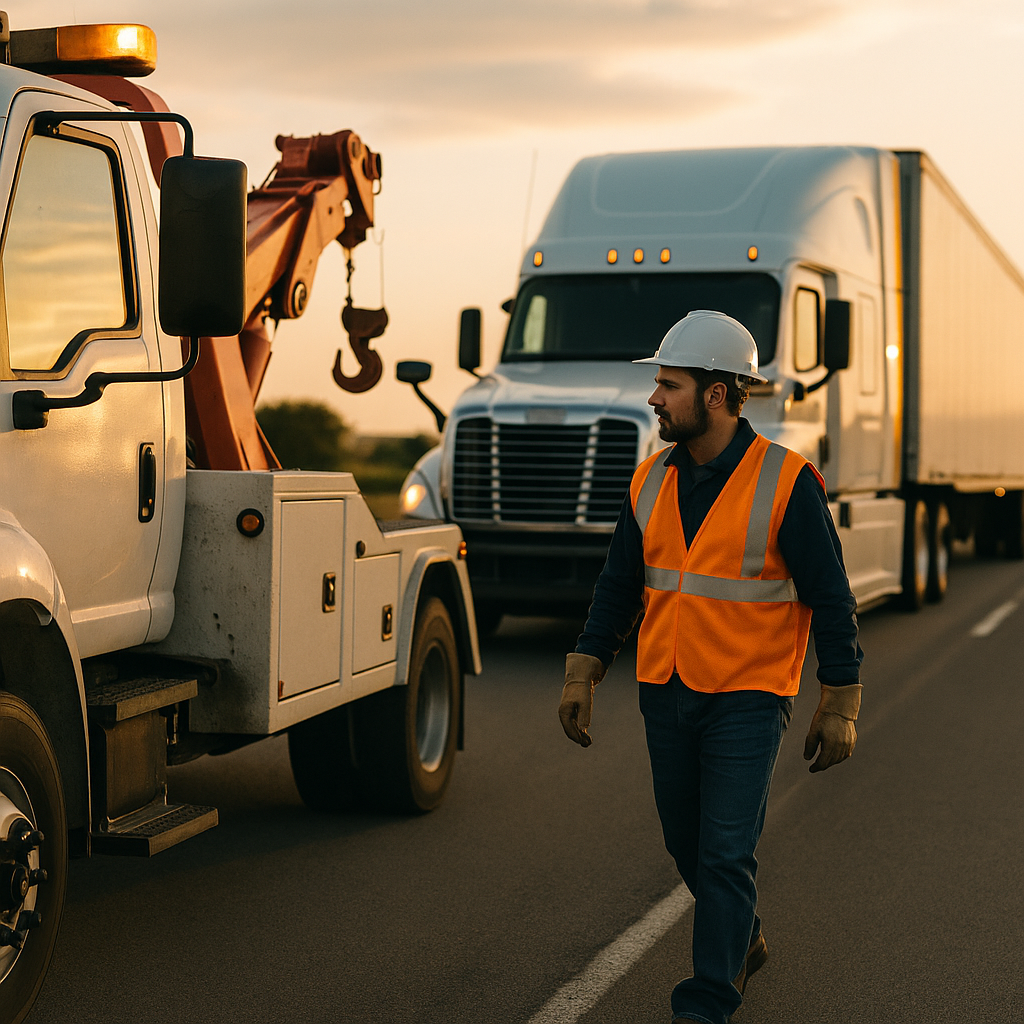

2026 road side assistance for semi trucks costs $300–$1,000+ per call and $2,500–$5,000+ for towing. Compare options—save the checklist.
Road side assistance for semi trucks in 2026 usually costs $300–$1,000+ for a typical service call, and $2,500–$5,000+ when it turns into a heavy-duty tow or recovery. That one number is why a breakdown can wipe out a week’s profit—especially with after-hours rates, rural travel, or a steer-tire situation.
If you want the towing side of the bill explained in plain English, start with this semi truck towing cost breakdown. This guide is built for owner-operators and small fleets who care about cash flow, uptime, and getting back under load.
Table of Contents
Reading time: 8 minutes
- Key takeaways
- What counts as semi-truck roadside assistance (and when to call)
- How much does roadside assistance for semi trucks cost in 2026?
- Response times: realistic ETAs, SLAs, and how to get help faster
- Choosing road side assistance for semi trucks: program types + dispatch tools
- Frequently Asked Questions
- Conclusion
👉 Prefer watching a quick video about semi truck insurance?
Watch the video below for a quick overview of semi truck insurance rules, how much it costs, and practical ways to save. Or give us a call: (704) 290-3630
Key takeaways
In 2026, most Class 8 roadside service calls cost $300–$1,000+, while heavy-duty towing or recovery commonly runs $2,500–$5,000+ before add-ons like winch-outs or storage.
- Budget reality: A basic call is often $300–$1,000+, and a heavy-duty tow commonly hits $2,500–$5,000+.
- Your bill is mostly travel + time: Rural lanes, nights/weekends, and specialized equipment multiply cost fast.
- A fast fix starts with a clean request: A GPS pin + tire size + symptoms can save hours.
- Pick a model that matches your lanes: Membership can make sense on remote routes; pay-per-use can win if you rarely break down.

What counts as semi-truck roadside assistance (and when to call vs limp to a shop)
Semi-truck roadside assistance is an on-scene dispatch service for common breakdown events (tires, jump starts, fuel delivery, lockouts, and minor air/electrical issues), while major failures often require a mobile mechanic or a heavy-duty tow/recovery.
Roadside isn’t “fix anything anywhere.” Most calls end in one of three outcomes: a quick on-shoulder fix, a limited repair attempt that needs parts, or a tow/recovery because it’s unsafe or not repairable on-scene.
Roadside vs mobile mechanic vs heavy-duty tow/recovery
- Roadside assistance: Dispatches a vendor for common events (tire help, jump, lockout, fuel, minor air/electrical).
- Mobile mechanic: Broader troubleshooting and repair capability, but still limited by parts, tools, and safe working conditions.
- Tow/recovery: Used when it’s unsafe or not repairable on-scene (steer tire failure, major air loss, coolant dump, drivetrain issues, wreck recovery).
If you want a deeper “what’s covered vs what’s extra” breakdown (plus a practical checklist), use this guide on semi truck roadside assistance.
2-minute call decision checklist (use this on the shoulder)
Call roadside now if:
- You’re on a narrow shoulder, blind curve, or unsafe area.
- You have a steer tire issue, active air loss you can’t isolate, or an engine derate you can’t clear.
- You see coolant, oil, or fuel leaking.
- You can’t guarantee the truck will roll safely to a shop.
Limp to a shop (only if safe/legal) if:
- It’s a minor issue you’ve isolated (example: small air leak you can temporarily cap).
- You’re close to a safe lot with a real repair option.
- You have HOS to work with and can keep it safe.
Dispatcher sanity-check: “Are you sending a service truck that can repair this onsite—or are we likely ending in a tow?”
How much does roadside assistance for semi trucks cost in 2026? (pricing table + what drives the bill)
Roadside assistance for semi trucks in 2026 commonly runs $300–$1,000+ per service call and $2,500–$5,000+ for heavy-duty tow/recovery, with after-hours, rural travel, and specialized equipment pushing totals higher.
Roadside feels expensive because it is expensive: you’re paying for urgency, travel time, and capability—often in places where qualified help isn’t close.
ATRI’s operational cost research is a useful reminder that repairs and maintenance are already a major line item in trucking, and roadside is the premium version of that problem (overtime + travel + downtime). Source: https://truckingresearch.org/operational-costs-of-trucking/
Typical 2026 price ranges by scenario
Ranges below reflect common market realities—not a quote. Location, after-hours rules, and equipment needs can swing the number.
| Roadside Event (Class 8) | Typical 2026 Range | What’s Usually Extra |
|---|---|---|
| Service call / dispatch + initial labor | $300–$1,000+ | After-hours multipliers, additional labor time |
| Tire service (repair attempt) | $450–$900+ | Tire itself (if replacement), roadside premium |
| Tire replacement (steer tire scenarios often highest) | $900–$1,800+ | Tire price varies, casing, disposal, extra labor |
| Jump start / battery-related call | $250–$700+ | Battery cost, diagnostics time |
| Fuel delivery | $250–$600+ | Fuel cost, after-hours, remote travel |
| Lockout | $200–$500+ | After-hours, complexity |
| Minor air/electrical repair (fittings, airlines, lights) | $350–$1,200+ | Parts, extended diagnostics |
| Heavy-duty tow or recovery | $2,500–$5,000+ | Winch-out, off-road, load shift, storage, mileage |
If you want cost ranges broken down specifically for heavy-duty service calls vs tow/recovery, use this cost-first page on heavy duty roadside assistance.
Why rural calls cost more (and what to expect)
Rural roadside calls cost more because vendor density is lower, travel time is longer, and parts availability is usually worse, which increases minimum charges and pushes more jobs into towing.
- Higher chance you pay a minimum (example: minimum hours + trip fee).
- Longer ETA (and sometimes multiple dispatch attempts).
- More calls turn into a tow because parts can’t be sourced quickly.
What drives the bill (simple cost model)
Most roadside invoices follow a basic formula: trip/dispatch + labor hours + equipment + mileage + parts + after-hours.
Diesel technician pay varies by region and experience, and roadside often adds paid travel and after-hours premiums on top of labor (BLS data is a baseline reference, not a roadside rate card). Source: https://www.bls.gov/oes/current/oes493031.htm
Do this before you authorize:
- Ask for ETA, hourly rate, minimum hours, and trip fee/mileage.
- Set a not-to-exceed amount unless they call you first.
- Require an itemized invoice (labor, travel, parts) and photos when it matters (like tire replacement).
Response times: realistic ETAs, SLAs, and how to get help faster
Real-world semi-truck roadside response times are typically 45–120 minutes in major corridors and can run 2–6 hours+ in rural areas, especially nights/weekends or when specialized recovery equipment is needed.
A “24/7” promise usually means 24/7 dispatch, not a qualified service truck parked 20 miles away.
What impacts response time (the stuff dispatch won’t say out loud)
- Vendor density: More vendors nearby = faster pickup.
- Weather and road conditions: Travel time and safety rules slow everything down.
- Time of day: Nights/weekends often mean fewer techs on call.
- Job complexity: Heavy wrecker, rotator, or recovery = longer scheduling time.
SLA questions to ask (before you pay or enroll)
- Do you publish average response times by region?
- If the first vendor can’t make it, do you escalate automatically to a second option?
- Do you offer live status updates (text/app) so you’re not guessing?
Safety + documentation while waiting (protect yourself and your record)
FMCSA regulations require commercial motor vehicles to carry emergency equipment, including warning devices, under 49 CFR §393.95, which matters any time you’re stopped roadside. Source: https://www.fmcsa.dot.gov/regulations/title49/section/393.95
Do this immediately:
- Get as far off the traveled portion as safely possible.
- Set triangles/warning devices and improve visibility.
- Take photos of the location, unit/trailer numbers, dash lights/codes, and any damage.
Keep invoices, call logs, and photos; if an incident turns into a claim or shows up in your safety history, documentation helps—especially when you’re thinking about DOT record and trucking insurance.
Choosing road side assistance for semi trucks (membership vs pay-per-use) + provider comparison + dispatch tools
Choosing road side assistance for semi trucks comes down to whether you want a membership model with defined benefits or on-demand pay-per-use pricing with more flexibility but higher volatility.
This is where you stop thinking like a driver buying convenience and start thinking like an operator buying uptime.
Membership vs pay-per-use (which fits your lanes)
Membership programs
- Best for: frequent long-haul, remote lanes, drivers who want one number to call.
- Watch-outs: per-incident caps, exclusions (recovery), reimbursement rules, trailer limitations.
Pay-per-use / on-demand
- Best for: low incident frequency, strong in-house maintenance, flexibility to choose vendors.
- Watch-outs: price volatility, after-hours premiums, inconsistent SLAs.
Provider models (7 common ways to get help)
| Provider Type | What You’re Really Buying | Best For | “Gotcha” to Ask About |
|---|---|---|---|
| On-demand app dispatch | Speed + convenience | Single trucks, mixed lanes | Vendor availability in rural areas |
| Nationwide dispatch network | Process + billing consistency | Small fleets | Itemized invoice transparency |
| Directory/marketplace | Choice | Experienced owner-ops | Vetting quality varies |
| Local tire/service vendors | Familiarity | Regional operations | After-hours coverage |
| Heavy wrecker operators | Capability | Recovery/towing | Storage fees + recovery add-ons |
| OEM/dealer programs | Brand-specific support | Newer equipment | Coverage limits by component |
| Insurance-related add-ons | Risk planning | Budget-focused ops | What’s covered vs reimbursed |
If you run hotshot, don’t assume the semi-truck plan fits you—trailers, loads, and operating radius change what “good coverage” looks like. Start here: Hotshot insurance guide.
Dispatch tools: copy/paste checklist (this speeds up service)
Save this in Notes on your phone and in your dispatcher’s playbook:
- 1) Exact location: highway + direction (NB/SB/EB/WB), nearest exit + mile marker, GPS pin, and safe staging notes.
- 2) Unit details: tractor + trailer type, tire size(s) and position (steer/drive/trailer; inside/outside dual), unit/trailer numbers.
- 3) Symptoms: air loss rate (fast/slow), isolation attempts, dash codes/derate, leaks/smoke, can it roll safely?
- 4) Money controls: ask hourly + trip/mileage + minimum hours + after-hours; set a not-to-exceed; require itemized invoice + photos of replaced parts.
Where trucking insurance fits into this (don’t miss the bigger money picture)
Roadside decisions can affect claims frequency, downtime, and how incidents are documented, which rolls into your broader insurance plan over time.
For a plain-English foundation on coverages and how they connect, bookmark Trucking insurance 101 (commercial truck insurance basics).
Frequently Asked Questions
The FAQ below answers common 2026 questions about road side assistance for semi trucks, including typical per-call costs ($300–$1,000+) and heavy-duty towing ranges ($2,500–$5,000+).
Most 2026 semi truck roadside assistance service calls cost $300–$1,000+ depending on travel, labor time, and after-hours rates, and heavy-duty tow or recovery commonly lands at $2,500–$5,000+ before add-ons. Costs climb fast with winch-outs, remote locations, rotator/rigging needs, storage, and mileage. If you want deeper ranges split between service-call pricing and tow/recovery pricing, start with heavy duty roadside assistance.
Semi truck roadside assistance typically includes dispatch for tire service, jump starts, fuel delivery, lockouts, and minor air/electrical repairs, while parts and major mechanical work are usually extra or not possible on-scene. The surprise for many drivers is that recovery work (winch-outs, rollovers, load shift, off-road pulls) is often excluded, capped, or handled by a different vendor category with different pricing. For a practical “what’s covered” breakdown and a checklist you can use before enrolling, see semi truck roadside assistance.
Semi-truck roadside response time is often 45–120 minutes in major corridors and can run 2–6 hours+ on rural routes, especially nights/weekends or when heavy recovery equipment is required. The fastest way to cut delay is to help dispatch send the right truck the first time: share a GPS pin, nearest exit + mile marker, exact tire size and position (steer/drive/trailer), and clear symptoms (air loss rate, dash codes, leaks). Also ask for ETA, minimum hours, and after-hours rate before you authorize work.
Some membership roadside programs cover heavy-duty (Class 8) trucks, but benefits are plan-specific and commonly limited by towing distance, dollar caps per incident, and exclusions for recovery (winch-outs, off-road pulls, load shift). Before paying, confirm four items in writing: (1) Class 8 towing limits, (2) recovery/winch-out rules, (3) whether the trailer is covered, and (4) whether claims are direct-pay or reimbursement. “Heavy-duty” in marketing language doesn’t automatically mean every tow and recovery scenario is covered.
Conclusion: Reduce downtime with the right plan + the right call process
Reducing roadside downtime usually comes down to two controllables: using a program that matches your lanes and calling in a clean, complete request that gets the right vendor dispatched first.
Save the checklist, ask rate/ETA questions before you authorize, and use a not-to-exceed limit so a “simple call” doesn’t turn into a surprise invoice.
Key Takeaways:
- Plan for $300–$1,000+ service calls and $2,500–$5,000+ tow/recovery scenarios in your budget.
- Cut delays by sharing a GPS pin, tire size/position, and clear symptoms on the first call.
- Protect yourself with an itemized invoice, photos, and a not-to-exceed authorization.
Related reading (cost control + fewer premium surprises): Affordable trucking insurance—how to save on coverage and Top mistakes that increase insurance costs.