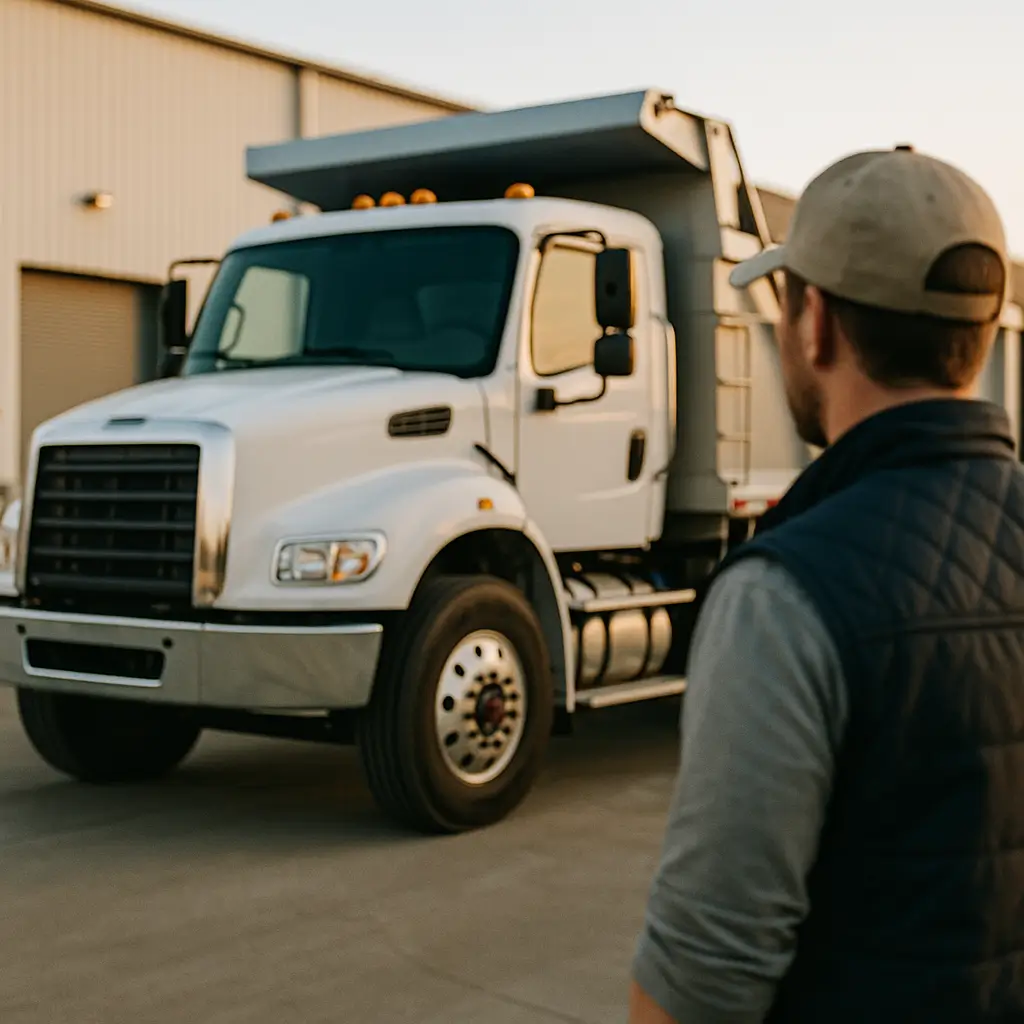
Dump truck insurance for personal use usually means a policy that accepts the truck’s weight class and dump body, often a commercial auto form rated for personal use. Physical damage coverage can be added to protect the truck itself. Occasional work use can create off-duty liability gaps.
Dump truck insurance for personal use usually requires a policy that accepts the truck’s GVWR/class and dump body—often a commercial auto form rated for personal use—plus physical damage if you want the truck protected.
If the truck also serves a motor carrier under a permanent lease, ask whether non-trucking liability applies during qualifying non-business use. It is not automatically the answer for an independently owned, personal-use-only dump truck.
To drive a dump truck for personal use, you typically need a policy that accepts the truck’s weight/class and dump body—often a commercial auto form rated for personal use—plus physical damage if you want the truck protected. For an eligible permanently leased owner-operator, confirm whether non-trucking liability covers the actual non-business trip; other personal or business operations need their own accepted primary coverage.
Key Takeaways: Essential Dump Truck Insurance for Personal Use
- Personal use doesn’t always mean “personal auto.” Dump bodies and higher GVWR often require a commercial-style policy form.
- Non-trucking liability isn’t automatic. It applies only to qualifying non-business use under an eligible arrangement; an empty truck or off-dispatch label alone is not proof of coverage.
- Your biggest risk is misclassification. One paid haul or jobsite activity can change what applies and trigger claim disputes.
- Buy coverage like a business owner. Pick limits to protect your assets and cash flow, not just the cheapest monthly number.
👉 Prefer watching a quick video about dump truck insurance?
Watch the video below for a quick overview of dump truck insurance rules, how much it costs, and practical ways to save. Or give us a call: (704) 290-3630
Table of Contents
Reading time: 8 minutes
- When a Dump Truck Is “Personal Use” (and why insurers still treat it like commercial)
- Do you need non-trucking liability for personal use of a dump truck?
- Coverage options for personal-use dump truck insurance
- Real-world scenarios: “Will insurance cover this personal use?”
- How much does dump truck insurance for personal use cost?
- State rules & registration: verify you’re classified correctly
- Buying the policy: questions that prevent denied claims
- Frequently Asked Questions
- Why Logrock (and how we define “affordable” trucking insurance)
- Conclusion: get your personal-use dump truck classified right
When a Dump Truck Is “Personal Use” (and Why Insurers Still Treat It Like Commercial)
“Personal use” for a dump truck typically means no hauling for hire, no business contract work, and no compensation (cash, check, or barter) tied to the truck’s trips.
You bought a dump truck for your own property projects—and it doesn’t insure like a half-ton pickup. In underwriting, the issue is often the vehicle class/GVWR, the dump body, and the severity of repairs (bed, hydraulics, frame, tires).
Typical personal-use scenarios
- Hauling gravel for your own driveway
- Moving dirt around your own land
- Driving to storage, a mechanic, or the wash
- Occasional hobby/project runs with no compensation
What commonly triggers “commercial” in the real world
- You get paid: Cash, check, Venmo, barter—payment still counts.
- Repeated “friend” jobs: Frequency looks like business use.
- Lettering: A business name/phone number on the door changes the story.
- Jobsite tie-in: Materials moved for a contract/job can be treated as commercial activity.
People hear “commercial auto” and assume it means “I’m a trucking company.” In insurance, it often just means the policy form that fits the vehicle (weight, body type, repair costs)—even if the declared use is personal.
Do You Need Non‑Trucking Liability for Personal Use of a Dump Truck?
Non-trucking liability (NTL) covers qualifying non-business liability for an eligible owner-operator permanently leased to a motor carrier. Coverage depends on the policy and actual trip, not simply being empty or off dispatch.
Sometimes NTL matters for a dump truck—but usually only in mixed-use or leased-on setups. For a strictly personal-use dump truck with no commercial work, NTL is often unnecessary because you should have a primary policy that already covers your stated personal use.
What non-trucking liability is (plain English)
NTL addresses qualifying liability to others during non-business use under an eligible leased-on arrangement. It does not replace primary liability, required filings or protection for damage to the dump truck itself.
Who actually needs it
- Mixed-use drivers: You sometimes use the truck commercially and still drive it for personal errands.
- Restricted primary policies: Your main liability has clear “working use only” language.
- Leased-on arrangements: Common owner-operator structure where the motor carrier’s policy may not cover off-duty trips.
Don’t rely on “I’m not hauling right now” as your definition of personal use. What matters is how your policy defines covered use, dispatch, and exclusions. For the cleanest real-life examples, read non-trucking liability insurance explained and compare it to your declarations page and endorsements.
Coverage Options for Personal-Use Dump Truck Insurance (What Each One Actually Protects)
A personal-use dump truck policy is usually built from five core lines: liability, physical damage (comprehensive/collision), UM/UIM, medical payments (or PIP), and—only in certain structures—non-trucking liability.
Whether the carrier calls it “commercial auto” or “heavy truck personal use,” the practical goal is the same: match the coverage to the truck’s class and how it’s actually used.
| Coverage | What it pays for | Common “gotchas” | Who should consider it |
|---|---|---|---|
| Liability | Injuries / property damage you cause | Limits too low for today’s verdicts | Anyone on public roads |
| Physical Damage (Comp/Collision) | Repair/replace your truck | Too-low deductible can spike premium | Anyone who can’t self-insure the truck |
| UM/UIM | If you’re hit by an uninsured/underinsured driver | State availability varies; limits matter | Anyone protecting medical + downtime exposure |
| Med Pay / PIP | Immediate medical payments (varies by state) | Not a substitute for UM/UIM | Owner-drivers and families |
| Non-trucking liability | Off-duty liability (specific setups) | Doesn’t cover business-like use | Mixed-use situations |
1) Liability (the must-have)
Liability coverage pays for bodily injury and property damage you cause to others, up to your policy limit.
Even “weekend-only” driving can produce a large claim. Pick limits based on what you own (home equity, savings, equipment), not just the minimum number on the quote.
2) Physical damage (comprehensive + collision)
Physical damage coverage pays to repair or replace your dump truck after collision losses and comprehensive losses (theft, fire, hail, vandalism).
Dump trucks are expensive to repair because the damage isn’t just sheet metal—bed components, hydraulics, frame alignment, and heavy tires add up quickly. If the truck is financed, lenders usually require this coverage.
3) UM/UIM (often overlooked, usually worth pricing)
Uninsured/Underinsured Motorist (UM/UIM) coverage helps pay when another driver causes the crash but has no insurance or not enough insurance to cover the loss.
If a passenger car hits you and carries only minimum limits, your medical costs and downtime don’t disappear. UM/UIM is often one of the best “value per dollar” lines on a heavy truck policy—especially if you’re protecting income and recovery time. For a deeper breakdown, see UM/UIM coverage in trucking insurance.
4) Picking limits that match your risk
Choosing limits is an asset-protection decision, not a price-shopping contest, because your out-of-pocket exposure is whatever sits above the policy limit.
If you want a practical way to decide, use choosing UM/UIM limits for trucking as a framework and apply the same thinking to liability and physical damage deductibles.
Real-World Scenarios — “Will Insurance Cover This Personal Use?”
Coverage on a personal-use dump truck claim is determined by the policy’s declared use, exclusions, and endorsements—not by your intent—so one “small” paid haul can change how a loss is handled.
Here’s a straight-shooting scenario map you can use to spot trouble before you’re stuck in a coverage investigation.
| Scenario | Likely covered?* | What coverage should respond | What to verify before you rely on it |
|---|---|---|---|
| You haul gravel for your own driveway | Usually yes | Liability + physical damage | Truck/class accepted; “personal use” documented |
| You help a friend move dirt “for free” | Maybe | Liability | Is volunteer work treated as business-like use? |
| You drive to the shop for repairs | Usually yes | Liability | Any radius or use restrictions? |
| You take $200 cash to haul one load | Risky | Depends on classification | Disclose it—misrepresentation can cause denials |
| Truck is lettered with a business name | Risky | Depends on underwriting acceptance | Get acceptance in writing |
*Varies by carrier and state, and by how your policy is written.
The pattern is consistent: claims don’t blow up because you meant to lie—they blow up because the policy doesn’t match reality.
How Much Does Dump Truck Insurance for Personal Use Cost?
Price context: The inherited ranges and scenario figures in this guide are planning illustrations, not a verified 2026 market survey or binding quote. Actual eligibility, coverage, deductibles and payment terms determine the written offer; do not assume every monthly figure equals an identical installment schedule.
Dump truck insurance for personal use is priced mainly by state, GVWR, truck value, garaging ZIP, driver MVR, annual mileage, and whether the carrier believes there’s any commercial exposure.
Costs vary a lot, but these ballparks help you sanity-check a quote (illustrative, per truck):
- Liability-only: often $75–$250/month
- Liability + physical damage: often $200–$700+/month
What moves the needle most
- GVWR/axle setup: single vs. tandem axle changes severity assumptions
- Truck value: and repair severity tied to the dump bed/hydraulics
- Annual mileage and radius: more time on road = more exposure
- Driver MVR + claims history: tickets and losses price in quickly
- Deductibles: too low can create “premium pain” for small losses
- Any hint of paid hauling: even “occasionally” can change eligibility
Two quick profiles (why the spread is big)
- Profile A: Older single-axle, limited miles, stored behind a gate → often lower end.
- Profile B: Newer tandem-axle, higher value, broader radius, parked street-side → often higher end.
For a closer look at what it takes to start and run a dump truck operation—including the insurance and compliance decisions involved—watch this step-by-step breakdown from LogRock:
State Rules & Registration — How to Verify You’re Classified Correctly (Without Guessing)
Registration class and declared GVWR can trigger commercial handling even when you claim “personal use,” so your insurer must match the policy to the truck’s legal classification and operating footprint.
This is where owners get tripped up: the DMV, the carrier, and the policy form don’t always use the word “commercial” the same way.
What to check before you bind
- How the truck is titled/registered: personal vs. commercial class
- Declared GVWR: and whether it matches the truck setup
- Crossing state lines: even occasional interstate trips can change compliance needs
- Local permits/weight rules: that apply to your operation and roads
If your use starts to look interstate/commercial, you’ll also hear about IFTA and IRP. These aren’t insurance products, but they sit in the same compliance ecosystem:
- IFTA basics for owner-operators
- IRP basics for owner-operators
- IFTA vs IRP: what applies and when
Bottom line: ask your agent/carrier to confirm (in writing) that the policy accepts (1) the dump body, (2) your stated use, and (3) your registration class.
Buying the Policy — Agent vs Direct, and the Questions That Prevent Denied Claims
Denied-claim situations most often come from mismatched use classification (personal vs business), undisclosed paid hauling, or a policy that doesn’t accept the dump body/GVWR—issues that an experienced agent can usually prevent upfront.
If your situation is truly simple (older truck, strictly personal use, local driving), direct may work. But dump trucks are specialty risks, so many owners do better with an agent who can place the vehicle correctly.
Agent is usually better when
- You’re near the line between personal and business use
- The truck is higher value or financed
- You want physical damage + UM/UIM built correctly
Direct can work when
- The carrier clearly accepts the dump body and weight class
- The use is clean and well documented
Copy/paste checklist (ask before you bind)
- Is the dump bed/body acceptable on this policy?
- How is my use classified on the declarations page—personal only or mixed?
- Are there exclusions for hauling materials (even my own)?
- Am I covered driving to storage/repairs?
- What’s excluded if I do one paid haul?
If you’re stacking coverages, think in systems—not single line items. The “build the right stack” mindset is laid out in integrated insurance solutions for trucking (building a complete policy), and the logic applies even when your dump truck is mostly personal use.
Does an empty dump truck automatically qualify for non-trucking liability?
An empty truck or an off-dispatch label does not establish non-trucking liability coverage. Progressive describes NTL for owner-operators permanently leased to a motor carrier during qualifying non-business use. A personal errand and a trip serving the carrier’s business are different exposures, even when neither trip carries a load. Confirm the actual policy and lease.
Progressive’s non-trucking liability description also says NTL does not protect the truck itself or qualify for federal or state insurance filings. A privately owned dump truck without that leased-on arrangement needs its own accepted primary-liability setup, not an assumption that NTL is a cheaper substitute.
Is dump truck insurance proof the same as a commercial driver’s license?
Insurance acceptance does not settle the driver’s license requirement. FMCSA’s CDL guidance applies to commercial operation and uses vehicle ratings or actual weights. A Class B commercial vehicle generally reaches the threshold at 26,001 pounds, including towing a vehicle not over 10,000 pounds. A heavy combination can instead trigger Class A requirements.
Check FMCSA’s driver-license classifications and the state licensing agency for the actual personal or business operation. Do not apply a commercial-use CDL rule to every private recreational trip, or assume that a personal-use insurance classification authorizes a driver to operate any weight class.
Frequently Asked Questions
No. A personal-use-only dump truck generally needs an accepted primary policy for the vehicle and disclosed use, not NTL as a substitute. Progressive describes NTL for eligible owner-operators permanently leased to a motor carrier during qualifying non-business use. An empty bed or off-dispatch label alone does not settle coverage. Review the actual lease and policy, and arrange physical damage separately if you want protection for the truck itself.
A heavy truck used personally is typically covered by a policy form that accepts the truck’s class/GVWR and body type—often a commercial auto form rated for personal use—plus physical damage (comprehensive/collision) if you want your truck protected. Liability covers injuries and property damage you cause, while physical damage covers your truck after collision, theft, fire, or hail. UM/UIM is also worth pricing because it helps when an uninsured or underinsured driver causes the crash. Coverage availability and UM/UIM rules vary by state, so confirm limits and endorsements before you rely on them.
Yes—many personal-use dump trucks are insured on commercial auto policy forms because the GVWR and dump body don’t fit standard personal auto underwriting rules. The critical requirement is that the declared use on the application and declarations page matches reality (personal only vs. mixed use), because a mismatch can trigger coverage disputes during a claim investigation. Before binding, get written confirmation that the carrier accepts the dump body, the truck’s class, and your actual driving pattern (radius/mileage). If you ever take paid hauling work—even once—disclose it immediately.
Often no—many personal auto carriers restrict heavy-duty trucks and commercial-style bodies such as dump beds, and some won’t write higher GVWR vehicles at all. Even if a policy is issued, underwriting rules can conflict with the actual vehicle type or use, which can create a dispute when a claim is filed. The safest approach is to confirm (in writing) that the policy accepts the dump body, the truck’s weight/class, and your stated use classification. If you want the truck protected, add physical damage and choose deductibles you can actually afford after a loss.
Personal-auto eligibility depends on the insurer, vehicle weight/class, dump body and actual use. Do not assume one universal GVWR cutoff applies to every carrier. Give the insurer the truck’s identification, rating, configuration and complete personal and business use, then obtain acceptance in writing. If a personal policy will not accept the vehicle, review a suitable commercial form or another eligible primary-liability solution rather than misclassifying the truck.
Coverage on your own private property typically applies for liability and physical damage if the policy doesn’t exclude it. Jobsite activity is a separate question. If the truck is at a jobsite connected to contract work—even informally—that could trigger a “commercial activity” exclusion. The word “jobsite” alone doesn’t void coverage, but compensation, a contract, or a pattern of work-related trips can change how a claim is handled. Before relying on your personal-use policy at any jobsite, ask your agent in writing whether that use is covered.
A single paid haul can void coverage for any loss that occurs during or after that trip if it wasn’t disclosed at policy inception. The underwriting issue isn’t frequency—it’s whether compensation was received. Carriers investigate claims closely when a truck’s declared use is “personal only,” and even a Venmo payment from a neighbor can come up during that process. If you’re considering occasional paid work, disclose it to your agent before the first job and get the correct coverage in place. Retroactive corrections after a loss rarely succeed.
Lenders typically require physical damage coverage (comprehensive and collision) on financed trucks, with the lienholder listed as an additional interest or loss payee on the policy. If you let physical damage lapse on a financed personal-use dump truck, the lender may force-place coverage at a higher cost—and force-placed coverage protects the lender’s interest, not yours. Check your loan agreement’s specific insurance requirements before choosing a deductible, and notify your lender when you bind coverage so they can confirm they’re listed correctly.
No. Progressive expressly says its non-trucking liability coverage does not qualify for federal or state insurance filings. NTL addresses qualifying non-business liability for an eligible owner-operator permanently leased to a motor carrier; it is not the primary liability solution for an independently operated truck. Ask which policy provides the required primary coverage and filings for your actual operation. An empty bed, personal errand or off-dispatch label alone does not establish that NTL applies.
Not by itself. Non-trucking liability concerns liability to others during qualifying non-business use, not physical damage to your truck. Progressive’s description expressly separates those exposures. Review collision and comprehensive or other applicable physical-damage coverage, the stated truck value, deductibles and accepted use with the insurer. Also confirm that the truck qualifies for the proposed NTL arrangement; buying physical damage does not cure an incorrect primary-liability classification or undisclosed hauling for pay.
No. An insurance classification does not determine your driving entitlement. FMCSA’s CDL guidance addresses commercial operation and uses the vehicle or combination rating and actual weight, with the applicable commercial Class B threshold at 26,001 pounds. Class A has a separate combination and towed-vehicle test. For genuinely private use, ask the state licensing agency which license and exemptions apply. Do not assume either that insurance replaces a license or that every private dump-truck trip automatically needs a federal CDL.
Why Logrock (and How We Think About “Affordable” Trucking Insurance)
“Affordable trucking insurance” means the lowest-cost policy that still pays claims for your real-world use, with limits that protect your assets and cash flow.
We think like operators because that’s what prevents bad surprises:
- Protect cash flow: downtime is expensive, even for “personal use” owners with projects to finish.
- Avoid paperwork mistakes: classification errors and missing endorsements cause most preventable problems.
- Match the policy to reality: the truck, the body, the GVWR, and what you actually do with it.
Whether it’s a dump truck for personal projects or a working truck that’s drifting into mixed use, the goal is the same: control risk so one bad day doesn’t wreck your plan.
Conclusion: Get Your Personal-Use Dump Truck Classified Right
The policy has to match the truck and the use. A dump body plus higher GVWR pushes many “personal-use” owners into commercial policy forms, and the gray areas (one paid haul, jobsite use, lettering) are where claim problems start.
Key Takeaways:
- Personal use ≠ personal auto for most dump trucks (GVWR and body type drive underwriting).
- Non-trucking liability is for specific mixed-use setups, not a universal add-on.
- Physical damage protects your truck; liability protects your assets.
- UM/UIM is often cheap compared to the damage an uninsured driver can cause.
If you want a clean quote, bring your GVWR, truck value, garaging ZIP, and a straight description of how you use the truck.
Related Reading: non-trucking liability insurance explained, UM/UIM coverage in trucking insurance, and IFTA vs IRP: what applies and when.
Whether your dump truck is strictly personal or starting to drift into mixed use, having the right policy classification prevents expensive claim disputes. LogRock works with owners who use heavy equipment for personal projects and can help you confirm coverage, close gaps, and get an accurate quote based on your truck and situation.