
Chameleon carriers MOTUS questions usually come down to one concern: can a legitimate owner-operator prove who they are when FMCSA records, authority details, or insurance filings change? MOTUS adds identity and business verification to registration work, but accurate documents still matter most. Learn what to check.
Start Here: FMCSA, MOTUS, USDOT Numbers, and MC Authority#
FMCSA is the federal agency that regulates motor carriers, while MOTUS is an FMCSA registration and identity-verification system. A USDOT number identifies a regulated carrier, and MC operating authority may apply to certain for-hire interstate operations. These are connected, but they are not the same thing.
What FMCSA does#
The Federal Motor Carrier Safety Administration, or FMCSA, is part of the U.S. Department of Transportation. It oversees federal motor carrier safety rules, carrier registration, operating authority, insurance filings, safety records, and related compliance programs.
FMCSA is not your insurance company or freight broker. It also does not decide every business dispute, cargo claim, or double-brokering allegation. Its job includes maintaining carrier records and enforcing the federal rules that apply to regulated operations.
What the MOTUS system does#
MOTUS is FMCSA’s registration-related system for identity and business verification. Its purpose is to make it harder for someone to submit registration actions using a false identity, a compromised account, or business information that does not match the carrier behind the record.
MOTUS is not a separate regulator, safety rating, insurance policy, or replacement for every FMCSA system. Follow current registration instructions from FMCSA instead of relying on old forum posts, screenshots, or secondhand advice. For a practical overview of authority steps, see this MOTUS MC registration guide.
What a USDOT number identifies#
A USDOT number identifies a motor carrier subject to FMCSA registration requirements. It ties the carrier to information such as its legal name, address, vehicle and driver counts, operating classification, and safety data.
A USDOT number is not proof that a carrier has active operating authority, active insurance filings, or permission to haul every kind of freight. It is one part of the carrier’s federal record.
When operating authority is separate from a USDOT number#
Operating authority, often called an MC number or MC authority, is federal authority that may be required for certain for-hire interstate carriers. A carrier can have a USDOT number without needing the same type of operating authority, depending on its operation.
That distinction matters when records change. A name update, ownership transfer, or new business entity can affect more than one record, so don’t assume updating one number updates everything else.

What a Chameleon Carrier Means in Trucking#
A chameleon carrier is a trucking business alleged to reappear under a new identity to avoid safety, enforcement, financial, or compliance consequences connected to an earlier operation. A new name, address, owner, or USDOT number alone does not prove a carrier is a chameleon carrier.
The basic definition#
The term “chameleon carrier” is commonly used when a carrier appears to shut down or leave behind a troubled record, then resume substantially the same operation under a different identity. The concern is not simply that a business changed. The concern is whether the change hides continuity that should have been disclosed.
For example, reviewers may look at whether there is substantial overlap in:
- Ownership or company management
- Trucks, trailers, drivers, or dispatch operations
- Business addresses, phone numbers, or contact information
- Operating history, safety history, and prior enforcement issues
Why reincarnation concerns matter#
A carrier record helps shippers, brokers, insurers, regulators, and the public understand who is operating trucks on the road. If a business can shed a poor record by repeatedly changing identities, it can make safety and accountability harder to track.
That is why identity verification matters. It is also why a legitimate operator should keep clean records showing who owns the business, where it operates, and what changed during a real transition.
What can create a legitimate business change#
Not every change is misconduct. Small trucking businesses change for normal reasons, including a new legal entity, an asset sale, a merger, an owner’s retirement, a family succession, or a documented change in ownership.
A carrier may also use a DBA, or “doing business as” name. A DBA is a business name used publicly that differs from the legal entity name. The key is that the carrier accurately discloses the relationship and keeps its records consistent.
Why a new number alone does not prove misconduct#
A new USDOT number is not automatic evidence of fraud, evasion, or a chameleon operation. The right question is whether the business facts are truthful and fully disclosed—not whether a number changed.
If the equipment, leadership, employees, address, and operations overlap with a prior carrier, FMCSA may reasonably need more context. If there was a legitimate purchase or properly documented separation, those records can explain the situation.
How MOTUS Is Intended to Address Fraudulent Registrations#
MOTUS is intended to make fraudulent registration actions harder by connecting the person making a change to verified identity and business information. Stronger verification can support FMCSA screening, but it cannot automatically prove a carrier is legitimate or eliminate fraud, double brokering, or unsafe operations.
Identity verification#
Identity verification confirms that a person seeking to access or update a carrier record is tied to a verified identity. Login.gov is a government sign-in service used across federal systems to help verify and secure account access.
That does not mean every person with Login.gov access can change any carrier’s record. FMCSA may require users to establish the proper relationship to the business and follow its current registration process.
Business verification#
Business verification focuses on whether the carrier information submitted lines up with the legal business behind the registration. This can include details tied to the entity, authorized officials, and business identity.
The practical goal is simple: make it more difficult to create, take over, or alter a motor carrier record with false information. If you are starting authority or updating carrier details, understand the registration steps before submitting a motor carrier number application.
Why linked records may receive closer review#
A new registration may receive closer attention when submitted information appears connected to another carrier record. Shared equipment, management, addresses, phone numbers, or prior business identities may be relevant, especially if the connection is not explained.
That is not a verdict. It is a reason to have documents ready before making changes. A rushed update with mismatched names and addresses can look very different from a documented ownership transfer with consistent records.
A registration delay can turn into a real business problem when your truck is ready, a load is waiting, and your authority or filing status does not match what a broker sees. If your ownership, authority, or insurance details are changing,
What MOTUS cannot decide on its own#
MOTUS does not replace freight-broker vetting, cargo-claim handling, or private due diligence. It also cannot guarantee that every carrier record is error-free or that every bad actor is stopped.
Double brokering, for example, is a freight transaction problem where a party accepts freight and improperly re-brokers it without authorization. Registration screening may help establish identities, but brokers and carriers still need their own verification practices before tendering freight or releasing a load.
Current MOTUS Transition Issues to Watch Without Assuming the System Is Failing#
During a transition to stronger verification, carriers may encounter account-access friction, identity-verification steps, or record mismatches across systems. An apparent mismatch does not automatically mean authority is lost, a record is fraudulent, or the MOTUS system has failed.
Verification and account-access friction#
Identity checks can take time, particularly when a business has recently changed names, owners, addresses, or authorized officials. Access problems may also happen when the person attempting the update cannot establish the required relationship to the carrier.
Do not respond by creating another application or a second identity just to get around the issue. That can create more conflicting records and make a legitimate explanation harder later.
Record mismatches across systems#
Carrier records may not match perfectly when one system has been updated and another system is still processing information. A legal name on a state record, insurance application, bank document, or FMCSA record may also differ because someone used a DBA, old address, or outdated entity name.
Start with the basics: identify the exact legal entity, compare the USDOT number and MC authority details, and find the date each record was last updated. Guessing about the reason for a mismatch does not fix it.
Why public status information may not update at the same time#
Public carrier information can reflect a different update cycle than the action you just submitted. An insurer’s filing process, a registration update, and a public record display may each have separate timing.
Use SAFER as an official public source for reviewing carrier identity and status information. Save what you see, including the date and time, instead of relying on a screenshot sent by a third party.
When to document and escalate a problem#
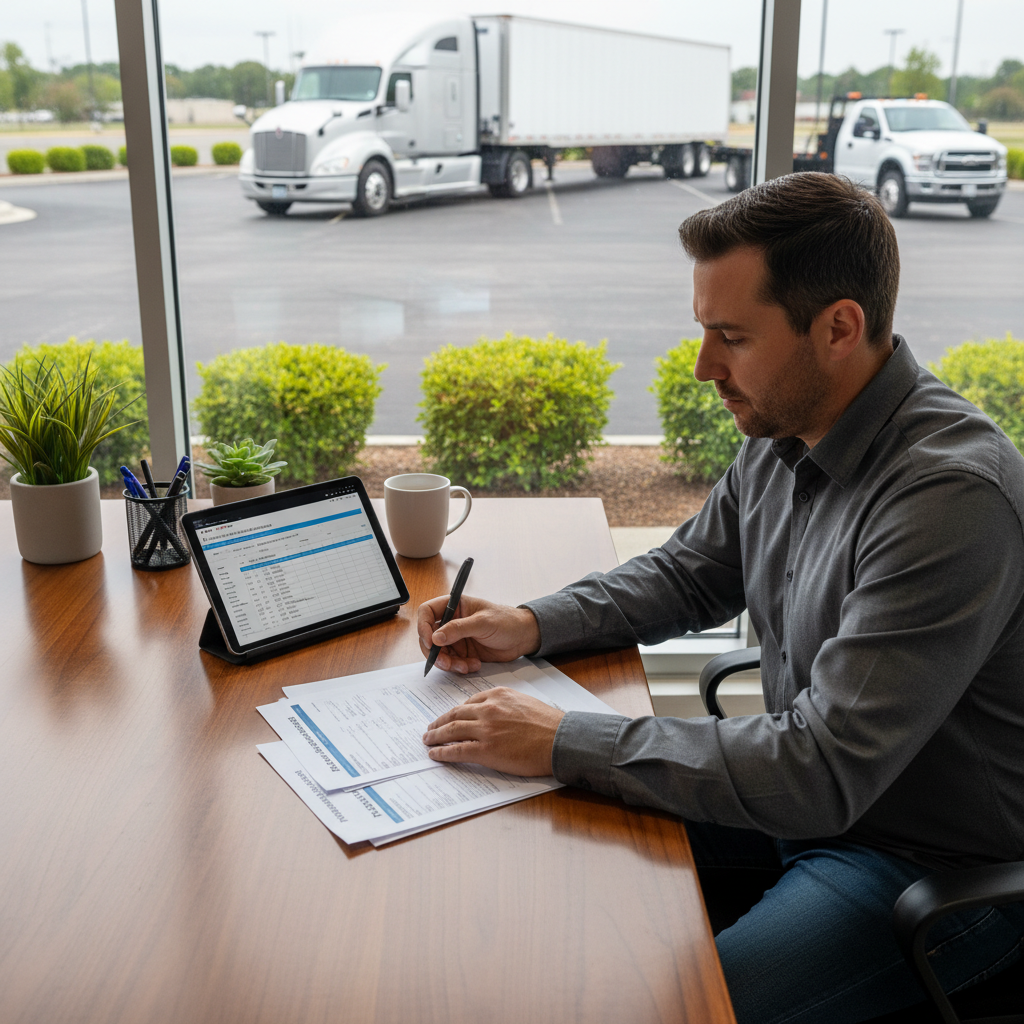
Keep a dated file with confirmation numbers, screenshots, submitted documents, emails, and notes from any registration-related conversation. That record helps you explain what was submitted, when it was submitted, and what information was in question.
Then follow the current FMCSA correction or support process. A documented issue is easier to resolve than a verbal description made weeks later from memory.
A Documentation Checklist for Legitimate Owner-Operators and Small Fleets#
Legitimate carriers can reduce identity-verification problems by keeping business, ownership, location, operations, and insurance details consistent before making registration changes. Your principal place of business should be a real operating location backed by records, not an address chosen only because it is convenient.
Confirm the legal business identity#
Start with the exact legal name of your business. If applicable, retain your entity formation records, EIN documentation, DBA registration, and state business information.
An EIN is an Employer Identification Number issued by the IRS to identify a business for tax purposes. Your FMCSA record, insurance application, bank documents, and state business information should not tell conflicting stories about who owns and operates the trucking company.
Document the principal place of business#
A principal place of business is the real location where the carrier maintains or can make available its required business records and conducts its operations. The recordkeeping concepts in 49 CFR Part 390 provide useful context for why accurate carrier information matters.
A mail drop or borrowed address may not tell the full story of where your business actually operates. Keep reasonable support for your legitimate location, such as lease records, utility records, business records, or other documents appropriate to your circumstances and current FMCSA instructions.
Keep ownership and authorized-official records current#
An authorized official is the person permitted to act for the business on registration matters. Keep ownership records, management details, and contact information current when a partner joins, an owner exits, or a company changes legal structure.
For a one-truck operation, this may seem obvious. But a mismatch can still happen when a spouse, dispatcher, accountant, or prior partner is listed in one place and not another.
Match operating details across filings and insurance#
Review these details before you submit a registration update:
- Legal business name and DBA, if used
- Physical and mailing addresses
- Ownership and authorized-official information
- USDOT number and MC authority details, where applicable
- Vehicle garaging location and operating radius
- Cargo, for-hire status, and interstate or intrastate operations
Keep prior documents during a legitimate transition. If you bought assets from another carrier or moved an existing business into a new legal entity, old records may help explain continuity without creating the false impression that you are hiding it.
Keep proof ready before making registration changes#
Do not submit documents FMCSA has not asked for. But do organize the records you may need before starting a change, then follow the current instructions for the specific action.
A documentation-first approach also protects you when someone asks why two records share an address, vehicle, or contact person. A clear, truthful explanation supported by dates is far better than trying to reconstruct the story after a problem appears.
When Multiple USDOT Numbers or Changing Business Details Need a Closer Look#
Multiple USDOT numbers or changing business details deserve a closer look when the carrier cannot clearly explain the legal entity, ownership, equipment, management, and operating history behind them. A number change is not the issue by itself; incomplete or inconsistent disclosure is the concern.
Situations that may be legitimate#
Several situations can create legitimate changes in a carrier record. A documented purchase may transfer equipment to a new owner. A business may form a new legal entity and properly update its records. Separate companies may share a building but maintain distinct ownership, equipment, employees, and operations.
A real ownership transition can also happen when a family member buys the business or takes over management. The paperwork should show what changed, when it changed, and whether the prior business is still operating.
Situations that may raise questions#
Closer review makes sense when a new carrier uses substantially the same trucks, leadership, drivers, address, and business contacts as a prior carrier without a clear explanation. Unexplained overlap does not establish misconduct, but it can create questions.
The same applies to inconsistent legal names, conflicting ownership statements, or an application that appears designed to separate a new record from a prior operating history. Accuracy is the protection here.
How to explain a legitimate transition#
Build a simple timeline. Include the prior entity, the new entity, sale or transfer dates, ownership changes, equipment transfers, address changes, and the reason for the update.
If the businesses are genuinely separate, identify what separates them. That may include different ownership, dispatch, trucks, drivers, customers, finances, or operating authority. Don’t over-explain or speculate—just provide accurate facts and supporting records when requested.
What to do if your record appears linked to another business#
Compare official records first, then gather documents that support your actual business structure. Do not assume a shared address or similar name means you are being accused of wrongdoing.
For registration questions, contact the appropriate FMCSA channel and follow its current instructions. Keep this separate from drug and alcohol compliance: the FMCSA Clearinghouse guide explains a different system for driver drug and alcohol program reporting.
Review Insurance and FMCSA Filings Before an Identity or Authority Change#
A legal-name, ownership, address, vehicle, or authority change can affect both your insurance underwriting information and FMCSA filings. A commercial trucking insurance policy is not personal auto insurance, and having a policy does not by itself confirm every required federal filing is active.
Why an insurance policy may need review#
Your insurance professional needs the right facts to rate and issue coverage for the actual operation. A change in legal entity, garaging location, truck ownership, cargo, operating radius, or for-hire status can affect the information on the policy.
Tell your broker or insurer before relying on a changed carrier record. The entity name, USDOT number, MC authority details where applicable, and operational facts should align with the policy.
The difference between a policy change and an FMCSA filing#
Your policy is the insurance contract between you and the insurer. An FMCSA filing is evidence filed with FMCSA to show that financial-responsibility requirements are met for the regulated operation.
For relevant interstate operations, BMC-91 and BMC-91X are common evidence-of-insurance filings. An MCS-90 is an endorsement associated with certain federally regulated motor carrier financial-responsibility obligations; it is not the same thing as broad insurance coverage for every loss.
Use a motor carrier filings checklist to identify the information that needs a second look when carrier details change.
Details that should match#
Review your legal entity name, DBA where applicable, physical address, USDOT number, MC authority details, truck information, and garaging location. If the business has changed hands, make sure the insurance application does not still describe the former owner’s operation.
Federal financial-responsibility requirements depend on the carrier’s operation, commodity, vehicle weight, and whether it operates interstate or intrastate. Under 49 CFR Part 387, for example, for-hire interstate carriers hauling general freight in vehicles over 10,001 pounds must carry at least $750,000 in public liability. That rule is not a universal limit for every trucker; review the FMCSA insurance requirements that fit your actual operation.
Avoid operating on assumptions during a transition#
Do not assume that an update submitted to FMCSA instantly updates insurance filings, public records, or broker onboarding systems. Confirm status through official resources and with the insurer or broker responsible for the filing.
Your actual premium depends on your operation, cargo, radius, driving history, and other factors. The same facts that affect underwriting can also matter when a carrier identity or authority record changes.
What to Do if Your Carrier Record Looks Wrong or Your Verification Is Delayed#
If your carrier record looks wrong or verification is delayed, verify official information first, preserve a dated paper trail, and correct the underlying mismatch through the proper FMCSA process. Do not create a new USDOT number, application, or business identity just to work around an unresolved issue.
Check official information first#
Review the carrier’s public information through FMCSA and SAFER. Compare the legal name, USDOT number, MC authority details, address, and operating status against your business records and insurance documents.
Do not make decisions based solely on a social-media post, a load-board screen, or a broker’s screenshot. Find out exactly which field is wrong and whether it is actually out of date or simply displayed differently.
Create a dated documentation file#
Keep copies of registration confirmations, submitted forms, identity-verification notices, insurance communications, and screenshots of official status pages. Label each item with the date and what action it relates to.
That file can help you answer a support request quickly. It also keeps you from accidentally submitting conflicting information while trying to solve the same issue in several places.
Separate registration issues from insurance issues#
A registration correction and an insurance filing issue may overlap, but they are not always the same problem. Ask your insurer or broker whether the policy information and any needed filing match the carrier record you are trying to correct.
It can also help to understand the role of a commercial insurance carrier versus the role of a broker, FMCSA, or registration system. Each party handles a different part of the process.
Get help before a mismatch disrupts operations#
MOTUS may make identity verification more rigorous. Legitimate owner-operators are best served by accurate documents, consistent disclosures, and prompt correction of errors—not by trying to outrun a mismatch with another application.
If an entity, authority, address, or operating detail has changed, get the insurance and filing questions scoped before the record causes a dispatch, broker, or compliance problem.
FAQ#
What are the current issues with MOTUS and FMCSA?
Carriers may encounter account-access friction, identity-verification steps, and business-record mismatches while FMCSA moves registration work through stronger verification controls. A mismatch may involve an old legal name, DBA, address, authorized official, or timing difference between related systems. It does not automatically mean a carrier lost authority or that the record is fraudulent. Check official FMCSA and SAFER information, save dated screenshots and confirmation numbers, and follow current FMCSA correction instructions. If insurance information is involved, confirm details with the insurer or broker separately.
What is a chameleon carrier in trucking?
A chameleon carrier is a trucking business suspected of reappearing under a new identity to avoid consequences tied to a prior operation, such as safety, enforcement, financial, or compliance problems. Reviewers may look for substantial overlap in ownership, management, equipment, drivers, addresses, and operating history. But a name change, ownership update, new address, or new USDOT number alone does not prove misconduct. Legitimate events—such as a documented asset purchase, succession, merger, or newly formed legal entity—can create real record changes that need clear documentation.
Is FMCSA the same as MOTUS?
No. FMCSA is the Federal Motor Carrier Safety Administration, the federal agency responsible for motor carrier safety regulation, registration, operating authority, and related oversight. MOTUS is an FMCSA registration and verification system intended to improve identity and business verification for certain carrier-record actions. Neither one is the same as a USDOT number, which identifies a regulated motor carrier, or an MC number, which can represent operating authority for certain for-hire interstate operations. MOTUS is also separate from the FMCSA Drug and Alcohol Clearinghouse.
Did Super Ego change their name?
Do not assume a company changed its name based on a forum post, social-media claim, or similar-looking carrier record. Review current and historical official FMCSA and SAFER information, including the legal name, USDOT number, MC authority details, addresses, and disclosed business relationships. A name change may be legitimate, but a similar name can also belong to a different company. If you are evaluating a carrier for a business decision, compare official records and supporting documents rather than drawing conclusions from an unverified claim.