
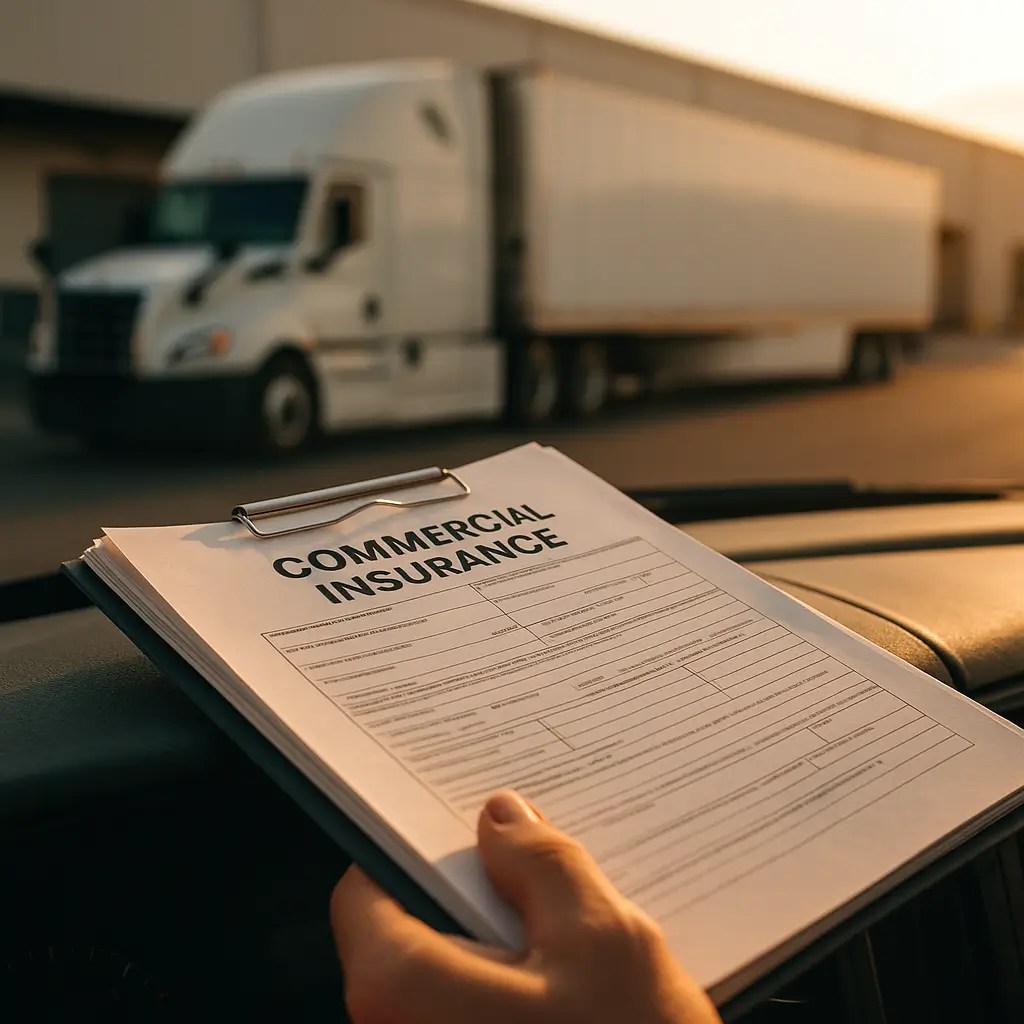

Learn 12 commercial insurance documents truckers may need, including COIs, ACORD forms, declarations, endorsements, filings, loss runs, and a quick checklist.
Commercial insurance documents are the proof packets brokers, shippers, and regulators use to decide whether you can haul a load today—often within minutes. In trucking, the fastest “yes” usually comes from a clean packet that includes a current COI, the right endorsement PDFs, and (when required) active filings, not just a screenshot of your policy.
If you want the bigger context on coverages and why document requests happen, start with these commercial truck insurance basics.
What documents are included in commercial insurance documents?
Commercial insurance documents usually include a certificate of insurance (often ACORD 25), evidence forms (like ACORD 28 for property), a binder (temporary proof), the declarations page, full policy forms, endorsements, schedules, exclusions, invoices, loss runs (claims history), cancellation/non-renewal notices, and—when regulated—required insurance filings.
Table of Contents
Reading time: 8 minutes
- Commercial insurance documents: key takeaways
- Commercial insurance document checklist (12 must-haves)
- COI + ACORD forms: what they are (and what they aren’t)
- Policy documents: dec page, endorsements, schedules, exclusions
- Trucking insurance proof requirements: when a COI isn’t enough
- Frequently Asked Questions
- Conclusion: build a ready-to-send insurance packet

Commercial insurance documents: key takeaways
Commercial insurance documents for trucking typically include a COI plus supporting policy documents (like endorsements and the declarations page) that prove specific contract wording, limits, and effective dates.
- A COI is proof, not the contract: A certificate can summarize coverage, but it doesn’t add contract-required wording by itself.
- Endorsements win or lose onboarding: Many broker/shipper requirements are only satisfied by an endorsement PDF (AI, WOS, P&NC, etc.).
- Filings are different than PDFs: In regulated situations, “proof” can mean an insurer filing with an authority, not an email attachment.
- Accuracy affects price: Wrong entity names, VINs, garaging, radius, and operations create audit issues and renewal surprises.
One reason premiums jump is inconsistent underwriting info (vehicles, ops, radius, classifications). If you’re trying to keep affordable trucking insurance, the paperwork has to match the risk—this breakdown helps: affordable trucking insurance.
Commercial insurance document checklist (12 must-haves)
A complete trucking insurance packet usually needs 12 core documents because brokers and shippers verify coverage in layers: summary proof first, contract wording second, and compliance proof (if required) last.
Even if your operation is “just me and my truck,” you’re still a business. Your document packet is how you get onboarded, keep freight moving, and avoid last-minute “no docs, no load” problems.
For the coverage side of the equation, see the owner-operator insurance checklist — it covers the 6 critical coverages and how they work together.
Fast checklist (save this)
| Document | What it proves | When you need it |
|---|---|---|
| 1) Certificate of Insurance (COI) – typically ACORD 25 | Summarizes active liability coverage, limits, dates | Broker onboarding, shipper/vendor compliance, facility access |
| 2) Required endorsement PDFs (when requested) | Confirms contract-required wording exists | When they ask for AI, WOS, P&NC, etc. |
| 3) Declarations page (“dec page”) | Snapshot of named insured, period, limits, forms list | When a COI isn’t enough or contracts are higher risk |
| 4) Full policy forms (policy contract) | The actual contract language | Claims disputes, serious contract reviews |
| 5) Exclusions/limitations list | What’s not covered (or is restricted) | Before signing freight agreements, dedicated contracts |
| 6) Schedules (autos, drivers, locations, equipment) | The “who/what/where” underwriting is rating | VIN lists, covered units, driver lists, locations |
| 7) Binder (temporary proof) | Coverage is bound before policy issuance | Same-day onboarding when policy docs aren’t issued yet |
| 8) Auto ID cards | Roadside proof (vehicle-specific) | Roadside, terminals, some customer gates |
| 9) Proof of premium/payment (invoice/receipt) | Policy isn’t about to cancel for non-pay | When compliance asks due to prior cancellations |
| 10) Loss runs (claims history report) | Claim history + reserves | Shopping renewals, moving markets, larger accounts |
| 11) Cancellation / non-renewal notices (if issued) | Formal policy status updates | Compliance follow-up, internal risk management |
| 12) Regulatory filings (when required), such as a BMC-91X filing | Proof filed with an authority (not just a PDF) | FMCSA/state requirements for certain operations |
How to use this checklist (real-world)
- If you’re requesting proof from a vendor/subcontractor: COI + required endorsements first. Ask for the dec page only if the job is higher risk.
- If you’re providing proof to a broker/shipper: don’t wing it. Use the same packet layout every time so your onboarding team can approve you quickly.
Watch this to understand why your carrier packet — and the documents in it — can make or break your broker and shipper onboarding:
COI + ACORD forms: what they are (and what they aren’t)
A Certificate of Insurance (COI), commonly issued on ACORD 25, is a one-page summary of coverage details (carrier, policy number, effective dates, and limits) and is not the policy contract.
Most delays happen here because people treat a COI like it changes coverage. It doesn’t. If a contract requires special wording, the policy needs an endorsement that adds (or confirms) that wording.
What a COI is (plain English)
A COI typically shows:
- Named insured: the legal entity that owns the policy (LLC name matters).
- Carrier: insurance company name (and NAIC number in many formats).
- Policy number(s): per line of coverage.
- Effective / expiration dates: what onboarding teams verify first.
- Limits: what your broker/shipper uses to match contract requirements.
- Certificate holder: the party receiving the COI.
Why it’s essential (business reality)
- It’s the fastest way to get approved for freight and facilities.
- It cuts down “back-and-forth” with onboarding teams.
- It protects revenue by preventing dispatch delays.
Common COI rejection reasons
COIs get kicked back for simple mistakes that cost real money:
- Wrong entity name: LLC vs DBA mismatch (or spelling differences).
- Wrong dates: expired COI attached to a new carrier packet.
- Missing endorsements: they asked for AI/WOS/P&NC and only got the COI.
- Outdated after a midterm change: new truck, new address, new ops, old COI.
Before you submit your next packet, watch this breakdown of the most common mistakes that get carriers rejected or delayed:
If you want a trucking-specific walkthrough (including what brokers usually look at first), use this guide: certificate of insurance (COI) for truckers.
ACORD forms (ACORD 25 vs ACORD 28)
ACORD publishes standardized insurance forms used across carriers and agencies, and the two you’ll see most are ACORD 25 (liability certificate) and ACORD 28 (property evidence).
- ACORD 25: Certificate of Liability Insurance (the “COI” most brokers mean)
- ACORD 28: Evidence of Commercial Property Insurance (property proof)
Standardized form ≠ standardized coverage. The underlying policy and endorsements control what’s actually covered.
Source: ACORD forms overview
COI request template (copy/paste)
Subject: Insurance Documents Request – [Company / Load / Contract #]

Hi [Agent/Broker Name],
Please issue a COI and provide the endorsement PDFs for the following requirements:

- Named Insured: [Exact legal entity name]
- Certificate Holder: [Company name + address]
- Additional Insured: [Yes/No — if yes, provide endorsement PDF]
- Waiver of Subrogation: [Yes/No — if yes, provide endorsement PDF]
- Primary & Noncontributory: [Yes/No — confirm by endorsement or policy wording]
- Required Limits: [Auto liability $1M, GL $1M, cargo $____, etc.]
- Effective Date Needed By: [Date/time]
- Job/Load Reference: [Broker packet / load #]

Thanks,
[Your name / phone]
Here’s a step-by-step walkthrough on how to send your own certificates of insurance when you need proof on the fly:
Policy documents: dec page, endorsements, schedules, exclusions (the stuff that matters in a claim)
Declarations pages, endorsements, schedules, and exclusions are policy documents that control coverage because they are part of the insurance contract that carriers and courts rely on during a claim.
If a COI is the receipt, the policy documents are the contract. This is where coverage is granted, restricted, or modified—especially when a customer contract requires special wording.
Declarations page (“dec page”)
What it is: a summary page listing the named insured, policy period, key limits/deductibles, and usually a list of forms/endorsements attached.
Why it matters: it’s the fastest way to confirm you’re looking at the right insured and the right policy term.
What it isn’t: it’s not the full policy language, and it won’t show all conditions or exclusions by itself.
Source: NAIC consumer glossary
Endorsements (where contracts are won or lost)
Endorsements modify the policy by adding, removing, or changing coverage terms, which is why onboarding teams often request endorsement PDFs instead of relying on COI remarks.
If you’re regularly stuck at “approved pending endorsements,” this is usually the reason. Here’s the plain-English breakdown: insurance endorsements explained.
- Additional Insured (AI): extends certain protections to another party as required by contract.
- Waiver of Subrogation (WOS): limits the insurer’s right to seek recovery from a party.
- Primary & Noncontributory (P&NC): confirms how coverage responds when multiple policies apply.
- Notice of cancellation language: often limited by the policy and state rules—don’t overpromise.
Schedules and attachments (where underwriting gets specific)
Schedules are where the policy lists the exact items being rated and covered, such as covered autos by VIN, garaging address, driver lists (when applicable), and operating radius/territory.
If a schedule is wrong, you can trigger audit issues, claims confusion, and expensive renewal corrections.
Exclusions/limitations (read before you sign)
Exclusions are where “I thought I was covered” turns into a denial, so you should check them before signing a dedicated lane contract or any agreement with strict insurance terms.
- Operations: certain work types can be excluded or restricted.
- Commodities: certain cargo categories can be limited or excluded.
- Driver eligibility: age/experience/MVR standards may apply.
- Territory/radius: rating and eligibility can change by operating area.
- Subcontracting: some programs restrict or condition subcontracted work.
Trucking insurance proof requirements: when a COI isn’t enough (filings + compliance)
FMCSA financial responsibility rules under 49 CFR §387.9 set minimum public liability coverage requirements for for-hire motor carriers — typically $750,000 to $5,000,000 depending on commodity and operation type — and insurers may need to file proof using forms such as BMC-91 or BMC-91X when applicable. The MCS-90 endorsement is another filing-adjacent document you may need depending on your authority type and commodity.
Trucking is regulated, and “proof” can mean a filing with an authority—not a PDF for a broker. A COI can still be requested by customers, but regulators and enforcement systems rely on filings when filings are required.
FMCSA overview: Insurance Filing Requirements
What a filing is (plain English)
A filing is when the insurer (not the driver) submits proof of required coverage directly to a regulator or authority so your compliance status shows as active in that system.
If you’re not sure whether your operation requires a filing, this breakdown explains what a filing means in trucking insurance and the two contexts where it applies.
Why it’s essential (cash flow + authority survival)
- Authority risk: if required filings aren’t active, you can lose operating authority or get sidelined.
- Time risk: “We emailed the COI” doesn’t fix a missing filing, because the recipient is different.
Who typically needs filings
Filing needs depend on authority type and state/federal rules, but common scenarios include carriers operating under FMCSA requirements and certain intrastate operations depending on state law.
For trucking-specific examples and what to ask your agent for, see the BMC-91X filing guide and the MCS-90 endorsement guide.
Pro tip to stop the “I’m compliant / no you’re not” spiral
Ask this exact question before you resend paperwork:
“Do you need a COI packet, or do you need a regulatory filing? If filing, which one and who is the recipient?”
That single sentence prevents days of confusion and cuts down on rejected onboarding tickets.
Frequently Asked Questions
These FAQs cover the insurance paperwork most trucking operations get asked for, including COIs (often ACORD 25), ACORD forms, and the difference between a certificate holder and additional insured status.
A certificate of insurance (COI) is a one-page summary that shows your insurance is active, including coverage types, limits, policy dates, and who requested the certificate. A COI is proof/evidence of insurance—not the full policy contract—so it doesn’t change your coverage terms by itself. In trucking, most brokers use the COI as a quick “go/no-go” check for effective dates and limits, then request endorsements if the contract requires special wording. If there’s a dispute, the policy and endorsements control, not the COI.
In most cases, a COI can be issued within minutes to a few hours of a clear, complete request — especially when your agent uses a modern agency management system. Delays happen most often when the request includes endorsements that require insurer review (such as specific additional insured wording), when the entity name on the request doesn’t match the policy, or when the agent is working off old policy information after a midterm change. The fastest path is sending a complete request upfront (include the exact entity name, required limits, and the specific endorsements needed) rather than sending a partial request and correcting it after.
ACORD forms are standardized insurance documents used to present coverage information in a consistent format across carriers and agencies. The most common examples are ACORD 25 (Certificate of Liability Insurance, often called the COI) and ACORD 28 (Evidence of Commercial Property Insurance). Standardized forms help compliance teams read information faster, but the form itself doesn’t create or expand coverage; the underlying policy language and endorsements determine what’s actually covered.
A binder is temporary proof that coverage is bound and in force — issued when a policy has been agreed to but the full policy documents haven’t been processed yet. It typically shows the carrier, coverage types, limits, effective date, and named insured. A binder is not the same as a COI: a COI summarizes an existing, active policy, while a binder covers the window before that policy is formally issued. Binders are common at policy inception, after a major change, or when you need same-day proof and the insurer’s system hasn’t processed the policy yet. They usually expire within 30–90 days and should be replaced by the formal policy documents once issued.
Commercial insurance documents typically include a COI (often ACORD 25), declarations page, endorsements, policy forms, schedules, and exclusions/limitations. Depending on timing and compliance needs, you may also need a binder (temporary proof), invoices/receipts (proof of payment to avoid non-pay cancellation), loss runs (claims history), and cancellation/non-renewal notices. In regulated trucking scenarios, you may also need active regulatory filings, which are submitted by the insurer to the authority rather than sent as a PDF.
A loss run is a claims history report issued by your current or prior insurance carrier. It lists every claim filed on your policy over a given period — typically 3 to 5 years — along with the claim status (open or closed) and any reserves set. Loss runs are most often required when you’re shopping for a new policy or moving to a different carrier, because underwriters use them to evaluate your risk history before issuing a quote. Request them from your insurer as early as possible — some carriers take several business days to prepare them, and delays in getting loss runs can slow down your renewal or market move.
No—being the certificate holder only means a party receives the COI, while additional insured status usually requires an endorsement attached to the policy. If a contract requires Additional Insured, Waiver of Subrogation, or Primary & Noncontributory wording, the safest move is to request the actual endorsement PDF and confirm the wording matches the contract requirements. For trucking-focused examples and common mistakes, use: additional insured requirements and waiver of subrogation.
Yes — if your operation requires a filing under FMCSA rules, a COI does not satisfy that requirement. A BMC-91X is filed by your insurance carrier directly to FMCSA, updating your compliance record in their system. A COI goes to your broker or shipper as proof of coverage — it’s a separate document for a separate audience. If your authority requires active filings, your agent issues the COI to customers and your carrier files the BMC-91X with FMCSA independently. If you’re not sure whether your operation requires a filing, ask your agent to confirm based on your authority type and commodity hauled.
Most rejections come with a specific reason — wrong limits, missing endorsement, entity name mismatch, or an expired COI. Fix the flagged item first before resending the entire packet. If the issue is an endorsement that needs to be added, contact your agent immediately and ask for the corrected endorsement PDF — don’t rely on a COI note or remarks box to fix contract-required wording. If the entity name is wrong, confirm the exact legal name on the policy and update the COI request accordingly. Keeping a clean, pre-approved packet template on file significantly reduces the time it takes to resolve rejections on future submissions.
Conclusion: build a “ready-to-send” insurance packet (and keep loads moving)
A repeatable insurance packet reduces onboarding delays because most brokers verify a current COI first, then confirm contract wording through endorsements and the declarations page, and finally check filings when regulations require them.
If you’re running under your own authority, your document packet is part of your operating system—right next to maintenance planning and your rate-confirmation process.
Key Takeaways:
- Send the same packet structure every time: COI + endorsements + dec page (when needed) beats random attachments.
- Don’t rely on COI remarks for contract wording: when AI/WOS/P&NC is required, provide the endorsement PDF.
- Know when “proof” means a filing: ask who the recipient is before you waste a day resending PDFs.
If you want to build your coverage stack based on your operation, these are good next reads:
If you’re building a carrier packet or trying to get your coverage documents in order before your next onboarding, LogRock can help you review your operation, confirm your coverage structure, and get your certificates and endorsements issued fast. Talk to our team — ask questions, identify gaps, and request a quote based on your specific setup.
Speak with LogRock and request a quote




