
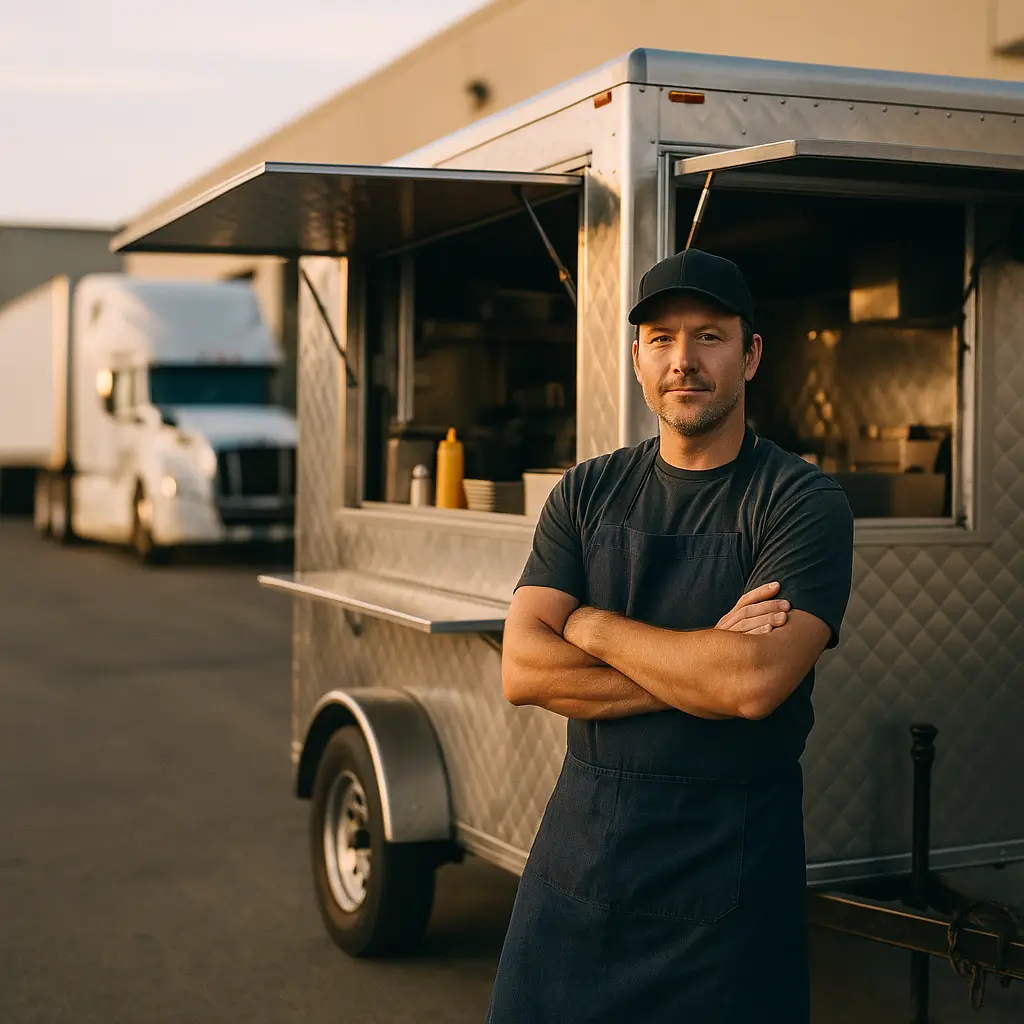

See food cart insurance costs starting at $26/month, 6 essential coverages, COI steps, and when commercial truck insurance may be required.
Food cart insurance is usually a small bundle of policies that helps you get approved to vend (via a COI) and protects you from the two losses that end seasons fast: customer injury claims and stolen/damaged gear. Most food cart owners pay about $300–$1,500/year for basic general + product liability, and $800–$3,000+/year once you add equipment coverage, employees, higher limits, or frequent festivals.
If you’re rushing to meet a market deadline, start with liability first, then add equipment and event-specific endorsements. For the baseline protections most venues want (slip-and-fall, burns, property damage), see Food cart general liability basics.
Table of Contents
Reading time: 8 minutes
- Key takeaways (save time, save money)
- What is food cart insurance (and who needs it)?
- Food cart insurance requirements (COI + limits)
- What coverages are included in food cart insurance? (6 core options)
- Is inland marine coverage needed for a food cart?
- Food cart insurance cost in 2026 (monthly & annual)
- How to compare providers and buy the right policy
- Next steps: get the right coverage (and the COI)
- Frequently Asked Questions

Key takeaways: food cart insurance (save time, save money)
Most markets and venues commonly expect a $1,000,000 per-occurrence general liability limit plus a Certificate of Insurance (COI) delivered before setup, even when your city doesn’t legally “require” a specific policy.
- Start with liability first: General liability + product liability is the fastest path to getting approved to vend.
- If your cart and gear move, inland marine is usually the right tool: It’s designed for equipment in transit and off-premises.
- COI delays cost real money: A same-day certificate process can save a full event day of revenue.
- Cheap only works if it pays: Match limits and endorsements to where you sell, not the lowest monthly price.
What is food cart insurance (and who needs it)?
Food cart insurance is a set of commercial coverages—typically anchored by general liability and product liability—selected to match your vending setup, event schedule, and equipment value rather than a single standardized “food cart policy.”
If you sell at farmers markets, festivals, office parks, campuses, or private venues, you’ll usually need insurance to (1) satisfy contracts and permits and (2) avoid paying claims out of pocket when something goes wrong.
Food cart vs. food truck vs. pop-up vendor (quick differences)
- Food carts: Often lower auto exposure than trucks, but high foot-traffic liability (lines, hot surfaces, spills).
- Food trucks: Higher premiums are common due to the vehicle value, road risk, and commercial auto requirements.
- Pop-ups: Sometimes lower risk, but venues still commonly require a COI and additional insured status.
Food trucks carry higher premiums due to vehicle value, road risk, and commercial auto requirements — see food truck insurance for a full breakdown.
Who typically needs a policy
- Street-permitted food carts
- Farmers market vendors
- Festival and event vendors
- Carts operating on private property (brewery patios, office parks, campuses)
- Anyone who must issue COIs to book work or keep a recurring spot
Festival and event vendors often overlap with food cart operations — if you sell under a tent or booth rather than from a cart, see food vendor insurance for how coverages and requirements differ.
Food cart insurance requirements: what’s “required” vs. what’s “expected” (COI + limits)
Food cart insurance “requirements” usually come from contracts and permits, and the most common contract request is $1M general liability plus a COI naming the organizer or venue as additional insured.
Three different buckets get mixed together:
- Legal requirements: State/city rules (which vary widely).
- Contract requirements: Markets, landlords, event organizers, catering clients.
- Business survival requirements: Losses you can’t cash-flow (lawsuits, theft, equipment damage).
For a clear baseline on how insurance needs change by business type and contracts, the U.S. Small Business Administration summarizes it here: https://www.sba.gov/business-guide/launch-your-business/get-business-insurance.
Common minimums you’ll see (not universal, but common)
Many markets and venues commonly ask for $1,000,000 per occurrence and $2,000,000 aggregate general liability, plus additional insured status and a COI delivered before set-up.
- $1,000,000 per occurrence: The most common entry-level limit for many public events.
- $2,000,000 aggregate: Common for season-long markets or recurring events.
- Additional insured: Venue/city/organizer is added to your policy for liability arising out of your operations.
- COI timing: Often required 24–72 hours before the event (sometimes sooner).
Some public venues publish their expectations directly; NYC Parks, for example, outlines event insurance and COI mechanics (limits and wording vary by event): https://www.nycgovparks.org/permits/special-events/insurance.
COI step-by-step: how to get it approved the first time
A Certificate of Insurance (COI) is a one-page proof of coverage listing your policy types, limits, and dates, and it does not change coverage unless an endorsement is issued.
- Get the venue’s exact legal name + address (not the brand name on signage).
- Confirm what must be listed: certificate holder, additional insured wording, and any endorsements (primary & noncontributory, waiver of subrogation).
- Verify limits and dates (one-day event vs. season-long market).
- Request the COI with a deadline and delivery method (PDF email vs. portal upload).
If you need coverage for a single event or a same-day COI, catering insurance for a day covers what to expect and how fast it can happen.
For a reusable checklist and the exact fields organizers care about, use Certificate of insurance (COI) explained.
What coverages are included in food cart insurance? (the 6 core options)
Food cart insurance typically includes general liability and product liability first, then adds equipment (inland marine), property, workers’ comp, and auto-related coverage based on your operations and contractual requirements.
If you want neutral definitions while you compare quotes, the NAIC’s business insurance overview is a useful reference point: https://content.naic.org/consumer/insurance/business-insurance.
Coverage cheat sheet (fast table)
| Coverage | What it protects | Who needs it most |
|---|---|---|
| General liability | Customer slips/falls, burns, property damage | Almost every cart |
| Product liability | Foodborne illness, allergy claims, contamination | Anyone serving food/drink |
| Inland marine (equipment) | Cart, grills, propane setup, POS, gear in transit/off-premises | Mobile carts, event-heavy vendors |
| Commercial property | Commissary storage or a fixed leased space | Vendors with a dedicated location |
| Workers’ comp | Employee injuries and related medical/wage benefits | Anyone with employees (varies by state) |
| Auto-related | Business vehicle use + liability from transport/deliveries | Anyone towing/hauling or delivering |
1) General liability (slips, burns, property damage)
General liability insurance covers third-party bodily injury and property damage claims, and many venues use it as the first “yes/no” requirement for vendors.
- A customer slips near your line
- Someone gets burned by a hot surface
- Your setup damages a venue’s property
2) Product liability (foodborne illness, allergic reactions)
Product liability coverage addresses claims that your food or drink caused injury or illness, including allegations of contamination and some allergy-related incidents depending on policy terms.
For a focused look at how liability coverage works for vendors specifically, see food vendor liability insurance. The FDA’s food safety preventive controls framework is also useful context for reducing contamination and illness risk.
Don’t assume it’s included—verify it’s listed on the quote and confirm any food-vendor exclusions.
- Allergen signage: Clear labels and staff scripts reduce “I didn’t know” disputes.
- Temperature logs: Especially helpful for dairy, seafood, and hot-held items.
- Cross-contamination controls: Separate utensils, prep zones, and sanitizer routines.
3) Inland marine / equipment coverage (your cart, grills, propane, POS)
Inland marine insurance is commonly used to cover movable business equipment while it’s in transit or away from your primary insured location.
If your cart, generator, POS, or cooking gear moves between storage, commissary, and events, this is often the cleanest way to insure it: Inland marine (equipment) coverage.
4) Commercial property (commissary storage, small rented space)
Commercial property insurance covers business property at a scheduled location, which matters if you rent a commissary, storage unit, or small prep space with your equipment inside.
If a landlord requires property coverage, confirm whether they also require specific limits or a COI naming them as additional insured or certificate holder.
5) Workers’ comp (if you have employees)
Workers’ compensation insurance pays statutory benefits for employee work injuries, and requirements are set by state law and can apply even with part-time payroll.
Workers’ compensation requirements vary significantly by state — the U.S. Department of Labor maintains a plain-language overview and links to state programs.
Rules differ by state, and some venues request proof regardless of what you think you “have to” carry.
6) Auto-related options (when towing/transporting/delivering changes the game)
Auto-related exposure exists anytime you use a vehicle for business purposes—towing a cart, hauling equipment, or delivering catering—and personal auto policies often exclude business use or limit coverage.
This is where carts brush up against “trucking-style” logic (commercial truck insurance, trucking insurance, hotshot insurance, semi truck insurance): you’re moving business property on public roads, and an at-fault crash can turn into a large liability claim if the policy is wrong.
Is inland marine coverage needed for a food cart?
Inland marine coverage is often recommended for food carts when the cart or equipment leaves a single insured address, because it’s designed to cover movable property against theft, vandalism, and transport-related damage.
When inland marine is usually a “yes”
- The cart or gear travels between storage, commissary, and events
- You do frequent festivals, pop-ups, and rotating markets
- Replacing the setup would shut you down for days (or longer)
When you might skip it (rare, but possible)
- Low equipment value: You can replace everything without crushing cash flow.
- Truly fixed location: Gear never leaves one covered address.
- Minimal event schedule: Limited transport and off-premises exposure.
Pro tip (prevents claim disputes)
Claims go smoother when you can prove what you owned and what it cost to replace.
- Take photos of the cart + all major equipment
- Record serial numbers and model numbers
- Save receipts or replacement cost estimates
- Document where it’s stored and how it’s secured
Food cart insurance cost in 2026: realistic monthly & annual ranges (and what drives price)
Food cart insurance cost in 2026 commonly ranges from $25–$125/month for liability-only to $70–$250/month when equipment coverage is added, with higher limits and frequent festivals pushing total cost higher. Lean liability-only setups can start as low as $26/month for vendors with a clean history and low-risk menu.
Typical 2026 price ranges (realistic planning numbers)
| Package | What’s included | Typical cost |
|---|---|---|
| Liability-only starter | General + product liability | $25–$125/month (≈ $300–$1,500/year) |
| Liability + equipment | Liability + inland marine/equipment | $70–$250/month (≈ $800–$3,000/year) |
| Add employees | Above + workers’ comp | Varies widely (payroll + state rules) |
| Higher-limit event-heavy | Higher GL limits, frequent events, more endorsements | Often $150–$400+/month |
For vendor-specific pricing benchmarks, see food vendor insurance cost for 2026 rate ranges.
Not sure how much coverage you actually need? This breakdown explains how to think through limits before you request a quote:
Monthly vs. annual: Monthly billing can help cash flow, but it often includes installment fees and requires a down payment. If you can swing it, paying annually can reduce total cost.
What drives price (the underwriting levers)
- Location + venue type: Dense foot traffic and large events usually cost more.
- Sales volume (gross receipts): More customers = more exposure.
- Menu risk: Raw/undercooked items, dairy, seafood, open flame, fryers.
- Equipment value: Higher replacement cost increases premium.
- Claims history + years in business: Prior losses and new ventures can price higher.
For practical ways to reduce cost without cutting essential coverage, use Lower your insurance premiums (without getting underinsured).
How to compare providers and buy the right policy (without getting burned)
Comparing food cart insurance providers is easiest when you force every quote to match the same limits, equipment values, event schedule, and endorsement requirements so you don’t get surprised after the COI is issued.
A simple quote framework (what to check every time)
- COI turnaround time: Same day vs. 3–5 business days.
- Additional insured process: Blanket endorsement vs. per-request fees and paperwork.
- Equipment valuation: Replacement cost vs. actual cash value (ACV).
- Food-vendor exclusions: Open flame, hot surfaces, off-premises operations, certain products.
- Claims handling: Response time matters when you’re forced to shut down.
If you want a clean framework for shopping and service-level comparison, start here: Compare small business insurance providers.
Quote checklist (prevents “apples-to-oranges” surprises)
- Same liability limits (and confirm product liability is included)
- Same equipment list and declared values
- Same number of event days / locations
- Same payroll / number of employees (if any)
- Same effective dates and deductibles
For a broader checklist of what policies are typically required and why, food truck insurance requirements is a useful reference point.
Understanding how underwriters evaluate risk can help you present your operation in the best light when shopping quotes:
Next steps: get the right coverage (and the COI) before your next event
A practical way to build food cart insurance is to buy coverage in an order that matches how venues approve vendors: liability first, then equipment, then staff/auto only when your operation actually triggers those exposures.
Use this order to stay booked and protected:
- General + product liability (so you can vend and sign contracts)
- Equipment coverage if replacing your cart/gear would hurt cash flow
- Workers’ comp / auto-related only if staffing and transport require it
If you sell mostly at festivals or markets, plan for event-driven COIs and endorsements: Event vendor insurance requirements.
If you tow, haul, or deliver, tighten up the auto piece early so you don’t fall into a coverage gap: Commercial auto vs hired & non-owned auto.
Quote-ready checklist: list your vending locations, expected event schedule, annual sales estimate, and your equipment list with values.
Frequently Asked Questions
Most food carts pay $300–$1,500/year for basic general + product liability, and $800–$3,000+/year when equipment coverage, higher limits, employees, or frequent events are added. Location (dense foot traffic vs. smaller markets), annual gross receipts, menu risk (open flame/fryers, dairy/seafood), and equipment value are the biggest price drivers. If you pay monthly, expect a down payment and possible installment fees. To lower premiums without getting underinsured, focus on reducing claims frequency and shopping quotes with identical limits and the same equipment schedule.
Food cart insurance typically includes general liability and product liability, and many vendors add inland marine (equipment) coverage to protect the cart and gear while in transit or off-premises. Common add-ons include commercial property if you have a fixed commissary/storage location, workers’ comp when you have employees (rules vary by state), and auto-related coverage if you tow, haul, or deliver for business. The right mix depends on your event schedule, venue contracts, and the replacement cost of your equipment.
Inland marine coverage is often a smart choice when your cart or equipment moves between storage, commissary, and events, because it’s designed for movable property exposure (theft, vandalism, and transport-related damage). It’s especially important when losing a generator, POS system, fryer, or the cart itself would shut you down for multiple event days and strain cash flow. To avoid claim friction, keep photos, serial numbers, and replacement cost documentation for major items and make sure the equipment schedule and values match what you actually use.
Maybe—workers’ compensation requirements depend on your state’s law and whether your helpers are true employees versus legitimately classified independent contractors. Even when you believe you’re exempt, some venues and organizers still request proof of workers’ comp (or an approved exemption) as a contract condition. The safest move is to confirm rules with your state agency and your insurance professional, then document payroll and job duties clearly. For a plain-English overview of what workers’ comp covers and when it’s triggered, see Workers’ comp basics.
Probably not safely. Most personal auto policies exclude or limit business use, and towing a food cart to a paid event qualifies as business use in many situations. If you get into an accident while hauling your cart to a market, your personal policy may not respond the way you expect. A commercial auto policy — or, in some cases, a hired and non-owned auto endorsement — can help close that gap. Verify with your insurer exactly what “business use” means under your current policy before your next event.
A blanket additional insured endorsement automatically extends additional insured status to parties you are contractually required to add, without needing a separate endorsement request every time. If you work multiple markets and events per season, it can be more efficient than paying per-request endorsement fees. Ask your insurer whether your policy includes blanket additional insured language or whether each venue requires its own endorsement.
It depends on your policy’s territory and covered operations. Many food cart policies are written for street vending and public markets, so if you start accepting private catering bookings at venues or corporate events, notify your insurer and confirm those events are within scope. Some policies exclude private events or require an endorsement for off-premises catering. For single-event needs, review catering insurance for a day before booking a gig that requires a fast COI.
The main difference is auto exposure. A food truck is a motorized vehicle driven on public roads, so its policy typically requires a commercial auto component covering the vehicle itself, road liability, and any cargo in transit — on top of general and product liability. Food carts are usually towed or transported rather than self-propelled, which means lower baseline auto exposure and often lower premiums. That said, if you tow your cart with a personal vehicle to events, that business use may not be covered by your personal auto policy. See food truck insurance for a full cost and coverage breakdown, and review your auto coverage before your next tow.
Actual cash value (ACV) pays what your equipment was worth at the time of the loss after depreciation. Replacement cost pays what it costs to replace the item with something comparable today, without a depreciation deduction. For a food cart, the difference can be significant: a used generator may have a low ACV but cost much more to replace. When reviewing inland marine or equipment quotes, confirm whether the policy pays ACV or replacement cost and whether high-value items like the cart itself are scheduled separately.
Conclusion: Build food cart insurance for approval first, then protection
A COI with $1M general liability is the most common “ticket” to vending at markets and events, and the best policies also protect the equipment that keeps you earning.
Start with liability and COI speed, then add inland marine if your gear moves, and only pay for workers’ comp or auto-related coverage when your staffing and transport actually require it.
Key Takeaways:
- Budget smart: Plan on $300–$1,500/year for liability-only and $800–$3,000+/year with equipment coverage.
- Prevent COI rejections: Use the venue’s exact legal name, confirm dates/limits, and request endorsements before the deadline.
- Insure what moves: If your cart/gear travels, inland marine is often the cleanest equipment solution.
If you’re getting ready to vend at markets, festivals, or private events and want to make sure your coverage and COI are in order, LogRock can help you review your operation, match the right policies, and get a quote fast. Talk to our team to ask questions and request a quote based on your actual setup.
Speak with LogRock and Request a QuoteIf you want to move quickly, gather your event schedule, sales estimate, and equipment list, then request quotes with identical limits so comparisons are fair.





