
2026 costs for semi truck liability insurance with a $1 million limit—what it covers, FMCSA vs broker rules, and savings tips. Compare quotes.
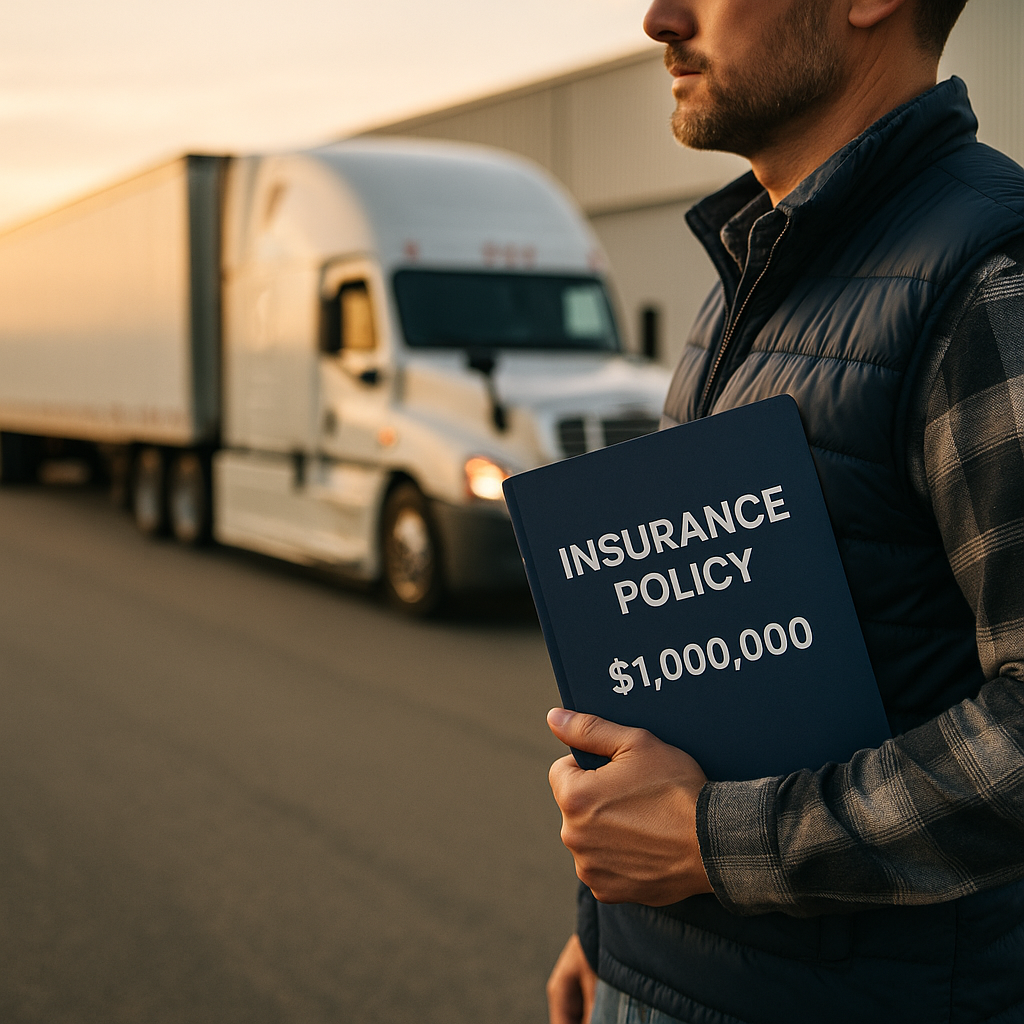
Semi truck liability insurance 1 million limit pricing in 2026 usually lands around $400–$1,600+ per month for many owner-operators, with the final number driven by authority age, state/lanes, cargo class, radius, and driving history. A $1M limit is often less about “extra coverage” and more about staying eligible for brokered freight, because many contracts require $1M CSL on the certificate.
If you’re buying coverage as a business decision (not a panic buy), you need two things: (1) the exact wording brokers want on the COI and (2) apples-to-apples quotes so you can control cost-per-mile. If you need the full coverage stack beyond liability-only, start with this semi truck insurance coverage overview.
Table of Contents
Reading time: 8 minutes
- Key Takeaways
- How Much Is Semi Truck Liability Insurance With a $1 Million Limit in 2026?
- What Does a $1 Million Liability Limit Cover (and What It Doesn’t)?
- FMCSA Minimums vs Broker Requirements: Do You Legally Need $1M?
- Liability-Only vs Full Package (and How to Keep $1M Liability From Killing Your CPM)
- Frequently Asked Questions
- Conclusion: $1M Liability Is the Market Standard—So Price It Like a Business Owner
Key Takeaways
In 2026, $1,000,000 auto liability is commonly treated by brokers as the baseline limit to tender loads, even when federal minimums for some operations can be lower.
- Typical $1M liability-only pricing (2026): about $400–$1,600+/month, depending on authority age, state/lanes, cargo, radius, and driving history.
- $1M liability covers third-party injuries and property damage—not your truck, cargo, or downtime.
- FMCSA minimums vary by operation and cargo, but brokers/shippers frequently require $1M CSL on the COI.
- Best way to control cost: quote consistent details (radius, cargo class, garaging, drivers) and avoid “audit bait” misclassifications.

How Much Is Semi Truck Liability Insurance With a $1 Million Limit in 2026?
In 2026, semi truck liability insurance with a $1 million limit typically costs about $400–$1,600+ per month for many owner-operators, with higher premiums common for new authorities or tougher states/lanes.
Leased-on operators can sometimes see lower out-of-pocket costs (because the motor carrier may provide or control liability through the lease), but most brokers still expect to see $1M CSL reflected correctly on the certificate for the hauling arrangement you’re using.
Typical liability-only cost ranges (real-world budgeting)
These are practical liability-only ranges for planning cash flow. When you start a new policy or renew, your “real” cash need is often down payment + first installment, not just the monthly number.
| Operation Type | Low | Typical | High |
|---|---|---|---|
| Leased-on (liability may be handled by motor carrier; varies by lease) | $250/mo | $400–$700/mo | $900+/mo |
| Own authority (newer authority, general freight) | $400/mo | $800–$1,400/mo | $1,600+/mo |
| Higher-risk mix (tough states/lanes, poor MVR, certain cargo) | — | $1,200–$1,800/mo | $2,000+/mo and up |
For broader monthly ranges (including full packages), use this benchmark guide on how much semi truck insurance costs.
Pro tip: don’t confuse “liability-only” with “cheap”
Liability-only can look “fine” until you realize what you’re self-insuring. If something goes sideways, you may be paying out of pocket for:
- Your tractor: physical damage (comprehensive + collision) is separate.
- Your cargo: motor truck cargo is separate.
- Your downtime: lost income is usually not covered by liability.
- Your injuries: occupational accident or workers’ comp alternatives are separate products.
What Does a $1 Million Liability Limit Cover (and What It Doesn’t)?
A $1,000,000 commercial auto liability limit generally pays for third-party bodily injury and third-party property damage caused by an at-fault accident, up to the policy limit, and may include legal defense depending on the policy form.
Think of commercial truck insurance liability as protecting your business from the damage you do to other people, not the damage to your own equipment or load.
What it is (plain English)
A $1,000,000 liability limit typically applies to:
- Third-party bodily injury: injuries to occupants of other vehicles, pedestrians, or other drivers.
- Third-party property damage: vehicles, guardrails, buildings, and other property you damage in an accident.
- Legal defense: often included, but coverage details vary by carrier and wording.
If you want the big-picture “how the coverages fit together” view, read commercial truck insurance basics so you don’t buy the wrong policy just to get a COI.
What $1M liability does NOT cover
These are the common surprises that wreck a budget after a claim:
- Your truck: physical damage is separate (comp/collision).
- Your cargo: cargo coverage is separate.
- Your injuries and lost wages: typically not covered by auto liability.
- Pollution/hazmat exposures: often excluded unless endorsed.
- Wear/tear, breakdowns, downtime: maintenance and business interruption risk are on you.
$1M CSL vs split limits (the wording that trips people up)
Many brokers ask for $1M CSL (Combined Single Limit), meaning one combined bucket for bodily injury + property damage per accident. Split limits (for example, 250/500/250) can get rejected if the contract specifically demands $1M CSL, even if the “total sounds close.”
FMCSA Minimums vs Broker Requirements: Do You Legally Need $1M?
FMCSA financial responsibility minimums vary by carrier type and what you haul, and while many general freight discussions reference $750,000 as a common federal baseline, brokers and shippers frequently require $1,000,000 CSL by contract.
Federal minimums (often not $1M)
Minimum insurance requirements are tied to operation type and cargo class, so the correct answer is: it depends on what you haul and how you’re operating. The most reliable way to confirm current federal requirements and filing context is FMCSA’s official resource:
https://www.fmcsa.dot.gov/registration/insurance-filing-requirements
Why brokers and shippers still require $1M anyway
Even when federal minimums are lower, a broker’s contract can set a higher bar. The common reasons are simple business math: standardization, risk transfer, and the reality that severe crashes can exceed lower limits quickly.
Proof of insurance: what brokers actually check
Brokers typically verify documentation and public status, not just a screenshot of a policy quote. Expect checks for:
- COI (Certificate of Insurance): dates, limit, named insured, and certificate holder details.
- Exact wording match: “$1M CSL” can be the pass/fail line.
- Authority/insurance status verification: often cross-checked in FMCSA systems.
You can see how carrier authority and insurance status are publicly verified via SAFER:
If you’ve ever wondered why one inspection or violation follows you into underwriting and renewals, read how your DOT record impacts trucking insurance.
Liability-Only vs Full Package (and How to Keep $1M Liability From Killing Your CPM)
Insurance cost-per-mile can be calculated as monthly premium ÷ miles per month, and this simple CPM math is one of the fastest ways to see whether your rates actually support a $1M liability premium.
Liability-only vs “working” policy
- Liability-only: meets the liability requirement, but you’re exposed on equipment, cargo, and downtime.
- Full package (typical working stack): liability + cargo + physical damage + (often) general liability, plus endorsements based on contracts (like trailer interchange, non-trucking liability, etc.).
Why this matters for cash flow
Insurance is a major operating cost, and industry cost studies regularly list it as a meaningful component of per-mile expenses. For a high-level industry reference, see ATRI’s Operational Costs of Trucking page:
https://truckingresearch.org/2025/10/operational-costs-of-trucking/
Mini CPM calculator (copy/paste simple)
Insurance CPM = monthly premium ÷ miles per month
- $700/mo ÷ 10,000 mi/mo = $0.07 CPM
- $1,400/mo ÷ 8,000 mi/mo = $0.175 CPM
Once you see the CPM, you can price freight like a business owner instead of hoping the numbers work out after fuel, deadhead, maintenance, and the random week where everything goes wrong.
Why your $1M liability quote swings so much
Underwriters price risk, and the same levers show up in almost every quote:
- Authority age: new ventures often pay more until there’s a proven track record.
- Garaging state + lanes: where you run can matter as much as where you live.
- Cargo & radius: different classes and long-haul vs local change severity expectations.
- MVR/violations & claims: tickets, at-faults, and preventables usually raise rates.
- Operations & documentation: safety process and clean paperwork reduce friction.
How to lower the premium without underinsuring yourself
Most “cheap” deals become expensive later through audits, missed requirements, or coverage gaps. Use a clean process instead:
- Quote apples-to-apples. Keep radius, cargo class, drivers, and garaging consistent on every quote request.
- Don’t play classification games. Misstated cargo or radius can trigger audit bills and contract issues.
- Improve what underwriters reward. Dashcams, telematics, documented maintenance, and a simple safety routine can help.
- Pick deductibles strategically. This often impacts physical damage more than liability, but it changes your total package pricing.
- Avoid lapses. A lapse can crush your options—especially as a new authority.
For a deeper checklist that focuses on real savings (without breaking requirements), use these proven ways to save on truck insurance.
State examples: why your zip code changes the number
Premiums can vary sharply by state, lanes, and loss environment. If you want quick state-specific context, here are two references:
Frequently Asked Questions
Most $1M liability questions come down to two things: what the policy actually covers and what wording a broker requires on the COI (often “$1M CSL”).
If you mean liability-only with a $1,000,000 limit, a practical 2026 planning range is $400–$1,600+ per month, with higher premiums common for new authorities, tougher states/lanes, higher-risk cargo, or a rough MVR. If you mean a full commercial truck insurance package (liability + cargo + physical damage and endorsements), the monthly number can be significantly higher—especially with financed equipment, stricter broker contracts, and long-haul operations.
$1 million auto liability typically covers third-party bodily injury and third-party property damage from an at-fault crash, up to the $1,000,000 limit, and it often includes legal defense depending on the policy form. It generally does not cover your tractor (physical damage is separate), your cargo (motor truck cargo is separate), your medical bills or lost wages, or downtime from being out of service.
$1M liability is often a broker/shipper contract requirement, while FMCSA minimums vary based on carrier type and cargo class and can be lower than $1M for many general freight operations. In practice, many brokers still require $1M CSL to tender loads, so it becomes the market “price of admission” even when federal minimums differ. FMCSA’s official reference is its insurance filing requirements page.
Sometimes an umbrella or excess policy increases your total protection, but many brokers require the underlying auto liability itself to be $1,000,000 CSL, so an umbrella may not satisfy the contract language if your base limit is lower. Umbrella forms can also have exclusions or conditions that surprise drivers, so confirm the exact COI wording the broker will accept before buying. To avoid preventable admin mistakes that spike premiums, review insurance mistakes that increase trucking insurance costs.
Conclusion: $1M Liability Is the Market Standard—So Price It Like a Business Owner
A $1,000,000 auto liability limit is often the difference between “eligible for loads” and “rejected at setup,” because many brokers require $1M CSL even when FMCSA minimums vary by operation and cargo.
The smart workflow is simple: (1) confirm the certificate wording (usually $1M CSL), (2) decide if you’re buying liability-only or a working package, and (3) convert the premium into CPM so you stop guessing at profitability.
Key Takeaways:
- Budget realistically: $400–$1,600+/month is a common 2026 planning range for $1M liability-only, but new authority can be higher.
- Know the gap: liability protects against third-party damage, not your truck, cargo, or downtime.
- Win the paperwork game: brokers care about exact COI wording and consistent, verifiable details.
If you want to compare quotes quickly and make sure your COI matches what brokers actually require, use the button above to get started.





