
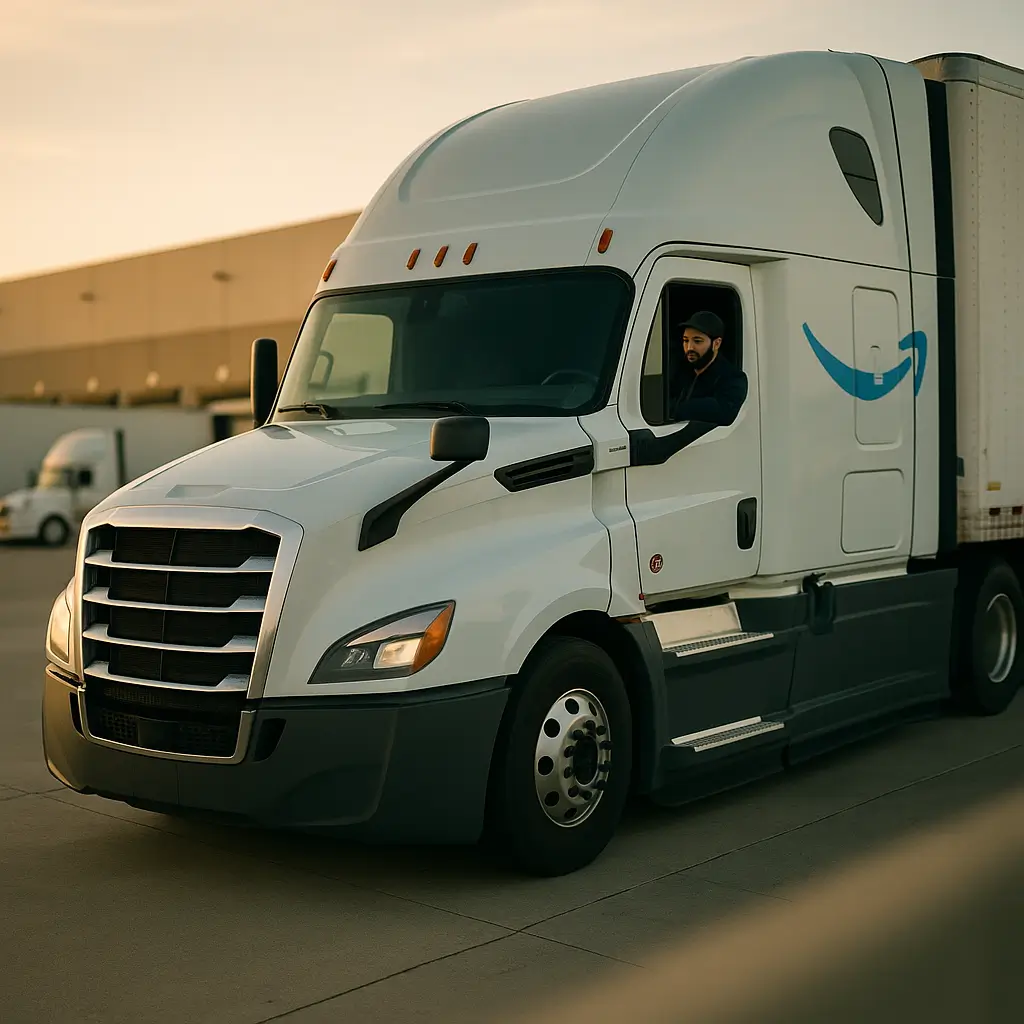

See Amazon Relay insurance costs, monthly ranges, required coverages, discounts, and ways to lower premiums safely.
Amazon Relay insurance cost is usually the difference between steady cash flow and “why did I even run this week?” for many owner-operators. If your coverages, limits, or filings don’t match how you operate (especially power-only), you can lose load eligibility—or worse, pay a claim out of pocket.
Featured snippet answer: Most Amazon Relay carriers should budget about $1,200–$3,500+ per truck per month for compliant trucking insurance in 2026, with pricing driven by authority age, MVR/PSP, lanes/radius, equipment value, cargo, and whether you need trailer interchange for power-only work.
Before diving into the numbers, here’s a quick overview of what Amazon Relay looks for when reviewing your insurance:
Key Takeaways: Essential Amazon Relay Insurance Cost Facts
- Plan for broker-level limits: Many Relay-ready setups revolve around $1,000,000 auto liability and $100,000 cargo (verify your current Relay requirements before binding).
- Power-only changes the risk: If you pull trailers you don’t own, trailer interchange can be the difference between covered and exposed.
- Year 1 is often the priciest: New authority + thin safety history commonly costs more than the same operation after 12–24 clean months.
- You can lower cost without gambling: Better classifications, tighter radius, higher deductibles (only if you have reserves), and clean COIs/filings are where real savings show up.
Table of Contents
Reading time: 7 minutes

Amazon Relay Insurance Requirements (What Amazon Typically Verifies)
Amazon Relay compliance reviews commonly verify proof of $1,000,000 commercial auto liability, $100,000 cargo, and commercial general liability (often $1,000,000 per occurrence / $2,000,000 aggregate), plus additional coverages like trailer interchange for power-only and workers’ comp where applicable.
Always confirm your current requirements inside the Relay portal before you bind or renew, because limits, wording, and document rules can change.
1) Auto Liability (Primary) — The Non-Negotiable
Auto liability pays for bodily injury and property damage if your truck causes an accident, and it’s the foundation of any for-hire policy.
- Why it matters: Without it, you’re not hauling—period.
- Real-world benchmark: Many shipper/broker networks effectively require $1,000,000 even though FMCSA’s federal minimum for many non-hazmat for-hire interstate carriers is $750,000 under 49 CFR 387.9.
- Who needs it: Any carrier operating under its own authority on Relay.
2) Cargo Insurance — Protects the Load (and Your Relationship Score)
Cargo insurance covers covered loss or damage to the freight you’re responsible for while hauling.
- Why it matters: Cargo claims can trigger chargebacks, payment holds, and fewer load opportunities.
- Who needs it: Anyone hauling freight; commodity and limit requirements can vary by contract.
3) Commercial General Liability (CGL) — The “Non-Auto” Liability
Commercial general liability (CGL) covers third-party injury or property damage not caused by operating the truck, such as a slip-and-fall at a dock.
- Why it matters: Facilities often require CGL for access, contracts, and claims handling.
- Who needs it: Carriers interacting with warehouses, yards, docks, and customers.
4) Workers’ Comp / Employer’s Liability — If You Have Drivers (and Sometimes Even If You Don’t)
Workers’ compensation covers work-related injuries for employees. Workers’ compensation requirements vary by state — check your state’s labor or workers’ compensation board for the current rules that apply to your operation.
- Why it matters: Adding a driver can increase insurance spend quickly, and misclassifying labor can create compliance problems.
- Who needs it: Fleet owners with employees, and sometimes owner-operators depending on state rules and customer contracts.
5) Trailer Interchange — Common for Power-Only
Trailer interchange covers physical damage to a trailer you don’t own while it’s in your care, custody, and control under an interchange agreement.
- Why it matters: Power-only carriers often find out after a yard claim that “non-owned trailer” wording isn’t the same as trailer interchange coverage.
- Who needs it: Power-only carriers and anyone routinely hooking to non-owned trailers under interchange terms.
- Quick agent question: “Is my policy endorsed for trailer interchange, or do I only have non-owned trailer exposure?”
Amazon Relay Insurance Cost Per Month (2026 Ranges You Can Budget With)
For most Relay-ready owner-operators in 2026, compliant coverage commonly prices around $1,200–$3,500+ per truck per month, with higher numbers for new ventures, long-haul radius, power-only interchange exposure, and poor loss history.
There’s no single flat rate, but you can budget realistically by looking at line-item pricing.
| Coverage Line (Typical) | What It Covers | Typical Monthly Range (Per Truck) |
|---|---|---|
| Primary Auto Liability | At-fault accidents (injury/property) | $900 – $2,500+ |
| Cargo (often $100k+) | Freight loss/damage | $100 – $600+ |
| CGL | Dock/yard/customer premises liability | $50 – $200+ |
| Trailer Interchange (power-only) | Damage to non-owned trailers | $75 – $250+ |
| Physical Damage (Comp/Collision) | Your truck (and sometimes trailer) | $300 – $1,200+ |
| Workers’ Comp (if applicable) | Driver/employee injuries | Highly variable |
Reality check: A brand-new authority with one power unit that needs auto + cargo + CGL + physical damage (and possibly interchange) can climb quickly if the truck is high value, the radius is wide, or the MVR/PSP isn’t clean.
Amazon Relay Insurance Discounts (What They Are—and What They Aren’t)
Amazon Relay has promoted insurance discount programs through partner providers, but final pricing still depends on underwriting factors like losses, experience, state filings, radius, and equipment details.
- Discounts aren’t automatic: You typically have to enroll through a listed partner and qualify.
- Savings aren’t guaranteed: Your account can still rate higher based on loss history or exposure.
- Structure beats slogans: Wrong classifications (radius/commodity), missing endorsements, or mismatched trailer coverage can erase any “discount” with endorsements, audits, or denied claims.
For carriers using ELDs, ELD-based discounts can be one of the most legitimate ways to move your rate.
If you’re chasing discounts, compare the partner option against at least one independent market so you can see the real ROI.
For a quick breakdown of the discount opportunities available to commercial truck operators in 2026:
Proof of Insurance for Amazon Relay (How to Avoid the “You’re Not Compliant” Headache)
Amazon Relay compliance checks typically require current, correctly-worded proof of insurance (often a COI plus endorsements when requested) that matches the exact coverages and limits shown in your Relay requirements.
Most “non-compliant” problems aren’t complicated—they’re paperwork mismatches that cost you time and revenue.
Step-by-Step: What to Do
- Confirm required coverages and limits inside Relay (don’t rely on old screenshots).
- Request COIs showing the correct limits and any required wording.
- Add endorsements like Additional Insured and Waiver of Subrogation if they’re listed as requirements.
- Verify trailer interchange is shown if you’re power-only under interchange terms.
- Submit exactly as instructed and keep a clean folder system so you can resend fast.
Common Pitfalls That Get Carriers Stuck
- Cargo limit too low (example: requirement is $100,000, but your COI shows $50,000)
- Auto liability missing required wording/endorsement
- No interchange shown for power-only operations
- Certificate holder/entity details don’t match what Relay expects
- Expired docs because renewals weren’t processed or uploaded in time
If you’re still working through the Relay application or want to understand what they review, this walkthrough covers the full process:
Frequently Asked Questions
Yes — and getting quotes early is one of the smartest moves a new operator can make. Understanding your insurance costs before you commit to equipment, lanes, or a lease helps you build a realistic business plan. Some markets won’t write policies until your authority is active, but an experienced agent can walk you through what your premiums are likely to look like based on your intended operation, equipment value, and radius. Knowing your Day 1 insurance cost also helps you plan how much operating capital you’ll need before your first load. For a breakdown of what to expect in your first year, see our guide on new venture trucking insurance.
A Certificate of Insurance is a one-page document your agent issues that summarizes your active coverages, limits, effective dates, and the insurer’s name. Amazon Relay uses it to verify you’re compliant before activating your account or after a coverage change. The COI has to match the exact limits and wording Relay requires — if there’s a mismatch (wrong cargo limit, missing endorsement, wrong certificate holder), Relay can flag you as non-compliant even if you actually have the right policy. Keep a current COI on file and request a new one any time your policy changes.
Amazon Relay typically requires proof of $1,000,000 auto liability, $100,000 cargo, and commercial general liability (often $1,000,000 per occurrence / $2,000,000 aggregate), plus workers’ comp/employer liability where applicable. The exact list can change by program, lane, and compliance rules, so the only safe move is to confirm the current requirements inside your Relay portal before binding or renewing. If you run power-only, expect trailer-related requirements to come up during compliance review, and make sure your policy includes the right trailer damage coverage (interchange when required).
Most Amazon Relay carriers budget around $1,200–$3,500+ per truck per month for compliant trucking insurance in 2026, depending on new venture status, MVR/PSP, claims, operating radius, equipment value, cargo type, and added coverages like physical damage and trailer interchange. If someone quotes dramatically below market, treat it like a red flag and confirm what’s missing (common gaps include the right cargo limit, CGL, physical damage, trailer interchange for power-only, or required endorsements). The cheapest premium isn’t a deal if it makes you non-compliant or leaves you uncovered.
If you run power-only and pull trailers you don’t own under an interchange agreement, yes—trailer interchange is often needed to cover physical damage to that trailer while it’s in your possession. Without interchange, you can be personally responsible for common trailer losses like roof tears, landing gear damage, and swing-door hits at a dock or yard. A quick way to avoid the mistake is to confirm whether you have trailer interchange (damage to non-owned trailers under interchange) versus only physical damage (damage to your scheduled owned equipment) and whether the trailer coverage limit matches your exposure.
Yes — some carriers start on Relay using rented or leased box trucks, and insurance for non-owned equipment works differently than coverage for a truck you own. If you’re renting, your policy needs to reflect that, and the rental agreement may have its own insurance requirements on top of Relay’s. Talk to your agent before you book the first load so there are no gaps between what Relay requires and what your policy actually covers. For a deeper breakdown, review Amazon Relay insurance requirements for small fleets.
Amazon Relay’s published requirements typically focus on auto liability, cargo, and CGL — physical damage (comp and collision on your own truck) is generally not listed as a Relay requirement. However, if your truck is financed, your lender almost certainly requires it. And even if no one mandates it, running without physical damage on a truck worth $80K–$200K+ is a cash-flow risk most owner-operators can’t absorb. Factor it into your total insurance budget and discuss the right deductible with your agent. For related equipment protection context, see semi trailer insurance.
The biggest premium drivers are typically new venture status, MVR/PSP and violations, claims history, operating radius and lane density, power-only trailer exposure, and equipment value and deductibles. Insurers price both probability and severity, so anything that increases crash likelihood or claim size pushes rates up. To control cost, focus on what you can control: tighter radius when possible, clean compliance habits, safer driving, accurate classifications (commodity/radius/use), and deductibles you can actually fund after a claim.
Even a single claim can reduce the number of carriers willing to write your policy and push your rate up at renewal. Severity matters — a total-loss physical damage claim hits harder than a small cargo claim — but frequency matters too. Underwriters look at your claims history as a predictor of future losses. If you have a claim, being proactive about safety improvements, driver training, and documentation before your next renewal gives you a stronger story to tell underwriters. Your DOT record and trucking insurance history can also shape how underwriters view your risk.
Running Amazon Relay itself doesn’t automatically raise your rate, but the operational profile it involves — operating radius, freight type, power-only exposure, and loss frequency — feeds directly into how underwriters assess your risk at renewal. A clean loss history while running Relay is the strongest argument for maintaining or improving your rate. If you had claims during the policy period, be prepared to explain what changed: updated safety practices, driver training, or equipment improvements give underwriters a reason to price you better. Your DOT record and claims history both factor into what the next policy year looks like.
Relay’s compliance review timeline can vary — some carriers get cleared within a day or two, others wait longer if documents need corrections or if Relay’s team has a backlog. The fastest way through is to submit complete, correctly-formatted documents the first time: correct limits, correct certificate holder, required endorsements, and any additional wording Relay specifies. Having your agent familiar with Relay’s COI requirements saves a lot of back-and-forth.
If your insurance lapses — even for a single day — Amazon Relay’s compliance system will typically flag your account and can suspend or block your access to loads until you submit updated, compliant proof of insurance. Most commercial policies include a cancellation notice period (often 10–30 days) that goes directly to Relay if they’re listed as a certificate holder, but relying on that warning window is not a safe strategy. Stay ahead of your renewal: set calendar reminders 30–45 days out, confirm your updated COI is on file with Relay before your effective date changes, and never let a lapse happen on an assumption that “it’ll sort itself out.”
RMIS (Risk Management Information System) is a third-party compliance verification platform that Amazon Relay and many shippers use to track and verify carrier insurance in real time. When your agent submits your COI, the policy data flows through RMIS and has to match exactly what Relay expects — the right certificate holder, limits, and effective dates. Mismatches in how your policy is reported to RMIS are one of the most common reasons carriers get flagged as non-compliant even when their actual policy is correct. Work with an agent who is familiar with RMIS submission requirements and can confirm the data lines up before you go active.
The Logrock Difference: Insurance Built for Owner-Operators Who Care About CPM
For many single-truck accounts, fixing classifications and endorsements (like correct radius, correct commodity, and trailer interchange when needed) can change quotes by hundreds per month without changing your real-world operation.
Logrock isn’t here to sell a shiny policy that falls apart at claim time. We treat commercial truck insurance like a business tool: structured to keep you compliant, keep COIs clean, and keep premium aligned with how you actually run.
- Coverage matched to operations: power-only vs. not, lanes/radius, cargo limits, equipment values
- Fewer ugly surprises: correct endorsements, correct filings, fewer gaps
- Cash-flow mindset: premiums and deductibles built around what you can actually absorb
If you’re trying to figure out what Amazon Relay insurance will actually cost for your specific operation — or want to make sure your current policy is structured correctly for compliance — LogRock can review your lanes, equipment, and coverage needs with you. We’ll walk you through what’s required, what’s optional, and where carriers commonly overpay or leave gaps.
Conclusion: Get a Relay-Ready Quote Without Overpaying
In 2026, most Amazon Relay carriers should budget $1,200–$3,500+ per truck per month, and the fastest way to avoid overpaying is to match limits and endorsements to your real operation.
When the coverage is right, you’re not just “checking a box”—you’re protecting your authority, your cash flow, and your ability to keep booking loads.
Key Takeaways:
- Relay-ready setups commonly revolve around $1M auto, $100k cargo, and CGL (plus workers’ comp where applicable).
- Budget $1,200–$3,500+/month per truck in 2026, with big swings based on authority age, MVR/PSP, and lanes.
- If you run power-only, take trailer interchange seriously because it’s one of the most common (and costly) gaps.
If you want a quote that matches your lanes, equipment, and power-only exposure—and keeps your documents clean for compliance—get it structured correctly from day one.
Related reading





