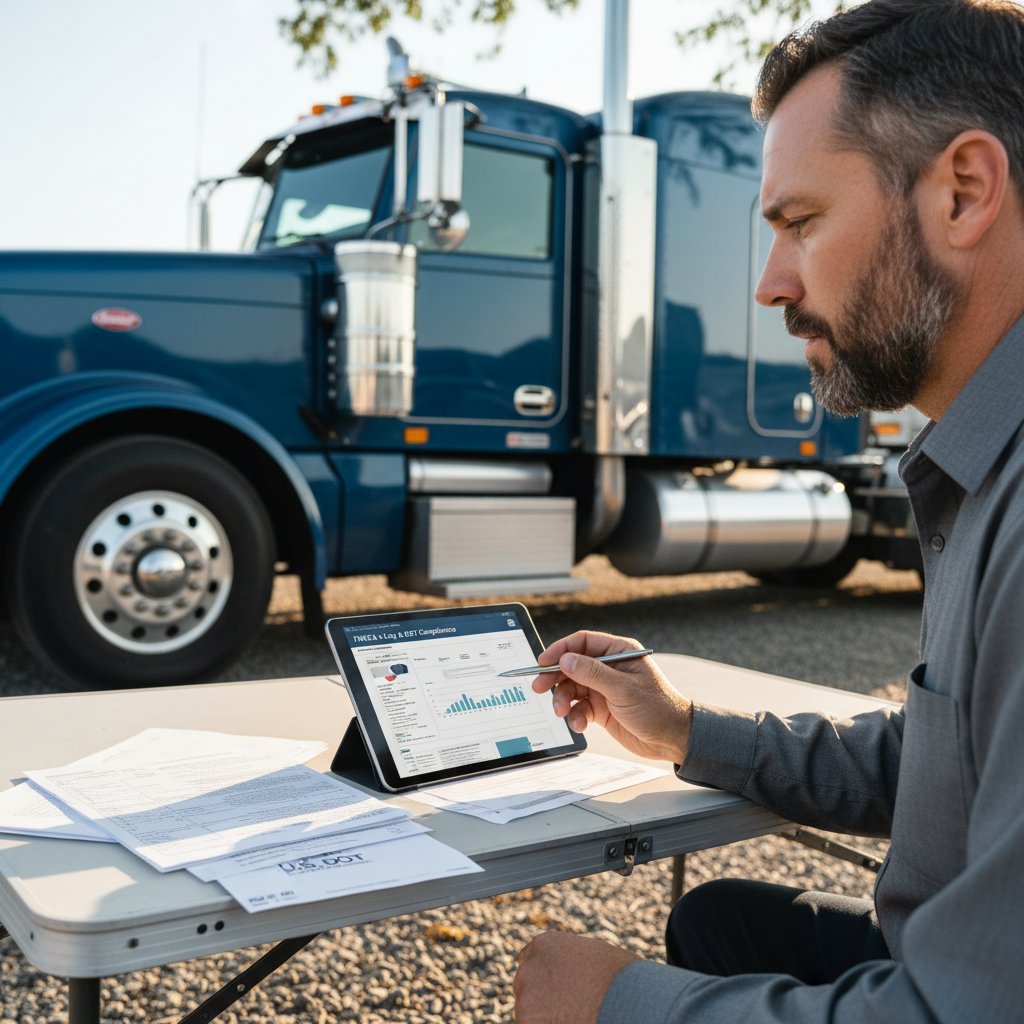
How much does commercial truck insurance cost in Connecticut? See 2026 rates by truck type, CT intrastate requirements, Highway Use Fee details, filings, and ways to lower premiums.
Driving in Connecticut means navigating the relentless traffic of the I-95 corridor, the steep hills of the Litchfield Hills, and the tight urban delivery zones of New Haven and Hartford. For truckers, the Nutmeg State is a high-stakes environment: high volume, high value, and high insurance premiums.
Unlike many states where your main concern is just DOT compliance, Connecticut has a specific cost that catches many truckers off guard: the Connecticut Highway Use Fee. If you operate an eligible heavy, multi-unit motor vehicle over 26,000 lbs in Connecticut, you may need to register and file quarterly reports.
In Connecticut, commercial truck insurance premiums typically land between $13,000 and $19,500 per year for many semi-truck operations with standard liability limits, while lighter truck types may come in lower. If you are shopping for a lower premium, also review our guide to the cheapest commercial truck insurance in Connecticut.
Table of Contents
Reading time: 8 minutes
Key takeaways: Connecticut truck insurance costs
- The price tag: Depending on coverage limit, a semi-truck owner-operator in CT can expect to pay roughly $13,500 to $19,200 per year for auto liability alone in the estimate table below.
- The HUF factor: Connecticut imposes a Highway Use Fee on certain heavy, multi-unit vehicles over 26,000 lbs. You must register and file returns through the state revenue system.
- Monthly breakdown: A typical owner-operator may budget around $1,300/month for liability and around $300/month for physical damage, depending on truck value, drivers, and limits.
- Intrastate rules: Connecticut requires certain intrastate commercial vehicles to obtain a USDOT number and report insurance coverage to the DMV.
Real numbers: estimated costs by truck type
The following estimates represent average annual auto liability costs for a driver with a clean record in Connecticut. Because Connecticut is effectively a bridge state between New York and Massachusetts, insurers often price policies around heavy traffic, dense delivery corridors, and Northeast repair costs.
| Vehicle Type | Limit $300,000* | Limit $500,000 | Limit $750,000 | Limit $1,000,000 (Standard) |
|---|---|---|---|---|
| Hotshot | $9,500 | $11,200 | $12,800 | $14,500 |
| Box Truck | $8,200 | $9,800 | $11,000 | $12,800 |
| Dump Truck | $10,500 | $12,200 | $13,800 | $15,500 |
| Semi Truck | $13,500 | $15,500 | $17,500 | $19,200 |
| Tow Truck | $9,500 | $11,500 | $13,000 | $14,800 |
*The $300,000 column is included as a comparison point for limited/light operations. Many freight, brokered, and interstate trucking operations need higher limits, often $750,000 or $1,000,000+ depending on state, FMCSA, and contract requirements.
Last update: June 19, 2026.
LogRock reality check: While state law may allow lower limits for some lighter or non-freight vehicles, many commercial freight vehicles and most brokered operations need substantially higher limits. If you touch the Port of New Haven or run for major logistics brokers, $1,000,000 auto liability is often the practical minimum to get loaded.
Want a quick visual breakdown of what Connecticut truck insurance costs in 2026? Watch our summary:
Liability limits: intrastate vs. interstate
Connecticut rules change depending on whether you operate only inside Connecticut or cross state lines. The tables below separate Connecticut intrastate requirements from FMCSA interstate requirements.
Table 1: intrastate requirements (Connecticut DMV)
For trucks that never leave Connecticut, such as Stamford to Hartford only.
| Vehicle Weight / Type | Minimum Liability Limit | Filing Required? |
|---|---|---|
| Freight > 10,001 lbs | $750,000 CSL | Yes (Form E for >18k lbs where applicable) |
| Freight > 18,001 lbs | $750,000 CSL | Yes (Form E / insurance card) |
| Hazmat (Gas/Oil) | $1,000,000 – $5,000,000 | Yes (Form E) |
| Household Goods (Movers) | $750,000 + cargo insurance | Yes (Form H) |
| Passenger (16+ seats) | $5,000,000 CSL | Yes (Form E) |
Note: CSL means Combined Single Limit. Connecticut DMV guidance says intrastate vehicles at or above certain weight thresholds need an intrastate USDOT number, and CT DMV provides a commercial vehicle insurance reporting process for qualifying motor carriers.
Table 2: interstate requirements (FMCSA / federal)
For trucks that cross state lines, such as New Haven to New York City.
| Vehicle Weight / Type | Minimum Liability Limit | Filing Required? |
|---|---|---|
| Freight < 10,000 lbs | $300,000 CSL | No, unless hazmat or another federal trigger applies |
| Freight > 10,001 lbs | $750,000 CSL | Yes (BMC-91X) |
| Hazmat (Gas/Oil/Explosives) | $1,000,000 – $5,000,000 | Yes (MCS-90 / FMCSA filings) |
| Passenger (16+ seats) | $5,000,000 CSL | Yes (BMC-91X) |
Not sure which limit applies to your operation? This breakdown helps:
Connecticut requirements and critical filings
To operate legally, your insurance agent or insurer may need to submit specific forms to Connecticut or FMCSA, depending on whether your operation is intrastate, interstate, household goods, hazmat, or port/intermodal.

- Highway Use Fee (HUF) permit: Effective January 1, 2023, the Connecticut Highway Use Fee applies to certain heavy, multi-unit motor vehicles over 26,000 lbs. The fee rate ranges from 2.5 to 17.5 cents per mile based on weight, and returns are filed quarterly through DRS.
- Form E: Used to prove to the DMV that you have valid liability insurance. It is commonly required for intrastate authority and qualifying heavy commercial vehicles.
- Form H: Required for household goods movers to prove cargo insurance coverage.
- Insurance ID card / proof: CT DMV says certain motor carriers must report commercial vehicle insurance coverage annually.
- USDOT number: Connecticut requires an intrastate USDOT number for certain intrastate commercial vehicles, including vehicles with qualifying weight ratings.
New to commercial truck insurance? Here is a plain-language explanation of what auto liability actually covers:
Frequently Asked Questions
Yes, meaningfully so. Insurers use garaging address — where the truck is primarily kept — to set rates. A truck garaged in Stamford, Bridgeport, or along the I-95 corridor can be priced more like a high-density Northeast operation than a rural operation. If your truck is garaged at a terminal in a less-dense county, you may qualify for a lower territory tier.
If you haul containers in or out of the Port of New Haven, drayage brokers and ocean carriers often require at least $1,000,000 auto liability and proof that your policy satisfies intermodal and terminal requirements. Many port/intermodal operations also need trailer interchange, UIIA-related endorsements, and sometimes general liability or additional insured wording on the COI.
Traffic density and repair costs are the main reasons. Connecticut roads, especially the I-95 corridor, have high congestion and frequent urban delivery exposure. Northeast labor rates and repair costs are also higher than in many Southern or Midwestern states, which can push up liability and physical damage premiums.
The Connecticut Highway Use Fee is a mileage-based fee on certain heavy, multi-unit motor vehicles over 26,000 lbs. The state says the fee is based on vehicle weight and miles driven in Connecticut, with rates ranging from 2.5 to 17.5 cents per mile. Carriers generally register and file returns through the Connecticut Department of Revenue Services.
Yes, in many cases. Connecticut DMV says you need an intrastate DOT number if you operate in intrastate commerce with a vehicle that meets the state’s qualifying weight threshold, including vehicles with a GVWR, GCWR, GVW, or GCW of 18,001 or more pounds. Interstate operations generally use the lower federal 10,001-pound threshold. Confirm your exact vehicle class before operating.
Auto liability is the core requirement for most commercial vehicle operations. Cargo insurance is not required by state law for every freight carrier, but brokers and shippers commonly require it before assigning freight, often at $100,000 or more. If you haul household goods, Connecticut may require a Form H cargo filing. For more detail, see our guide to box truck cargo insurance limits.
The MCS-90 is a federal financial responsibility endorsement attached to many interstate motor carrier liability policies. It is not cargo insurance. If you cross state lines as a for-hire carrier or operate under FMCSA authority, ask your agent to confirm whether the MCS-90 is attached before your first interstate load. For more detail, see our FMCSA insurance requirements for owner-operators.
Yes, some carriers offer credits for dashcams, ELDs, telematics, or documented safety programs, especially when the data supports safer driving and tighter radius verification. In a high-cost state like Connecticut, even a modest discount can matter. Ask your agent which carriers reward telematics and what proof they need at quote or renewal. This guide on ELD discounts for owner-operator insurance can help.
The LogRock difference: we navigate the Northeast
Trucking in Connecticut is not just about driving; it is about tax compliance, filings, and surviving the I-95 squeeze. Many agents forget about the HUF registration or fail to file the correct Form E for intrastate work, leaving you exposed to fines and operating delays.
At LogRock, we help match your Connecticut operation to the right coverage, filings, and markets. That includes Highway Use Fee awareness, Form E/Form H questions, port/intermodal requirements, cargo limits, and quotes from carriers that understand Northeast traffic risk.
Conclusion: get your Connecticut quote
Connecticut offers lucrative freight rates for those who can handle the cost of operations. Don’t let insurance premiums or missed filings eat your profits. Your final price depends on truck type, garaging address, limits, cargo, filings, and whether you run intrastate only or cross state lines.
Key Takeaways:
- Semi truck liability in Connecticut can range from roughly $13,500 to $19,200/year depending on selected limits.
- The Highway Use Fee is a major Connecticut-specific operating cost for qualifying heavy vehicles.
- Intrastate and interstate rules can require different filings, limits, and compliance checks.
If you’re operating in Connecticut — navigating the I-95 corridor, dealing with the Highway Use Fee, or trying to meet Port of New Haven requirements — LogRock can help you find coverage that fits your operation and your budget. Talk to our team to review your filings, compare specialized Northeast carriers, and request a quote with no obligation.